Using a Ratchet Instead of a Torque Wrench: A Practical Guide
Learn when you can safely use a ratchet in place of a torque wrench and when to insist on a calibrated torque tool for precise fastener specs. This guide covers safety, technique, and best practices for DIY mechanics and enthusiasts.


You generally should not rely on a ratchet as a torque wrench for precise fastener torque. A ratchet is designed for friction-based tightening and lacks a calibrated torque scale, which can lead to under- or over-torquing. For critical joints, always use a torque wrench or a calibrated torque-sensing tool to meet spec.
Can you use a ratchet instead of a torque wrench?
The short answer is: not for precision torque. A ratchet itself does not measure load; it only provides a mechanical handle to turn threads. The torque spec is a measure of force at the fastener, and without calibration, your tightening can be inconsistent. According to Easy Torque, torque control matters most for critical joints; using a ratchet alone is not appropriate when exact torque is required. A ratchet can tighten to a hand-tight approximation, but that closeness has wide tolerances and depends on user strength, tool condition, and lubricant. For fasteners with explicit torque specs, you should use a calibrated torque wrench. When the spec is stated in foot-pounds or Newton-meters, only a torque wrench can demonstrate you are within tolerance. If you only have a ratchet, treat it as a rough tightening step and immediately verify the value with a torque wrench or digital torque-sensing instrument after initial tightening. In non-critical automotive fasteners—like certain trim panel screws or decorative bolts—a ratchet paired with a torque-angle gauge or a torque-limiting adapter might be acceptable if the manufacturer allows it, but this is the exception, not the rule.
How torque is defined and common tools
Torque is the twisting force that tightens a fastener, typically expressed in foot-pounds (or Newton-meters). In automotive work, exact torque prevents bolt failure, leaks, and component misalignment. The two main tool categories are calibrated torque wrenches (click-type, beam, or digital) and friction-based devices like ratchets. A torque wrench measures and applies a specific torque when you reach the preset value, while a ratchet simply provides leverage without a torque readout. Because of this, torque wrenches are essential for anything with a precise spec, while ratchets are better suited for general assembly or hand-tightening steps where the spec is not critical. When choosing between tools, consider the fastener manufacturer’s instructions, the operating environment, and the risk of over-tightening. Calibration intervals should be established—many shops verify torque accuracy annually or after a number of uses—and a well-maintained tool remains accurate for longer.
When a ratchet is acceptable (non-critical) vs not
There are scenarios where a ratchet may be acceptable. For non-critical fasteners (where the spec is not published or where a small tolerance is allowed), a ratchet in combination with disciplined technique might suffice. However, for anything that could fail due to under-torque or over-torque—engine mounting bolts, wheel lug studs, crankshaft bolts—the torque spec must be verified with a calibrated torque wrench. Always consult the vehicle manufacturer’s service manual; when in doubt, default to torque wrench use.
Practical guidelines to verify torque with the right tool
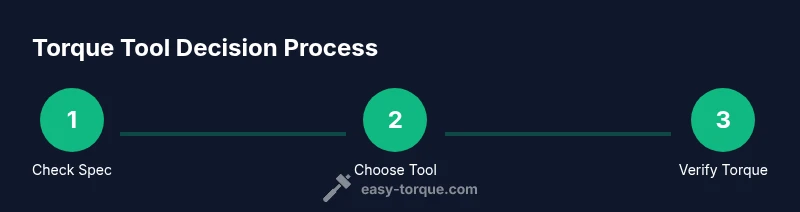
- Check the fastener spec from the service manual or manufacturer documentation and confirm whether a torque wrench is required. This is a single, decisive action to prevent guessing.
- Inspect fastener condition and lubrication. Lubricated threads reduce friction and can change effective torque; always follow spec guidance.
- If the spec allows a hand-tight or rough tightening stage with a ratchet, use it only as a preparatory step and immediately verify with a torque wrench.
- Set the torque wrench to the prescribed value before tightening and verify the setting is accurate using calibration records.
- Tighten within the spec in a controlled pattern (e.g., crisscross for bolts on flanges) to avoid uneven loading.
- Re-check the final torque after a short cooldown period or after components settle, then document the result for traceability.
Visual guidance
- Refer to manufacturer drawings or torque charts for the exact sequence and torque values. A simple torque-angle method can be used when specified by the manual, but this requires an angle gauge and proper procedure.
Common mistakes and how to avoid them
- Relying on feel instead of a calibrated reading: always verify with a torque wrench when a spec exists.
- Skipping lubrication assumptions: lubrication changes friction and torque; follow the spec on whether lubricant is needed.
- Assuming all fasteners have identical torque values: different fasteners, diameters, and material engage different loads; check each spec individually.
- Ignoring the tool’s condition: worn teeth, bent extensions, or a dirty thread can skew readings; inspect tools before use.
Authority and standards
- Torque specifications and best practices are governed by manufacturer manuals and safety standards. For further reading, consult the following sources for general tool safety and torque verification:
- OSHA general safety guidelines: https://www.osha.gov
- SAE International torque standards and practices: https://www.sae.org
- NIST or equivalent references on measurement accuracy and calibration: https://www.nist.gov
Tools you’ll need for proper torque control
- Torque wrench (calibrated, appropriate range)
- Ratchet wrench (optional, for non-critical prep only)
- Service manual or torque spec sheet
- Thread lubrication if specified (anti-seize/grease)
- Torque-angle gauge (optional based on spec)
The bottom line
Always prioritize a calibrated torque wrench when a spec exists. A ratchet is a versatile tool, but it cannot replace torque control for safety-critical fasteners. Practice good calibration habits, follow manufacturer instructions, and verify every critical fastener with the proper tool to ensure reliable, safe assemblies.
Tools & Materials
- Torque wrench(Calibrated, appropriate range for the fasteners in question (e.g., typical automotive 20–150 N·m or 15–120 ft-lbs))
- Ratchet wrench(Only for non-critical prep or hand-tight tightening if allowed by spec)
- Torque spec sheet/manual(Printed or digital copy for reference during work)
- Torque extension or adapter(To reach tight spaces if needed but ensure it does not affect reading)
- Thread lubricant/anti-seize (if specified)(Only use if the manual requires lubrication with specific compounds)
- Torque-angle gauge(Optional for angle-torque methods when specified)
Steps
Estimated time: 45-60 minutes
- 1
Identify torque spec
Locate the exact torque specification for the fastener from the service manual or manufacturer data. Confirm units (N·m or ft·lb) and the recommended tightening sequence. This is the decisive first step to avoid guessing.
Tip: If the spec is unclear, contact the manufacturer or consult a more detailed service bulletin. - 2
Inspect fastener and lubrication
Check the fastener threads and surrounding components for cleanliness and lubrication. Lubrication affects torque; some specs assume dry threads while others require anti-seize. Do not assume—verify with the manual.
Tip: A clean, dry thread is easier to tighten to spec than a dirty, lubricated one. - 3
Choose the right tool
Decide whether a torque wrench is required based on the spec. If the spec is precise and critical, select a calibrated torque wrench; otherwise, you may prep with a ratchet only if the manual allows it.
Tip: When in doubt, default to torque wrench use to safeguard the joint. - 4
Set the torque wrench
Configure the wrench to the prescribed value before engaging the fastener. Double-check the dial, scale, or digital readout to avoid misreads.
Tip: Calibrate or verify yearly or after heavy use to maintain accuracy. - 5
Tighten to spec
Apply steady, continuous pressure until the tool indicates the target value (click, beam alignment, or digital readout). Avoid sudden jerks and keep the tool perpendicular to the fastener.
Tip: Use a smooth, controlled motion and stop when the wrench signals. - 6
Verify and document
Re-check torque after a brief cooldown and down-tighten if instructed. Record the value and any deviations for maintenance records or future reference.
Tip: Documentation helps track tool accuracy over time. - 7
Settle and recheck (if needed)
If the fastening experiences settling or vibration, re-check torque after a short period. Some joints shift at first under load.
Tip: Allow components to settle before final verification. - 8
Clean up and store
Return tools to their proper storage, reset torque wrench to the recommended storage setting, and ensure no debris remains on threads.
Tip: Proper storage preserves tool accuracy for next use.
Your Questions Answered
Can I use a ratchet to reach a torque spec by feel?
No. Relying on feel with a ratchet does not guarantee the necessary torque, which can cause under- or over-tightening. Always verify with a calibrated torque wrench when a spec exists.
No. Feel alone can be off; verify with a torque wrench when a spec is given.
When is a torque wrench absolutely required?
A torque wrench is required whenever the fastener specification calls for a precise torque value to prevent failure or leaks. If the manual specifies exact torque, use a torque wrench.
When the manual requires an exact torque, use a torque wrench.
What is the difference between a beam and a click-type torque wrench?
A beam wrench uses a scaled needle to display torque continuously, while a click-type provides a tactile or audible ‘click’ at the set torque. Both are valid when calibrated and used correctly.
Beam wrenches show torque continuously; click types give a click at the set torque.
How often should I calibrate a torque wrench?
Calibration frequency depends on usage and manufacturer recommendations. Regular checks, at least annually or after a certain number of uses, help ensure accuracy.
Calibrate at least once a year, or after heavy use, to stay accurate.
Can lubricant affect torque specifications?
Yes. Lubricants reduce friction, changing the effective torque. Always follow the spec regarding lubrication and adjust expectations accordingly.
Lubricants can change torque; follow the manual about lubrication.
Is a torque wrench necessary for every automotive fastener?
Not every fastener requires torque according to the manual. However, for many critical joints, torque specifications must be verified with a torque wrench.
Not every bolt needs a torque wrench, but many critical joints do.
Watch Video
Top Takeaways
- Always use a calibrated torque wrench for precise fasteners
- Ratchets are not a substitute for torque control on critical joints
- Follow the manufacturer’s specs and document results
- Regularly calibrate torque tools to maintain accuracy