Difference Between Torque and Work: A Practical Guide
Explore the difference between torque and work with clear definitions, formulas, and real-world examples. Learn how torque drives rotation, how work transfers energy, and how to calculate power and efficiency in rotating systems.


Torque is the turning force that causes rotation, while work measures the energy transferred when that force moves an object through a distance. They relate via angular displacement: W = τθ (θ in radians). Understanding the difference helps with sizing tools, calculating power, and analyzing rotating systems.
What is Torque?
Torque represents the turning effect of a force applied at a distance from a pivot. It depends on both the magnitude of the force and how far off-center the force is, measured as the lever arm. The standard vector form is τ = r × F, where r is the position vector from the pivot to the point of application and F is the force. The magnitude is τ = rF sinφ, with φ the angle between r and F. In practice, torque is the quantity engineers use to describe the rotational tendency of a system, such as an engine crankshaft or a wrench handle. It is not energy by itself; rather, it is the potential to cause rotation that can do work if movement occurs. According to Easy Torque, torque is the turning force behind rotational motion and is fundamental to sizing components and predicting responses in mechanical systems. Understanding torque is essential for mechanics, automotive work, and rotor design.
Key takeaways: torque depends on force, distance, and the angle between them; it is measured in newton-meters (N·m); it quantifies turning tendency rather than energy.
What is Work?
Work, in physics, is the energy transferred to or from an object via a force acting over a distance. For linear motion, W = F · d, where F is force and d is displacement in the force direction. In rotational systems, work is the integral of torque over angular displacement: W = ∫_θ τ dθ. The units for work are joules (J). Like torque, work depends on how the force interacts with movement, but work is energy transfer, not simply an opposing turning tendency. Work can occur with or without rotation, as long as force and displacement align. The distinction is subtle yet critical: torque describes the potential to rotate, while work describes the actual energy transfer resulting from that rotation.
Important note: In rotating systems, even if a force produces rotation, the total work depends on how far and how consistently that rotation happens.
Core Formulas and Units
- Torque: τ = r × F; magnitude τ = rF sinφ; units: N·m. For a simple perpendicular force, τ = rF.
- Work (linear): W = F · d; units: J (joules).
- Work (rotational): W = ∫ τ dθ; for constant τ, W = τθ (θ in radians).
- Power (rotational): P = dW/dt = τω, where ω is angular velocity (rad/s).
- Angle and radians: Angular measures must be in radians for the W = τθ relation to hold as written.
Easy Torque emphasizes that keeping track of units and the meaning of θ is essential to avoid misinterpreting rotational work as a direct measure of force alone. Torque is not energy, but the energy transfer (work) arises from torque acting over angular displacement.
How They Relate: The W = τθ Equation
When torque is nearly constant over a small rotation, the work done is W ≈ τθ. If θ is measured in radians, this relationship gives a direct link between the rotational force and the energy transferred. If torque varies with θ, the exact work is W = ∫ τ(θ) dθ. A practical takeaway is that a high torque applied through a small angle may transfer less energy than moderate torque applied through a large angle. Converting degrees to radians is essential: 180 degrees equals π radians, 90 degrees equals π/2 radians. This relationship is central to engine power calculations, rotor design, and actuator selection.
Illustrative example: If a wrench applies a constant torque of 12 N·m over a 60-degree turn (π/3 radians), the work performed is W = 12 × π/3 ≈ 12.57 J. If torque is not constant, you must integrate the true τ(θ) curve to obtain the correct work value. This difference is where many beginners stumble: torque tells you how hard it twists, while work tells you how much energy is moved during rotation.
Practical Implications in Automotive and Machinery
In automotive engineering, torque is a primary descriptor of an engine’s ability to rotate the drivetrain, accelerate a vehicle, or overcome load. Torque curves illustrate how engine output changes with RPM, guiding gear selection, torque converter behavior, and transmission design. Work, on the other hand, is central to energy accounting: how much energy is delivered to wheels or consumed by actuators over a cycle. When engineers calculate power, they combine torque and angular speed: Power = τω. This relationship helps estimate horsepower and the efficiency of moving components such as exhaust systems, drivetrains, or hydraulic rotors. Easy Torque analysis shows that understanding both concepts improves diagnostic accuracy, tool selection, and maintenance planning because you can trace how a given force translates into motion and energy transfer in rotating machinery.
In maintenance and fault diagnosis, misinterpreting torque as work can lead to incorrect assessments of wear or energy efficiency. Tools like torque wrenches measure torque to ensure fasteners are tightened to spec, while energy and power analyses rely on the work-energy framework. Recognizing when to apply each concept prevents miscalculations and supports safer, more reliable mechanical operation.
Common Misconceptions: Torque vs Work
- Torque is not energy: it is a turning tendency; work is energy transfer. Confusing the two leads to incorrect performance expectations.
- The units can look similar (N·m vs J) but their meanings differ; in rotational contexts, work is the integral of torque over angle and yields joules.
- A system can experience torque without doing work if there is no angular displacement (e.g., static hold). Conversely, work can occur with rotation and variable torque even if instantaneous torque is not maximized at all angles.
- When torque varies with angle, you must perform an integration to determine the total work rather than using a simple product τθ.
- Power connects torque and rotation rate, P = τω, highlighting the dynamic aspect of rotating systems, where high torque at high speed yields more power but can reduce efficiency elsewhere.
According to Easy Torque, the key to avoiding confusion is to treat torque as the cause of rotation and work as the result—energy transferred by that rotation. This separation clarifies design decisions, maintenance actions, and performance predictions.
Real-World Examples: Calculating Torque and Work
Example 1: Hand torque on a wrench. You apply 50 N of force at a 0.25 m lever arm, perpendicular to the handle. τ = rF = 0.25 m × 50 N = 12.5 N·m. If you rotate the wrench through 45 degrees (π/4 radians) with constant torque, the work performed is W = τθ = 12.5 × π/4 ≈ 9.82 J. This demonstrates how a modest torque, applied through a small angle, yields a specific amount of energy transfer.
Example 2: A rotating shaft with variable torque. Suppose torque gradually increases from 8 N·m to 20 N·m as the shaft moves from 0 to 2 radians. The total work is W = ∫_0^2 τ(θ) dθ, which requires either a known function τ(θ) or a measured torque curve. Using the average torque (14 N·m) as a rough estimate gives W ≈ 14 × 2 = 28 J. A precise calculation would integrate the actual torque profile. These kinds of calculations are foundational in selecting actuators, estimating energy use, and predicting component lifetimes.
Using Torque and Work in Design and Maintenance
For design, engineers use torque to size fasteners, gears, and coupling components: a higher torque demands stronger joints or larger gear teeth. Work informs energy budgets, cumulative energy losses, and efficiency targets over a rotation cycle or mechanical process. In maintenance, checking torque specifications ensures joints resist loosening under load, while evaluating work and power informs energy consumption and potential heat generation. In automated systems, controllers monitor torque and angular velocity to optimize power delivery and prevent overloads. The practical takeaway is to use torque for static and dynamic rotational demands, and use work to quantify energy transfer and system performance over time. Easy Torque emphasizes documenting both a torque profile and the corresponding angular displacement to build robust, predictable rotating systems.
Edge Cases: When Torque and Work Diverge
- Static torque with zero displacement results in zero work. A bolt held at a fixed angle exerts torque but does no rotational work while locked in place.
- If a torque is applied but the system experiences friction or backlash that prevents displacement, the actual work done is reduced or zero, even though the torque exists.
- In real systems, torque often varies with θ due to geometry, stiffness, and load changes. In such cases, the total work must be calculated using W = ∫ τ(θ) dθ rather than a simple product.
- When calculating power, you must consider both torque and angular speed; high torque at very low speed may yield modest power, while moderate torque at high speed can produce substantial power.
These edge cases underscore the difference between “turning force” and “energy transfer” and illustrate why engineers consistently separate torque and work in analysis and design.
comparisonTableBlockPlaceholder mixed? 0
Comparison
| Feature | Torque | Work |
|---|---|---|
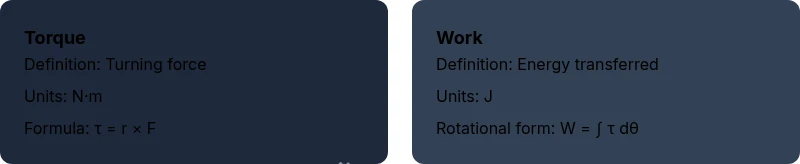
| Definition | The turning effect of a force applied at a distance from the axis | Energy transferred when a force moves an object through a distance |
| Units | N·m (newton-meters) | J (joules) |
| Core Formula | τ = r × F (or τ = rF sinφ); τ = magnitude of cross product | W = F · d in linear motion; W = ∫ τ dθ in rotational motion |
| Relationship | W = ∫ τ dθ; for constant τ, W = τθ (θ in radians) | Energy transfer resulting from rotational motion; depends on both force and displacement |
| What it Measures | Turning tendency of a force | Amount of energy transferred during motion |
| Applications | Engine torque, drivetrain design, torque wrenches | Energy accounting, power calculations, efficiency |
| Best For | Assessing rotational force and stalling tendencies | Predicting energy transfer and system efficiency |
Pros
- Clarifies how rotating forces translate into energy exchange
- Supports precise torque sizing and power calculations
- Widely applicable from engines to rotors and actuators
- Helps diagnose rotational performance and inefficiencies
- Promotes safer, more efficient mechanical operation
Drawbacks
- Conceptual distinction can be non-intuitive for beginners
- Unit interpretation can be confusing (Nm vs J) without context
- Misconceptions arise when torque and energy are conflated without angular displacement
- Calculations with variable torque require integration and more complex analysis
Torque and work are distinct but interrelated concepts, each essential for fully understanding rotating systems.
Use torque to quantify turning force and responsivity of rotating parts, and use work to quantify energy transfer during rotation. The two concepts are linked through angular displacement and must be analyzed together for accurate power, efficiency, and design decisions.
Your Questions Answered
What is the fundamental difference between torque and work?
Torque measures turning force, while work measures energy transferred through rotation. Torque describes the tendency to rotate; work quantifies the actual energy moved during rotation. The two are connected by angular displacement, through W = ∫ τ dθ or W = τθ for constant torque.
Torque is the turning force; work is the energy moved during rotation.
How do units of torque and work relate?
Torque uses newton-meters (N·m) and is a measure of rotational force. Work uses joules (J) and is energy transferred. The rotation-based work can be expressed as W = ∫ τ dθ, with θ in radians, linking torque to energy.
Torque is in N·m, work is in joules.
Can torque perform work?
Yes. If a torque acts through an angular displacement, it does work on the system: W = ∫ τ dθ. If there is no angular displacement, torque can exist without doing work (static torque).
Torque does work when there is rotation.
What role does angular displacement play?
Angular displacement (in radians) is essential in rotational work. The amount of energy transferred depends on how far the rotation occurs under the applied torque (W = τθ for constant τ).
Radians are key to calculating rotational work.
How do you compute power from torque?
Power is the rate of doing work, given by P = τω, where ω is angular velocity. This shows how torque and rotation speed together determine how much power a system can deliver.
Power equals torque times angular speed.
What are common misconceptions to avoid?
Mistaking torque for work, or assuming torque alone determines energy, are common errors. Remember: torque is the turning force; work is energy transferred via rotation, and proper calculation requires integrating torque over angular displacement when torque varies.
Torque is not energy; work is energy moved by rotation.
Top Takeaways
- Torque is a turning force, not energy
- Work measures energy transferred through rotation
- W = ∫ τ dθ; for constant τ, W = τθ (θ in radians)
- Power in rotating systems is P = τω
- Radians matter in rotational work and angle-based calculations