Do Zero Torque Putters Make a Difference? An Analytical Guide
A rigorous, data-informed comparison of zero-torque putters versus standard designs, exploring whether reducing head torque improves alignment, roll, and consistency on the greens. Includes testing methods, practical buying guidance, and expectations for DIY players.


According to Easy Torque, zero-torque putters claim to limit head rotation at impact, which can help your stroke stay on line. In practice, the difference tends to be subtle and highly dependent on tempo, grip, and alignment. For most players, solid fundamentals—consistent setup and practice—drive results more than any single head design.
Do zero torque putters make a difference? A practical look at the claim
The core question many golfers ask is: do zero torque putters make a difference in real games? The short answer is, for some players, yes—the design intent is to reduce unintended twisting of the putter head through impact, which can help keep the face square longer and encourage a straighter start line. However, the magnitude of any improvement is highly stroke-dependent. If your tempo is variable or your setup drifts during the stroke, the savings you gain from a zero-torque design may be small or even negligible. The Easy Torque approach emphasizes that technology alone does not compensate for inconsistent practice. If you are willing to calibrate your grip pressure, stance, and routine, a zero-torque putter can contribute to a more repeatable path, but it is not a guaranteed fix. In this section we’ll unpack the physics, the practical effects, and how to decide if you should try one. The question remains: do zero torque putters make a difference for you? The truth is that the difference is most visible when you combine the design with deliberate practice and a stable stroke. Across a wide range of handicaps, players who combine a solid setup with a thoughtfully chosen putter tend to see better dispersion on greens, regardless of whether the head is marketed as zero-torque or not.
The physics behind torque in a golf putter and what it means for your game
Torque, in a golf club, describes the tendency of the head to twist around the shaft axis during swing and impact. For putters, the practical concern is how much the head rotates about its vertical axis as the ball makes contact. A head that twists less on off-center hits can, in theory, maintain a more consistent planar path and reduce the amount of undesired sidespin imparted to the ball. This is not a magic lever; it’s a nuance. The simplest way to visualize it is to imagine two putter heads that are identical in weight and balance, but one is engineered to minimize effective head rotation at impact. If your stroke already produces a clean, stable impact, you may notice little difference. If your tempo or alignment fluctuates, the reduced head rotation can feel stabilizing. By acknowledging this, you can gauge whether a zero-torque design aligns with your personal physics. The takeaway is that torque behavior is one input among many: shaft length, loft, face milling, and weight distribution all shape the outcome on the green.
What zero-torque putters claim and how that translates in practice
Manufacturers of zero-torque putters often claim reduced face rotation and more consistent impact, especially on off-center hits. The practical implication is that players might see tighter dispersion and a more predictable roll when their stroke remains steady. In practice, you’ll hear testimonials from players who emphasize that a head design like this can help with alignment cues and confidence, but you’ll also encounter skeptics who warn that any perceived benefit is highly contingent on one’s stroke. The Easy Torque framework stresses that such claims should be evaluated against real-world performance, not just marketing rhetoric. If you test a zero-torque design, measure dispersion patterns with a consistent practice routine, and compare to a trusted standard putter, you’ll get a meaningful read on its effect for your game.
How to test torque effects on the greens before committing to a purchase
Testing should be systematic and repeatable. Start with a controlled practice routine: 50-100 putts from varied distances, using a target line and a consistent tempo. Use impact tape or ball-tracking software to observe whether the face remains square longer on mis-hits, and record dispersion at standard distances (8–12 feet is a common range). Swap a standard model with a zero-torque model and repeat the same drill, ensuring you maintain the same alignment and tempo. Track the number of putts that finish within a tight window of your target line and note any changes in start line consistency. The core question to answer is: do zero torque putters make a difference in my dispersion and green speed control? The analysis should be personalized—what works for one player may not translate to another.
Who benefits most from zero-torque putters, and what this means for your selection
Players who struggle with inconsistent tempo or who frequently mis-hits along the toe or heel may benefit more from a zero-torque design, since reduced twisting can help maintain alignment through impact. Conversely, players with already smooth, repeatable strokes might see little measurable gain and could instead prefer a different alignment aid or weight configuration. It’s important to separate the aesthetics of a claim from tested performance. The best approach is a fit session that includes a trial with a zero-torque model, preferably with a ball-tracking or shot-trace system to quantify changes in dispersion. Remember: do zero torque putters make a difference? Yes for some, but not universally.
Practical buying guidance and a plan to integrate a potential change
If you decide to experiment with a zero-torque putter, adopt a staged plan: 1) verify fit and alignment using a trusted fitter, 2) run a controlled practice comparison for 2–3 weeks, 3) assess dispersion, rhythm, and confidence under real playing conditions. Budget for a trial period, recognizing that model availability varies by brand and that prices may be higher on specialty designs. Pair the putter choice with complementary practice such as tempo drills, path drills, and aim-point exercises. In other words, the investment should align with your broader goal: better greens performance through consistent, repeatable mechanics.
Integrating torque awareness with fundamentals: alignment, grip, and tempo
Even the most advanced head geometry cannot compensate for a poor stroke. The key is to integrate torque awareness with sound fundamentals. Work on a simple setup routine: square shoulders, neutral grip pressure, and a steady tempo. Use a mirror or video feedback to confirm that your eyes align with the target line throughout your stroke. If, after a fair trial, you observe less dispersion or more consistent start lines, a zero-torque putter might be worth adopting. If not, you’ve gained useful information about your swing and the value of your investment. The central question—do zero torque putters make a difference for you—becomes an empirical verdict, not a marketing claim.
Common pitfalls and setting realistic expectations
Expectations should be grounded in data, not hype. Some players expect dramatic, round-wide improvements from a change in head geometry alone. Others anticipate instant precision because a putter “feels” smoother. In reality, the most reliable gains come from a blend of tested equipment, deliberate practice, and improved alignment. Keep a journal of your rounds before and after trying a zero-torque putter, noting not only dispersion but factors like green speed and slope that influence results. Remember the core question: do zero torque putters make a difference? They can, but only when integrated with high-quality fundamentals and consistent practice.
Authority sources
- https://www.golfdigest.com
- https://www.sciencemag.org
- https://www.nist.gov
Authority sources
Comparison
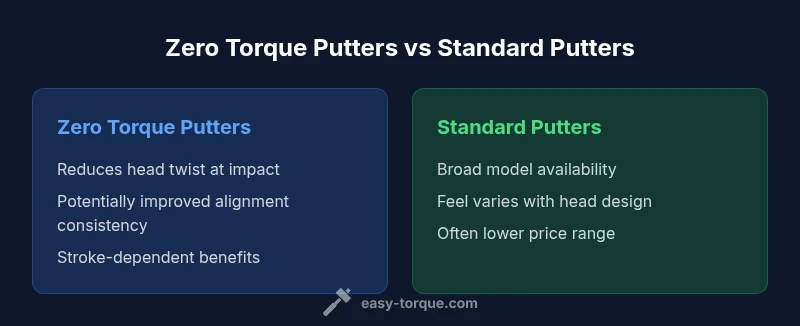
| Feature | Standard Putter | Zero-Torque Putter |
|---|---|---|
| Torque behavior at impact | Higher potential for head rotation during impact | Minimized head rotation with aligned impact |
| Feedback and feel on center hits | Direct feedback typical of conventional heads | Smoother feedback with reduced twist |
| Forgiveness on off-center hits | Moderate forgiveness depending on design | Improved forgiveness for certain mis-hits |
| Consistency across strokes | Stroke-dependent consistency | Potentially more consistent with stable tempo |
| Price range and model availability | Broad price range across brands | Generally higher price for zero-torque models |
| Best for | Players with established tempo seeking value | Players targeting reduced head twist and improved alignment |
Pros
- May improve stability for players with tempo faults
- Can promote straighter starts with consistent alignment
- Encourages deliberate setup and practice
- Broad compatibility with many grips and stances
Drawbacks
- Benefits can be marginal and stroke-dependent
- Higher upfront costs for specialized models
- Limited model variety compared to standard putters
Zero-torque putters can help select players improve stability, but they are not a universal fix.
If you struggle with head rotation, a zero-torque design may help. For most players, fundamentals and practice drive results more than the head shape.
Your Questions Answered
Do zero-torque putters make a noticeable difference for most players?
Yes, but the difference is often subtle and stroke-dependent. They can reduce twist at impact for some players, potentially improving alignment, but you’re unlikely to overcome major swing faults with the head alone.
They can help some players, but it’s not a magic fix.
Who should consider trying a zero-torque putter?
Players with tempo or alignment challenges may benefit; it’s most effective when paired with proper practice and a controlled fitting.
If your tempo is inconsistent, it may be worth testing.
How can I test whether a zero-torque design helps my game?
Get a fitting, borrow or demo the model, and perform a side-by-side dispersion test with consistent tempo and alignment.
Test with a fitting and compare results.
Are there downsides or trade-offs with zero-torque putters?
Yes. Benefits can be small, there may be fewer model options, and some players face a longer adaptation period.
There are trade-offs to consider.
Do pros use zero-torque putters?
Some pros experiment with alternative heads, but data on professional usage is limited and depends on fit.
Pros test many gears; it’s not universal.
Top Takeaways
- Assess your stroke tempo before buying
- Test with a fitting and controlled practice
- Expect modest, not dramatic, gains
- Pair equipment choice with solid fundamentals
- Budget time for a trial period