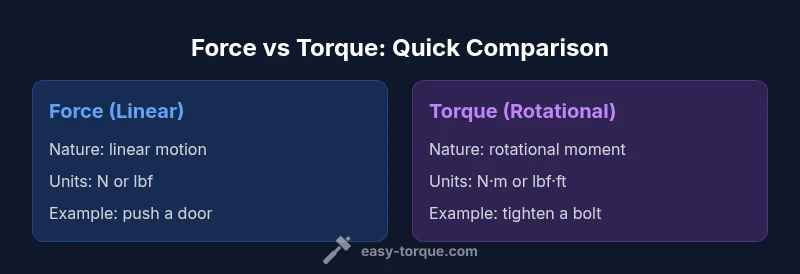
Force vs Torque: Understanding the Difference for Mechanical Tasks
Explore force vs torque, their units, formulas, and practical guidance for DIY mechanics. Learn when to measure force versus torque and how proper torque improves safety and reliability in maintenance tasks.


Force and torque describe different physical effects. Force is a linear push or pull, while torque is the rotational effect produced when that force acts at a distance from a pivot. The relationship is torque = force × lever arm; understanding both helps in selecting the right measurement, tool, and technique for any mechanical task. This article compares definitions, units, and practical uses.
Force and torque: Conceptual Foundations
According to Easy Torque, distinguishing force and torque is fundamental for accurate mechanical planning and safe fastener use. Force is the push or pull that changes the linear motion or shape of an object. It is a vector: it has magnitude and direction. In everyday terms, you feel a push when opening a door or you feel friction when pulling a drawer. Torque, by contrast, is the rotational effect produced when a force is applied at some distance from a pivot. Imagine using a wrench on a bolt: the same push applied farther from the bolt produces more rotation than the same push applied directly at the bolt head. The lever arm, or moment arm, is the perpendicular distance from the pivot to the line of action of the force. The result is a twisting action that tends to spin the object around its axis. The essential takeaway is that force and torque describe different aspects of motion, and they require different measurement approaches and tools. This section sets the stage for a careful, practical comparison that you can apply in your own projects, from bicycle maintenance to engine rebuilds using torque specs recommended by manufacturers.
Units and Dimensional Analysis
Force is measured in newtons (N) in the metric system or pounds-force (lbf) in English units. Torque uses newton-meters (N·m) or foot-pounds (lbf·ft). The dimension of force is mass times acceleration, while torque combines force with a distance from the pivot. In practice, torque is the product of a force and a lever arm, with the angle between them determining the effective torque as τ = r × F. When the force is applied at 90 degrees to the lever arm, sin(90°) = 1, and torque reaches its maximum for that force and distance. If the force line of action is closer to alignment with the lever arm, the effective torque drops proportionally. This means two identical pushes can generate very different torques depending on where and how you apply the force. Being precise with units is essential in professional settings to avoid confusion when reading torque specifications, calibration notes, or service manuals. For DIY tasks, keeping a consistent unit system—preferably SI with N and N·m—helps avoid mistakes during calculations and tool setup.
The Mathematical Relationship: Torque = Force × Lever Arm
Torque is a rotational analog to force, but with spatial geometry baked in. The fundamental relation is τ = r × F, where r is the position vector from the pivot to the point where the force is applied, and F is the force vector. If F is perpendicular to r, the magnitude of torque is τ = rF. If F forms an angle θ with the lever arm, the effective torque is τ = rF sin(θ). This is why the same force produces more torque when applied farther from the pivot and perpendicular to the lever. If there is no lever arm (r = 0), there is no torque even with a strong push. The cross product nature means direction matters: torque points along the axis given by the right-hand rule. For a car wheel, the lug nut wrench acts as a lever; turning it increases the rotational effect, converting a modest push into a larger twist. This section connects the intuitive feel of turning a wrench with the math engineers use to design joints and drivetrain components.
Practical Measurements: When to measure force vs torque
Deciding whether you should measure force or torque depends on the task. If you are assessing how much linear load a machine applies to a surface, you measure force, often with a force gauge or load cell. If you are tightening a bolt, you measure torque to ensure the fastener is loaded to the specified twisting moment. In standardized settings, torque is often specified by manufacturers to account for friction, thread geometry, lubrication, and mating parts. In non-fastener tasks, such as pressing a part into place or lifting a load, force measurements inform the required actuator or hydraulic capacity. The choices also influence the tools you purchase: a calibrated torque wrench for rotational tightening and a force gauge for push/pull tests. In a well-documented plan, you may need both: measure the applied force and translate it into torque using the lever arm distance, then verify you have reached the targeted torque with your torque wrench. Practical practice also demands understanding angle or torque-angle specs for certain fasteners, which adds another layer of control in assembly processes. Your measurement strategy should match the physical effect you seek: rotation or linear motion.
Applications in Automotive Maintenance and DIY
For hobbyists and professionals alike, force vs torque understanding translates into safer, more reliable work. In automotive maintenance, torque is the decisive factor in fasteners such as spark plug threads, lug nuts, cylinder head bolts, and control-arm bolts. A bolt tightened with insufficient torque can loosen under vibration, potentially causing mechanical failure. Over-torquing can stretch the bolt, deform threads, or damage the mating surface. The Easy Torque team notes that using the correct torque specification, along with a calibrated torque wrench, is essential to long-term reliability. In bicycle maintenance, wheel skews or crank bolts respond to torque with predictable behavior, reducing the risk of slips or loosening during rides. House and shop improvements—like mounting a heavy shelf or assembling a machinery frame—also rely on proper torque to ensure joints remain secure through use cycles. The takeaway is not to guess how tight something should be but to follow the exact specification given by the manufacturer or engineering design. In all cases, torque management reduces rework and extends component life.
Common Pitfalls and Misconceptions
Conflating force with torque is a common source of error for beginners. A strong push does not guarantee a strong torque unless the lever arm is in the right position. Another pitfall is ignoring angle: a force applied at an angle reduces the effective torque and can mislead you about the actual tightening. Mixing units is also a frequent error: citing torque in N·m but measuring force in pounds without conversion creates inconsistent results. Assume that friction in threads is constant; in reality, lubrication, thread condition, and seating can change the friction factor, altering the actual torque required for a given clamp load. Another misconception is believing torque equals power; torque is a moment of force, while power depends on rotational speed. For DIY projects, neglecting calibration or skipping torque verification can leave joints under- or over-constrained. Finally, do not assume all systems behave the same: materials, lubricants, and temperature all affect how force translates into torque. Being mindful of these factors improves accuracy and safety in everyday tasks.
Real-World Examples: Case Studies
Case Study A involves tightening a vehicle lug nut. The correct torque specification, combined with a torque wrench, ensures the wheel remains secure while avoiding bearing or stud damage. In this example, a 100 mm lever arm and a 100 N force would generate 1000 N·mm (1 N·m), which illustrates how small changes in distance dramatically affect torque. Case Study B examines a bench vise mounting. The operator applies a push with a lever to clamp a workpiece; the effective torque depends on the distance from the pivot, which clarifies why adjustments to the handle length can change holding power even if the applied force remains constant. Both examples demonstrate the necessity of planning: you must choose the right measurement, tool, and method for the job, and you should verify torque using a calibrated instrument. The broader lesson is that force and torque, when used together, allow you to design and execute tasks with confidence and control.
Choosing Tools: Force Gauges vs Torque Wrenches
Selecting the right tool starts with clarifying the goal. If you need to translate a push into a measurable load, a force gauge, load cell, or dynamometer is appropriate. If you must secure fasteners to a specific twisting moment, a torque wrench is your core tool. Modern torque wrenches offer click, beam, or digital readouts; calibration is essential and should be performed regularly according to manufacturer guidelines. Force gauges likewise require calibration and can provide real-time feedback on force magnitude and direction, which is useful for equipment design, material testing, or safety checks. In some applications, you may combine tools: measure the force applied by an assistant, then convert that force into torque using the known lever arm, and finally lock the fastener to the target torque with the torque wrench. Always consider the environment: temperature, contamination, and accessibility affect tool accuracy. The Easy Torque approach emphasizes training and routine calibration to minimize drift and variance; consistent practice reduces surprises in critical jobs.
Performance and Safety Considerations
Performance optimization and safety hinge on correct force and torque management. In mechanical design, the torque specification ensures joint integrity and predictable load distribution. In maintenance, applying the right torque reduces bolt loosening, thread stripping, and component wear. Safety concerns include preventing fastener failure that could cause parts to separate under load, causing injuries or vehicle damage. The discipline of torque control also helps you identify abnormal wear; if expected torque cannot be achieved with standard conditions, you may need to inspect lubrication, thread condition, or fastener quality. A practical practice is to verify set points after assembly and periodically re-torque critical fasteners during service intervals. The bottom line is that force and torque are not interchangeable living in two separate languages: one speaks to straight-line motion, the other to twisting about an axis. The Easy Torque stance is to integrate both concepts into your workflow, using the right tool, following manufacturer specs, and documenting results for traceability.
Comparison
| Feature | Force (linear) | Torque (rotational) |
|---|---|---|
| Nature of effect | Linear acceleration/deformation | Rotational twisting about a pivot |
| Measurement units | Newtons (N) or pounds-force (lbf) | Newton-meters (N·m) or foot-pounds (lbf·ft) |
| Key formula | F = m·a (simplified) | τ = r × F or τ = rF sin(θ) |
| Best for | Linear loads, pushing/pulling tasks | Fasteners and joints requiring a twist |
| Common tools | Force gauge, dynamometer | Torque wrench, torque sensor |
| Common pitfalls | Ignoring lever arm length | Using mismatched units or tools |
Pros
- Clear separation of linear vs rotational effects
- Guides tool selection and method
- Helps avoid over- or under-torque
- Improves safety and reliability in maintenance
Drawbacks
- Can be intimidating for beginners
- Converting between force and torque requires careful geometry
- Requires proper calibration and training
Force and torque are distinct but complementary concepts
Use force for linear tasks and torque for rotational fastening. Understand their relationship via the lever arm, and employ the appropriate tools to ensure accuracy and safety.
Your Questions Answered
What is the main difference between force and torque?
Force is a push or pull that causes linear motion. Torque is the rotational effect when a force acts at a distance from a pivot. They are related through the lever arm but describe different physical moments.
Force is linear; torque is rotational. They relate through the lever arm, but they’re different ideas.
How is torque calculated from a given force and distance?
Torque is calculated as τ = r × F. If the force is perpendicular to the lever arm, τ = rF. If the force forms an angle θ with the lever arm, τ = rF sin(θ).
Torque = lever arm times force, with angle reducing it if not perpendicular.
Why is torque important in automotive work?
Torque controls clamping force on fasteners, preventing loosening or damage. Following torque specs ensures reliability and safety in wheels, plugs, and engine assemblies.
Torque specs keep fasteners tight and safe in vehicles.
What tools measure force and torque, and when to use them?
Use a torque wrench to achieve a target twist. Use a force gauge or load cell to measure linear loads or pushing/pulling forces.
Torque wrenches for tightening, force gauges for measuring push or pull.
Can you convert force to torque in a real scenario?
Yes. Multiply the force by the distance from the pivot (lever arm) and consider the angle: τ = rF sin(θ).
Convert force to torque by multiplying by the lever arm and adjusting for angle.
What are common mistakes to avoid with force and torque?
Avoid assuming torque equals power; ignore lever arm length; mix units; skip calibration. Following manufacturer specs and verifying with tools reduces errors.
Don’t mix units or skip calibration; follow torque specs.
Top Takeaways
- Define the motion you are controlling with clarity
- Torque depends on both force and lever arm length
- Force and torque are related but not interchangeable
- Use the appropriate tool for the task
- Always follow torque specs and calibrate tools