Is Torque the Same as Work? A Clear Comparison
Explore the fundamental difference between torque and work. This analytical guide explains definitions, units, formulas, and real-world examples to distinguish these core physics concepts.


The quick answer: is torque the same as work? No — they are distinct physical quantities. Torque is the rotational effect of a force about an axis, driving angular motion, while work is the energy transferred when a force moves an object through a distance. In rotating systems, if torque is constant, the work done equals W = τθ, where θ is the angular displacement in radians; for varying torque, W = ∫ τ dθ.
Is the question "is torque the same as work" worth distinguishing?
Yes. In many introductory explanations this question arises, and the evidence shows they are different concepts with a precise relationship in rotating systems. Torque describes the turning effect of a force about an axis, while work measures energy transfer during motion. The distinction matters for analyzing motors, gears, and shafts where rotational motion converts input torque into useful energy. Throughout this guide, we distinguish the rotational effect (torque) from the energy transfer (work). In practical terms, torque is the turning force; work is the energy delivered by that turning action. The reader should keep this separation clear when sizing components or predicting system performance.
In everyday terms, torque is what you feel when you tighten a bolt with a wrench, while work is the energy you expend to achieve that tightening over a distance. When asked, is torque the same as work, the intuitive answer is no, yet their connection is essential for engineers designing rotating machinery.
Core definitions: torque vs work
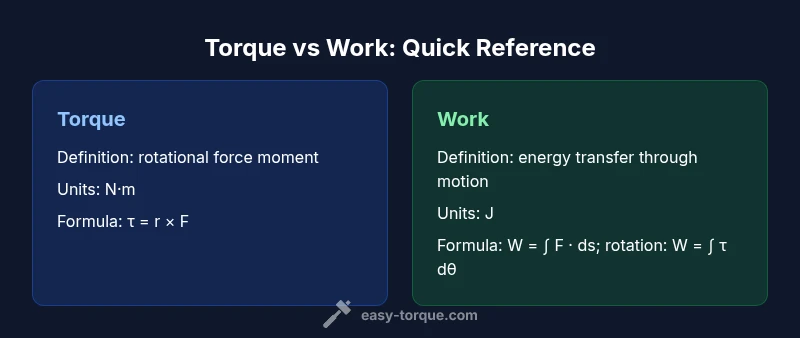
Torque, denoted by τ, is a moment of force that tends to cause rotation about an axis. It depends on the applied force and the lever arm, and its SI unit is the newton-meter (N·m). Work, denoted by W, is the energy transferred when a force causes displacement; its SI unit is the joule (J). For rotational motion, work can be expressed as W = ∫ τ dθ, where θ is the angular displacement in radians. This formula links torque to energy transfer, showing how rotation converts applied turning force into work.
Understanding these definitions helps avoid common misinterpretations when terms like torque, energy, and work are used in mechanical design and physics problems.
Units and dimensions: how they differ
Torque is a moment of force described by the cross product of radius and force, yielding units of N·m. It describes a rotational tendency rather than an energy quantity. Work is energy transfer and has units of joules. While both involve force, torque is about rotation, and work is about energy transfer due to motion. Dimensionally, torque has dimensions of mass·length^2/time^2, while work has mass·length^2/time^2, with angular units bridging the two in rotational systems when torque acts through an angle.
This distinction becomes important when converting between linear and rotational analyses, such as translating a bolt-tightening torque into the corresponding rotational work performed by a wrench over an angle.
Mathematical relationship: W = ∫ τ dθ
The core link between torque and work in rotation is the integral W = ∫ τ dθ. If torque τ is constant while the object rotates through an angle θ, the work done is simply W = τθ. If the torque varies with angle, you integrate over θ. This relation shows that work is the energy transferred by the torque as the system experiences angular displacement, reinforcing that torque and work are distinct but mathematically connected quantities.
In many practical situations—such as braking, clutch engagement, or motor starts—knowing how τ changes with θ allows engineers to predict energy transfer, power requirements, and efficiency more accurately.
Constant torque vs variable torque scenarios
With constant torque, W = τθ is straightforward: a fixed turning force over a known rotation gives a predictable amount of work. Real systems often feature variable torque, especially in gears, belts, or engines where resistance or leverage changes with position. In these cases, W = ∫ τ(θ) dθ; the calculation requires either a torque profile or a function that describes how τ varies with θ. Misapplying the constant-torque formula in such contexts leads to errors in energy estimates and performance predictions.
Understanding the torque profile is essential for accurate endurance calculations, noise and vibration analysis, and determining the true energy cost of a rotational task.
Practical examples: twisting a bolt vs rotating a wheel
Consider tightening a bolt with a torque wrench. The applied torque converts into angular displacement as the bolt threads in; the work done depends on θ and τ. If you apply 60 N·m of torque over 0.5 radians, W = τθ ≈ 30 J. Now imagine a wheel with braking torque that increases as the wheel slows; the work done by the braking torque is the integral of τ(θ) over the stoppage angle. In both cases, torque remains a rotational measure, while work quantifies energy transfer during the rotation.
These examples highlight why the question is not about equality but about the relationship: torque is the cause, work is the effect, linked by the rotation angle.
Common misconceptions and pitfalls
One common pitfall is treating torque as energy. Torque is a moment that causes rotation; energy is the capacity to do work. Another error is assuming torque and work are interchangeable in all contexts; they only relate through W = ∫ τ dθ for rotating systems. Beginners also misapply W = Fd in rotational scenarios without converting linear displacement to angular displacement. Remember: angular displacement (radians) is the bridge between torque and work in rotational problems.
How to calculate if torque equals work in a system
Start by identifying whether the system involves rotation. If yes, write W = ∫ τ dθ. If torque is constant, you can simplify to W = τθ. Ensure θ is in radians. If torque varies with θ, you need either a torque graph or a function τ(θ) to perform the integral. Check units: torque in N·m, angle in radians, so the resulting W is in joules. Finally, differentiate between instantaneous power P = τω and total work over an interval to understand energy flow in the system.
Real-world relevance: energy, power, and efficiency
In mechanical design, differentiating torque and work helps in selecting motors, gears, clutches, and braking systems. Engineers examine how torque production affects energy consumption, heat generation, and efficiency. The relationship W = ∫ τ dθ connects input torque to energy delivered, enabling calculations of fuel or electrical energy requirements, battery life, and system performance under load. The distinction also informs safety and maintenance planning, as torque limits influence component wear and failure risk. In short, torque describes the rotational force; work quantifies the energy moved by that force through angular motion.
Design implications for engineering practice
From a design perspective, recognizing that torque and work are distinct yet connected informs how you select actuators, measure performance, and set tolerances. For rotational tasks, you must account for angle and torque profiles to estimate energy consumption, heat, and wear. When implementing control strategies, use P = τω to monitor real-time power and W = ∫ τ dθ to calculate energy over a cycle. This approach improves reliability, efficiency, and safety in machinery such as conveyors, pumps, and automotive drivetrains. The key takeaway is to treat torque as the rotational input and work as the energy output, linked by angular displacement.
Comparison
| Feature | Torque | Work |
|---|---|---|
| Definition | A measure of rotational force about an axis (moment of force) | Energy transfer resulting from a force causing displacement |
| Units | N·m (newton-meters) | J (joules) |
| Formula | τ = r × F (moment of a force) | W = F · d (work done by a force); for rotation W = ∫ τ dθ |
| Dimensional meaning | Rotational effect that causes rotation | Quantity of energy transferred during motion |
| Relation to rotation | Causes angular motion; independent of energy transfer | Represents energy moved by the rotating system |
| When to use | To analyze torque-producing elements (wrenches, shafts) | To quantify energy transfer in rotating tasks |
| Practical example | Bolt tightening torque with a wrench | Work done by turning a bolt through an angle |
Pros
- Clarifies how rotational force translates to energy transfer
- Helps engineers compare mechanisms by torque versus energy metrics
- Supports accurate energy budgeting in rotating systems
- Links rotational motion to energy concepts for design optimization
Drawbacks
- Can confuse beginners when mixing linear and rotational terms
- Requires calculus for variable-torque scenarios, which can be complex
- Misapplication of linear work formulas to rotational problems without angular conversion
Torque and work are distinct quantities, linked by angular displacement; use W = ∫ τ dθ to connect them in rotational systems.
Understanding the difference helps prevent misinterpretation in design and analysis. In rotating machinery, always distinguish input torque from energy transfer and apply the correct formula to predict performance and efficiency.
Your Questions Answered
What is the difference between torque and work?
Torque is the rotational effect of a force about an axis, while work is the energy transferred when a force moves an object through a distance. In rotation, work relates to torque via W = ∫ τ dθ.
Torque is the turning effect; work is the energy transferred by that turning action. In rotation, you add up torque over the angle turned to get work.
Can torque do work?
Yes. Torque does work whenever there is angular displacement, with W = ∫ τ dθ. If torque is constant, W = τθ. If torque varies, you must integrate across the rotation.
Torque can do work if the system turns; you calculate that energy by integrating torque over the angle.
Is torque the same as energy?
No. Torque is a moment of force that causes rotation, whereas energy (including work) is the capacity to perform that rotation. They are related but not the same quantity.
Torque is not energy; it’s a turning force. Energy is what you get or use when you rotate.
What role does angle play in W = ∫ τ dθ?
Angle (θ, in radians) is the variable of integration in rotational work. It determines how much rotation has occurred and, with torque, sets how much energy is transferred.
The angle tells you how much rotation happened, which scales the work done when you know the torque.
How is power related to torque and angular velocity?
Power in a rotating system is P = τω, where ω is angular velocity. This shows how torque and rotation rate combine to deliver instantaneous power.
Power equals torque times how fast you’re turning, measured by angular velocity.
What if torque changes during rotation?
If torque varies with angle, calculate work with W = ∫ τ(θ) dθ. This requires a torque profile or function τ(θ).
If torque isn’t constant, you must integrate to find the total work.
Top Takeaways
- Define torque vs. work clearly before solving problems
- Use W = ∫ τ dθ for rotating systems (τ may vary)
- Torque units are N·m; work units are J (joules)
- With constant torque, W = τθ (θ in radians)
- Power in rotation follows P = τω for instantaneous calculations