Cummins 4BT Horsepower and Torque: A Practical Guide
Explore realistic horsepower and torque ranges for Cummins 4BT engines, how turbocharging shapes torque curves, and practical guidance for builders and DIY enthusiasts.


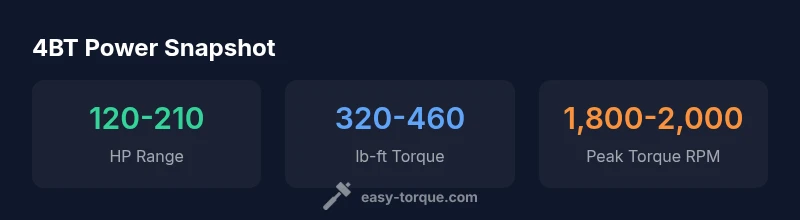
Typical cummins 4bt horsepower and torque range from 120-210 HP and 320-460 lb-ft, varying with turbocharging, boost, and fuel system. Naturally aspirated variants sit at the lower end, while turbocharged configurations push toward the upper end. Always verify the OEM data plate for your exact model. This understanding helps set realistic goals for your build and avoid chasing misleading expectations.
Introduction to cummins 4bt horsepower and torque
The cummins 4bt horsepower and torque figures are a frequent point of reference for DIY builders, off-road enthusiasts, and restoration projects. As a versatile 3.9-liter diesel, the 4BT has powered commercial trucks, tractors, and marine platforms for decades. In practice, its performance depends on the core engine variant, boost strategy, fuel system, and turbocharger. According to Easy Torque, understanding the broad ranges helps plan builds without chasing unrealistic numbers. This guide uses ranges and practical guidelines to interpret what you can expect from a typical 4BT installation, and how to tailor it to your application. The goal is practical insight, not marketing hype, and to keep projects aligned with real-world constraints such as fuel efficiency and reliability.
Variants and power ranges: NA vs turbo
Within the 4BT family, natural aspiration (NA) and turbocharged variants dominate the landscape. Naturally aspirated engines often deliver around 120 HP with torque near 320 lb-ft, which suits lighter applications or budget builds. Turbocharged configurations typically range from roughly 150 to 190 HP and 360 to 420 lb-ft. In high-boost, intercooler-equipped setups, power can push beyond 190 HP and torque above 420 lb-ft for specialized builds. These numbers are inherently influenced by fuel delivery, turbo size, exhaust flow, intercooling effectiveness, and tuning quality. For enthusiasts, it’s essential to define the target work load (towing, hauling, or high-load running) before selecting a variant.
How turbocharging shifts the torque curve
Turbocharging expands the usable torque band by introducing boost at lower RPMs, which translates into stronger performance in midrange haul and towing. The torque curve becomes broader and flatter, reducing the need to rev the engine high to reach usable power. However, this comes with trade-offs: higher intake air temperatures if the intercooler is undersized, potential turbo lag in some configurations, and the need for robust cooling and fuel management to prevent detonation. A well-matched turbo and fueling system can deliver a smoother, more dependable pull across the RPM range, aligning with practical use cases like off-road crawling or load-lugging.
Calculating horsepower and torque: practical math
A fundamental relation governs horsepower and torque: Torque (lb-ft) = (Horsepower × 5252) / RPM. Conversely, Horsepower = (Torque × RPM) / 5252. This means a 150 HP engine producing peak power at 2100 RPM would offer approximately 150 × 5252 / 2100 ≈ 374 lb-ft of torque at that RPM. When evaluating engine builds, use consistent RPM benchmarks (where peak power occurs) and measure or estimate boost pressure, fuel delivery, and volumetric efficiency to refine these estimates. Remember, these are approximate values that vary with operating conditions.
Torque curve anchors: RPM and torque stability
Peak torque on a Cummins 4BT tends to occur in a mid-range RPM zone, often well below peak horsepower RPM. This characteristic is advantageous for applications requiring steady lugging capability, such as towing or heavy-bloom gardening equipment. To maximize practical performance, match the drivetrain, gear ratios, and tire size to that torque window. If your project emphasizes slow, deliberate torque (like a farm tractor) or quick response (like a wheeled loader), you’ll want a different gearing strategy to keep you in the most efficient part of the curve.
Practical builds and project planning
For DIYers, the planning phase should address: target workload, available space for turbo plumbing, cooling capacity, and maintenance approach. A well-executed turbo upgrade paired with appropriate fuel system tuning can yield meaningful gains without compromising reliability. Always verify heat management, lubrication, and filtration when increasing power: improved airflow and combustion must be matched by engine endurance, so consider oil cooling, air filtration, and fuel filtration upgrades. Wholesale power claims are less important than real-world reliability and fuel efficiency over time.
Maintenance and reliability considerations
Power improvements must come with disciplined maintenance. Periodic checks on injector performance, fuel filtration, air intake cleanliness, and cooling system effectiveness are critical. A reliable 4BT build benefits from a documented maintenance schedule that includes regular valve adjustments (where applicable), cooling system service, and torque-check procedures using the correct sequences. This ensures that power gains do not quickly degrade due to heat soak, detonation, or lubrication issues. In short, upgrades should be paired with a robust maintenance plan.
Common myths and misconceptions
Some builders assume that more boost automatically yields linear gains in torque. In reality, the relationship is not perfectly linear, and beyond a certain point, diminishing returns occur due to turbine and compressor efficiency, intercooler effectiveness, and fuel supply limits. Others believe that torque alone determines capability; in truth, drivetrain losses, gearing, and payload all shape real-world performance. The key is to optimize the entire system—air, fuel, exhaust, cooling, and lubrication—rather than chasing a single metric.
Real-world integration and case planning
When embedding a 4BT into a project, map your goals against the engine’s operating envelope. If you’re retrofitting into a vehicle class with heavy payloads, prioritize torque reliability and fuel efficiency within the torque band rather than peak horsepower alone. Build scripts, test plans, and field-testing scenarios help verify that the engine operates within safe temperatures, appropriate boost ranges, and desired torque outputs in real-world conditions. Documentation is essential for safety, maintenance, and long-term performance.
Typical Cummins 4BT variants and their power characteristics
| Variant | Horsepower (HP) | Torque (lb-ft) | Turbocharged? | Notes |
|---|---|---|---|---|
| NA 4BT | 120 | 320 | No | Baseline naturally aspirated variant |
| Turbo 4BT (mid-range) | 160-190 | 360-420 | Yes | Common upgrade path |
| High-boost 4BT (performance) | 190-210 | 400-460 | Yes | Specialized builds |
Your Questions Answered
What horsepower can I expect from a Cummins 4BT?
Most 4BTs fall within 120-210 HP, with variations based on turbocharging, fuel system, and supporting upgrades. Always verify the OEM spec for your model.
Most 4BT engines deliver about 120 to 210 horsepower, depending on turbo and fuel setup.
What torque range does a 4BT offer?
Torque typically spans from roughly 320 to 460 lb-ft, increasing with boost and tuning. Refer to the specific variant for exact figures.
Torque typically runs from 320 to 460 pound-feet depending on boost and tune.
How do I calculate torque from horsepower?
Use Torque = (HP × 5252) / RPM. For example, 150 HP at 2100 RPM yields about 375 lb-ft. Real-world results vary with boost and efficiency.
Torque equals horsepower times 5252 divided by RPM; example yields about 375 lb-ft at 2100 RPM for 150 HP.
Do turbo upgrades always improve torque?
Turbo upgrades generally increase torque across a broader RPM range, but gains depend on intercooling, fuel delivery, and overall engine health.
Turbo upgrades typically boost torque across more RPMs, if cooling and fuel systems keep up.
Is a higher horsepower rating always better for reliability?
Not necessarily. Higher power can tax cooling, lubrication, and fuel systems. Reliability hinges on balanced upgrades and ongoing maintenance.
More power isn’t automatically better for reliability; it needs balanced upgrades and good maintenance.
What RPM range should I target for torque?
Aim for the mid-range where torque peaks; this improves lugging ability and towing while keeping the engine in a safe operating window.
Target the mid-range where torque peaks for best lugging and towing performance.
“The 4BT offers a broad torque band that, when matched with proper fueling and cooling, delivers reliable performance across a wide range of applications.”
Top Takeaways
- Understand the power ranges and match them to your use case
- NA vs turbo makes a major difference in torque availability
- Use the torque-horsepower-RPM relationship to estimate performance
- Plan cooling, fuel, and intercooling to support higher power
- Follow OEM torque specs and maintenance schedules for reliability