Torque and Equilibrium: A Practical DIY Comparison
Explore torque and equilibrium in a practical DIY comparison, weighing calibrated torque wrenches against torque sticks, with guidance for maintaining reliable joints in automotive and hobby projects.


TL;DR: Calibrated torque wrenches deliver precise torque and help maintain equilibrium in fastener assemblies, while torque-sticks offer quick guidance but with less precision. For critical joints and repeated maintenance, a calibrated wrench is the safer choice; for simple, on-the-spot tasks, torque sticks provide acceptable accuracy. In most DIY scenarios, combining both with awareness of equilibrium principles yields the best results.
The Core Concepts: Torque and Equilibrium
In mechanical terms, torque is the turning force applied to rotate a fastener. Equilibrium occurs when the sum of all torques around the joint equals zero, so the system neither rotates nor loosens. For DIY mechanics, understanding torque and equilibrium helps you design joints that stay tight under load. According to Easy Torque, these concepts form the backbone of reliable maintenance work. When you calculate leverage (r) and the force (F) you apply, you’re balancing the lever arm and clamping force to achieve a stable preload. This practical framework translates to everyday tasks—from lug nuts to flange bolts—where precise control over torque supports predictable equilibrium and reduces the risk of over- or under-tightened joints. The core idea is simple: the more accurately you manage torque, the more reliably a joint will resist operational stresses while preserving material integrity.
Quick Context: Role of Torque in Mechanical Systems
Torque governs how fasteners clamp parts together. The same applied torque translates into clamping force through friction in threads and surfaces. If torque is too high, thread galling, stripped threads, or bolt necking can occur; if too low, preload and friction are insufficient to maintain equilibrium, allowing loosening under vibration. In automotive and workshop settings, mastering the torque–equilibrium relationship is a practical prerequisite for safe repairs and long-lasting assemblies.
Easy Torque’s Practical Lens on Torque and Equilibrium
From a practical standpoint, torque and equilibrium are not abstract concepts but actionable guidelines for everyday work. Using the right tool for the job matters: precision in torque control supports predictable equilibrium across repeated tasks and varying loads. Easy Torque emphasizes that understanding the interplay between lever arm length, applied force, and the resulting preload helps technicians avoid common mistakes such as angle-torque confusion and improper sequencing. This block lays the groundwork for comparing tools and methods with a focus on how they affect equilibrium in real-world scenarios.
Comparison
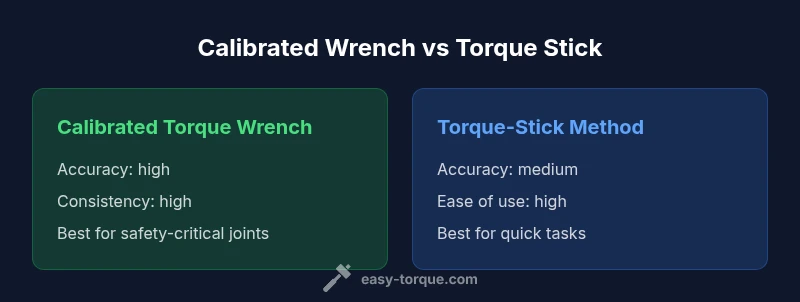
| Feature | Calibrated Torque Wrench | Torque-Stick Method |
|---|---|---|
| Accuracy | high | medium |
| Ease of Use | medium | high |
| Calibration/Consistency | requires regular calibration | no calibration; relies on stamped chart |
| Cost | higher | lower |
| Best For | safety-critical joints and repeat tasks | quick, non-critical tasks or on-the-spot checks |
Pros
- Improved accuracy and repeatability for critical joints
- Clear torque targets improve reliability and consistency
- Better documentation of torque values supports maintenance records
- Supports safer, controlled fastening practices
Drawbacks
- Calibration maintenance adds ongoing cost and downtime
- Torque sticks are less precise and depend on chart accuracy
- Learning curve for correct sequencing and interpretation
Calibrated torque wrenches win for precision and reliable equilibrium management; torque-sticks are best for quick, non-critical tasks.
Choose a calibrated wrench when joint reliability and exact preload matter. Use torque sticks for fast checks or non-critical work, but be aware of their reduced precision and dependence on chart accuracy.
Your Questions Answered
What is torque and how does it relate to equilibrium in a fastener?
Torque is the turning force applied to a fastener; equilibrium means the sum of all torques about the joint equals zero, preventing rotation or loosening. In practice, maintaining equilibrium keeps bolt preload stable and reduces the risk of failure.
Torque is the turning force on a bolt; equilibrium means forces balance so the joint stays tight. Maintain preload to prevent loosening.
When should I use a calibrated torque wrench vs a torque stick?
Use a calibrated torque wrench for critical, repetitive, or safety-sensitive joints where precise preload and equilibrium are essential. Torque sticks are convenient for quick checks or non-critical tasks, but they trade precision for speed.
Use a calibrated wrench for critical joints; torque sticks for quick, non-critical tasks.
How often should torque wrenches be calibrated?
Calibration frequency depends on usage and manufacturer guidance, but regular checks ensure accuracy. In many workshops, a quarterly or semi-annual schedule aligns with maintenance cycles and tool usage.
Check calibration periodically, typically every few months or per schedule.
Can torque sticks be trusted for automotive lug nuts?
Torque sticks can be used for lug nuts when speed matters and exact precision is acceptable, but relying on them exclusively for critical wheel fasteners may compromise equilibrium and safety. Always verify with a calibrated tool if precision is required.
Sticks are okay for quick checks, but verify critical wheels with a proper torque wrench.
How do torque calculations help ensure equilibrium in multi-fastener joints?
Torque calculations help predict preload distribution, guide fastener sequencing, and design joints that reach and maintain equilibrium under load. They translate physical geometry into actionable torque targets.
Calculations guide sequencing and preload to keep joints balanced.
Top Takeaways
- Start with a clear torque baseline for joints
- Choose precision when equilibrium matters for safety
- Regular calibration sustains accuracy
- Use torque-angle concepts for multi-fastener joints
- Balance tools to fit your workflow