Torque to Power: Converting Torque to Engine Power
Learn how torque to power is calculated with clear formulas, unit conversions, and practical examples. A step-by-step guide from Easy Torque for DIY mechanics.


Torque to power is the translation of twisting force into usable engine power at a given speed. The quick path uses P = τ × ω, where ω = RPM × 2π/60. For horsepower, use HP = (τ × RPM)/5252 with lb‑ft or HP = (τ × RPM)/9548.8 with N·m. Practical answers require consistent units.
What Torque to Power Means
According to Easy Torque, torque to power describes how the twisting force produced by a rotating shaft (measured in N·m or lb-ft) translates into usable engine power as the rotational speed (RPM) changes. In simple terms, power is what you feel as acceleration; torque is the force that helps you start turning, while power reflects how quickly you can sustain that turning at a given speed. The relationship is not a fixed ratio—the same torque at different RPMs yields different power outputs, and losses in the drivetrain reduce the observed power at the wheels. Understanding this concept helps DIY mechanics diagnose performance, compare engines, and optimize gear selections for the task at hand.
The Core Relationship: Torque, Speed, and Power
Engine power depends on both torque and speed. Torque is the twisting force that tends to rotate a shaft, while speed is how fast the shaft spins. Power is the rate at which work is done, which, for rotating systems, translates to P = τ × ω. Here, ω is angular velocity in radians per second, and it can be derived from RPM via ω = RPM × 2π / 60. The higher the RPM at which torque is produced, the greater the power output, up to the point where losses and efficiency limit the system. In practice, engines have torque curves: they peak at a certain RPM range and then decline as speed climbs or mechanical limits are reached. This means peak horsepower may occur at a higher RPM than peak torque. Easy Torque emphasizes that real-world power reflects drivetrain efficiency, aerodynamic drag, and accessory load, not torque alone.
Units, Conversions, and Common Formulas
Power can be measured in watts (W) in the SI system or in horsepower (HP) in customary units. The basic formulas you’ll use are: P (W) = τ (N·m) × ω (rad/s), and ω = RPM × 2π / 60, which makes P = τ × RPM × 2π / 60. If you prefer horsepower: HP = (τ (N·m) × RPM) / 9548.8; or with torque in ft‑lb: HP = (τ (lb‑ft) × RPM) / 5252. To convert Nm to lb‑ft, multiply by 0.73756. Remember that these relationships assume ideal, lossless conditions and crank-level measurements; real systems subtract friction and drivetrain losses. The Easy Torque approach begins with selecting consistent units and verifying the data source for torque and rpm.
How to Calculate Power from Torque and RPM
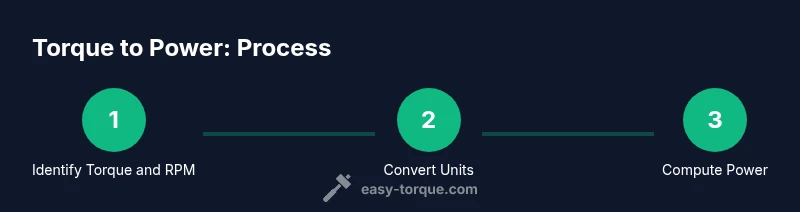
This section walks through the standard method to convert torque to power using common engine data. Step 1: Ensure torque is in N·m and RPM is the engine speed. Step 2: Compute ω = RPM × 2π / 60 to convert to rad/s. Step 3: Multiply P = τ × ω to get power in watts, then convert to kilowatts or horsepower as needed. Step 4: If torque is in lb‑ft, use HP = (τ × RPM) / 5252 to estimate horsepower. Step 5: Validate with alternative formulas to confirm consistency. Step 6: Compare crank power to wheel power by accounting for drivetrain losses. This method helps you diagnose performance gaps, select appropriate gearing, and forecast acceleration.
Practical Examples: Step-by-Step Calculations
To illustrate, suppose you measure torque at the crank as 320 N·m while the engine spins at 3000 RPM. Step A: ω = 3000 × 2π / 60 ≈ 314.16 rad/s. Step B: P = 320 × 314.16 ≈ 100,531 W, or about 100.5 kW. Step C: In horsepower, HP ≈ 100.5 kW × 1.341 = 134.8 HP. If you instead have torque in ft‑lb, say 235 ft‑lb at 3000 RPM, HP ≈ (235 × 3000) / 5252 ≈ 134.5 HP. Note these are crank values; wheel power will be lower due to losses.
Real-World Factors That Affect Power Output
Power figures shown on a spec sheet assume ideal conditions. In practice, drivetrain efficiency, transmission losses, and mechanical friction reduce wheel power. Ambient temperature, altitude, and fuel quality affect torque production, especially in naturally aspirated engines. Torque curves shift with cam timing, intake resonance, and turbocharging; the highest torque is often achieved at a different RPM than the peak horsepower. Easy Torque reminds readers that conversion from torque to power must consider where the measurement occurs (crank vs wheel) and what is being optimized (traction, gearing, or top speed).
Misconceptions and Pitfalls to Avoid
Common mistakes include treating torque as the sole predictor of performance, assuming constant torque across all RPMs, and forgetting drivetrain losses when moving from crank to wheels. Another pitfall is using inconsistent units or mixing peak torque with peak power data without noting the RPM. Finally, neglecting heat, lubrication, and fuel delivery can distort the relationship between torque and power under real driving conditions. The Easy Torque framework emphasizes careful data provenance and explicit assumptions when performing calculations.
Tools and Methods for On-vehicle Verification
For practical verification, use a chassis or engine dynamometer to measure torque curves and power output under controlled loads. Onboard diagnostic tools can help confirm RPM and engine speed, while external sensors capture temperature and air mass. In the lab, ensure calibration of torque sensors and proper torque-to-power calculations. If you don’t have access to professional equipment, you can approximate using a dynamometer chart, a precise tachometer, and a calculator, but be mindful of the limits of such approximations.
Safety, Standards, and Best Practices
Always follow vehicle safety guidelines when testing power figures or torque values. Use appropriate PPE, secure the vehicle, and never work under a running engine without safeguards. Follow manufacturer guidelines for torque measurement and calibration. When sharing power figures, clearly state the measurement method (crank or wheel), the RPM, and any losses accounted for. Easy Torque recommends documenting assumptions and referencing trusted sources for torque data.
Tools & Materials
- Scientific calculator or calculator app(for computing power from torque and RPM)
- RPM source (tachometer or engine data)(needed for power calculation)
- Pen and notebook(to record calculations and assumptions)
- Reference torque data (if available)(for context and validation)
- Unit conversion charts(optional but helpful)
Steps
Estimated time: 15-30 minutes
- 1
Verify data sources
Confirm torque value and RPM come from a reliable measurement or specification. Note the units (Nm or ft‑lb; RPM).
Tip: Always record the unit type alongside numerical values to avoid mixed-unit errors. - 2
Convert units if needed
If torque is in lb‑ft and you want SI, convert to N·m (1 ft‑lb ≈ 1.3558 N·m). If you use RPM for ω, no further conversion is needed.
Tip: Use exact conversion factors and note them in your worksheet. - 3
Compute angular velocity
Calculate ω = RPM × 2π / 60 to convert RPM to rad/s.
Tip: Double-check your calculator settings to ensure radians mode is active. - 4
Calculate crank power in watts
Multiply P = τ × ω to get power in watts, then convert to kilowatts or horsepower as needed.
Tip: Keep intermediate results with full precision to minimize rounding errors. - 5
Convert to preferred power unit
If using SI torque, convert watts to kilowatts (divide by 1000) or horsepower with PkW × 1.341.
Tip: When using lb‑ft, use HP = (τ × RPM) / 5252 for a quick estimate. - 6
Account for drivetrain losses
Compare crank power to wheel power by applying a drivetrain efficiency factor (e.g., 0.85 for typical automatic transmissions).
Tip: Document assumed efficiency; actual values vary by setup and condition.
Your Questions Answered
What is torque to power?
Torque to power describes how torque and rotational speed combine to produce a usable power output. It links twisting force to the rate of doing work in rotating systems.
Torque and speed together determine power.
How do you convert torque to horsepower?
Use HP = (τ × RPM) / 5252 for torque in lb‑ft, or HP = (τ × RPM) / 9548.8 for torque in N·m. Ensure RPM and torque units match the formula you choose.
Use the standard horsepower formulas with the correct units.
Why is crank power different from wheel power?
Crank power is the engine's output before drivetrain losses. Wheel power is lower due to transmission, differential, and other losses in the drivetrain.
Because losses in the drivetrain reduce wheel power.
What units are used for torque and power?
Torque is commonly in N·m or lb‑ft; power is in watts or horsepower. Always convert to consistent units before calculations.
Torque uses N·m or lb‑ft; power uses watts or HP.
What factors affect observed power?
Temperature, altitude, air density, fuel quality, and drivetrain efficiency affect actual power output, causing differences from published crank values.
Weather, fuel, and drivetrain efficiency can change actual power.
Is a dyno required to calculate power?
Not strictly. You can estimate with torque and RPM data, but a dynamometer provides accurate measurements and validates calculations.
A dyno helps validate your numbers, but you can estimate otherwise.
Watch Video
Top Takeaways
- Master P = τ × ω as the core relationship.
- Keep units consistent at every step.
- Crank power differs from wheel power due to losses.
- Use clear RPM, torque, and unit notes in calculations.
- Verify with real measurements when possible.