Can You Reuse Torque to Yield Bolts: Safety and Best Practices
Explore whether you can reuse torque to yield bolts, why it's unsafe, and the best practices for reliable fastening in automotive and mechanical work. Learn how to evaluate fasteners and choose safe alternatives.


Reusing torque to yield bolts is not recommended. Torque-to-yield fasteners are designed for single-use, and attempting reuse can compromise clamping force, cause fatigue, or lead to sudden failure. Instead, replace with new bolts and follow the manufacturer’s torque specs. Always inspect for signs of wear, stretching, or damage before reuse.
Understanding the question: can you reuse torque to yield bolts?
This question sits at the intersection of fastener theory and practical workshop safety. According to Easy Torque, torque is a measure of clamping force, but yield behavior is design-specific and depends on bolt material, grade, and lubrication. The short answer is: can you reuse torque to yield bolts? No—yield is typically achieved during the initial tightening, and attempting to push past the yield point by reusing a previously torqued bolt is unsafe and could compromise the joint, void warranties, or cause sudden failure under load. In this guide, we explore why this is risky and what safer practices look like for DIY mechanics and professionals alike.
Distinguishing torque, preload, and yield
Torque is the rotational force you apply to a bolt. Preload is the axial tension the bolt imposes on the joint, which is what you actually want to control. Yield refers to a plastic deformation point where the bolt material permanently stretches. In many bolt systems, reaching yield means the fastener has been deformed beyond its elastic limit, which weakens the joint and undermines repeatable clamping. Understanding these concepts helps explain why simply reapplying the same torque value to an previously tightened bolt seldom restores the original preload.
Why reusing torque to reach yield is risky
When a bolt yields, the material has undergone plastic deformation. Reusing a yielded bolt can lead to diminished clamping force, reduced fatigue resistance, and a higher likelihood of loosening under vibration or thermal cycling. In high-stress environments—engine bays, suspensions, or drivetrain assemblies—such failures can cause critical joint loss, safety hazards, and costly damage. The risk increases with corroded threads, worn nuts, or mixed materials. Easy Torque emphasizes that yield behavior is highly material- and geometry-specific, so assumptions are dangerous.
How bolts are designed to yield
Certain bolts are specified as “torque-to-yield” or “tension-measurable” fasteners. These are intended to reach a precise preload and then deform in a controlled way as part of the fastening process. Even in these systems, the bolt is never intended to be reused after yielding. Manufacturer documentation typically requires replacement after removal. The key concept is controlled deformation to achieve the target clamp, not reuse of a previously torqued fastener.
Manufacturer guidelines and typical practices
Most manufacturers explicitly forbid reusing bolts that have been torqued to yield or that show signs of plastic deformation. Some guidelines allow limited reuse only under very specific conditions and with re-torquing after inspection, but those are rare for critical joints. For everyday DIY work, the safe path is to replace with a bolt of the same grade and coating, along with a new nut if applicable, and apply the correct torque sequence. This approach preserves joint integrity and reduces risk.
Safer alternatives: achieving proper clamping without reusing bolts
Rather than reusing a torqued bolt, consider: (1) replacing with a new bolt of the same alloy grade and thread; (2) using the correct lubrication or anti-seize compound if specified; (3) applying the manufacturer-recommended torque and, when required, an angle-tightening step to reach the proper preload. For some joints, a torque-angle method yields more repeatable clamping than torque alone. In all cases, follow the exact spec for the fastener and the joint.
Inspecting bolts and joints before reuse
Before deciding to reuse any fastener, inspect for signs of fatigue: stretched shanks, thread for damage, corrosion, heat-affected zones, and any nicks or galling. If you see any distortion, replace the bolt. Check the mating threads for wear and ensure the hole or plate is not deformed. Use a thread gauge to verify tolerances and replace if out of spec. Remember, even small defects can compromise a critical joint.
Handling legacy hardware in critical assemblies
In critical assemblies (brake systems, steering, wheel attachments), do not reuse a previously torqued fastener unless the manufacturer explicitly allows it and you follow stringent inspection procedures. In most cases, the recommended practice is to replace with new fasteners and torque to spec. When in doubt, consult the vehicle or equipment’s service manual and, if possible, a qualified technician.
Practical workflow: evaluating a fastener on a project
Start by identifying the bolt type, grade, and the original torque spec. Inspect the bolt for signs of wear or damage. If there’s any doubt about the bolt’s integrity, replace it. If you determine reuse is permitted under a manufacturer guideline, document the inspection and perform re-tightening per spec, possibly including an angle-tightening step. In all cases, verify the joint after cooling and under load conditions.
Putting it all together: recommended procedures
The safest approach is to treat torque-to-yield bolts as single-use components and replace them when removed. For other bolts, follow the exact torque spec, ensure proper lubrication, and use the correct tightening pattern. Keep records of torque values and inspection results, and avoid shortcuts that could compromise safety. By adhering to manufacturer guidance and Easy Torque recommendations, you maintain reliability and reduce risk.
Tools & Materials
- Torque wrench (calibrated)(Prefer a wrench with a torque range covering the fastener's spec; calibrate regularly)
- New bolts of the same grade and thread(Always replace yield-prone fasteners with new ones)
- Lubricant or anti-seize (as specified by manufacturer)(Only use if the spec calls for it; otherwise apply clean dry threads)
- Thread gauge or go/no-go gauges(Useful for verifying thread wear on mating parts)
- Clean rag and degreaser(Prepare bolt holes and threads to remove old residue)
- Service manual or manufacturer torque specs(Have the exact torque and sequence for the joint)
Steps
Estimated time: Varies
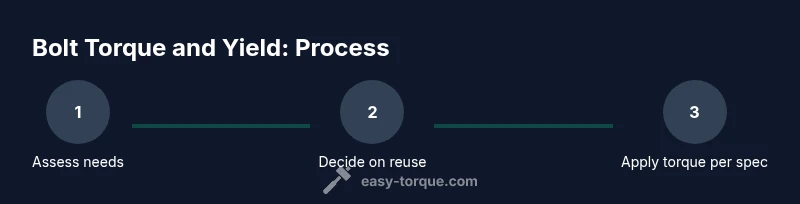
- 1
Identify bolt type and spec
Check the vehicle or equipment manual for the bolt grade, size, and the correct torque specification. Do not assume; verify the exact values from the official documentation.
Tip: When in doubt, contact the manufacturer or consult the service bulletin. - 2
Inspect the bolt and joint
Examine threads, shank, and head for wear, elongation, corrosion, or heat damage. If any defect is found, replace the fastener.
Tip: Use a thread gauge to confirm thread integrity before reuse. - 3
Decide on reuse vs replacement
If the spec calls for single-use or you observe any damage, replace with a new bolt. Do not reuse yield-prone fasteners.
Tip: Document the decision to reuse or replace for future maintenance records. - 4
Prepare threads and apply lubricant if required
Clean threads thoroughly and apply lubrication only if the torque spec requires it. Clean dry threads are common for many automotive bolts.
Tip: Avoid cross-threading by starting the bolt straight and hand-tightening first. - 5
Tighten to spec using correct pattern
Tighten in the recommended sequence (often a criss-cross or step pattern) to achieve even preload. If required, use an angle-tightening step after initial torque.
Tip: Double-check the torque after the entire sequence to ensure consistent preload. - 6
Cool and re-check
Allow the joint to cool if heat was involved and verify the torque again if the manual specifies a recheck after cooling.
Tip: Perform a post-installation inspection after operation starts. - 7
Record results
Document the bolt type, torque, and any observations for future maintenance references.
Tip: Keep a simple log with date, part numbers, and torque values.
Your Questions Answered
Can you reuse torque-to-yield bolts?
In most cases, no. TOY bolts are designed for one-time use; reusing them can significantly reduce preload and increase the risk of failure. Always replace with new fasteners and follow the official torque specs.
Usually not. TOY bolts are single-use by design; reuse risks joint failure. Replace with new bolts and torque as specified.
What is torque-to-yield?
Torque-to-yield is a method where tightening reaches the material's yield point and causes controlled deformation. It is used to achieve precise preload, but should be done only with bolts designed for this purpose and per manufacturer instructions.
Torque-to-yield reaches the material's yield point for precise preload, used only with approved bolts and specs.
How can I tell if a bolt has yielded?
Signs include visible permanent deformation, elongation, flange or head distortions, or a loss of clamping feel. If there is any doubt, replace the fastener.
Look for bending, stretching, or a loose joint. If unsure, replace it.
Are there cases where reuse is allowed?
Some non-critical joints may allow limited reuse with proper inspection and documentation, but most safety-critical applications require replacement. Always consult the service manual.
Only in rare, non-critical cases with explicit manual guidance; otherwise, replace.
What should I do in a brake or suspension joint?
Treat these as high-risk. Do not reuse bolts after removal. Use new fasteners and verify torque and pattern per the manual.
Brake and suspension bolts are high-risk—avoid reuse and torque per spec.
Watch Video
Top Takeaways
- Do not reuse torque to yield bolts.
- Replace yield-prone fasteners with new ones.
- Follow manufacturer torque specs and tightening patterns.
- Inspect for wear before reusing any bolt.