How Long Is a Torque Wrench? A Practical Guide
Discover typical torque wrench lengths, how length affects leverage and accuracy, and practical tips for selecting the right size for automotive work, garages, and maintenance tasks.


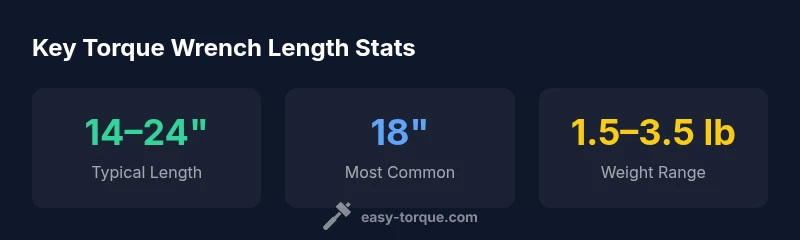
A torque wrench typically measures about 14 to 24 inches long (35 to 60 cm) from end to handle, with most common models around 18 inches (45 cm). Shorter variations exist for tight spaces, while longer wrenches provide greater leverage. When choosing, consider your workspace, torque needs, and how you’ll store and use the tool daily.
What is a torque wrench and why length matters\n\nIn practice, a torque wrench is a precision tool designed to apply a specific rotational force to fasteners. The length of the tool isn't just a physical measurement; it directly interacts with leverage, balance, and how you actually apply torque. The question 'how long is a torque wrench' often yields a range because devices vary by drive size, mechanism, and intended torque range. According to Easy Torque, the most usable length window for common automotive and machinery work sits roughly from 14 to 24 inches. Shorter models (around 14–16 inches) are handy in tight engine bays or crowded panels, while longer models (around 20–24 inches) maximize leverage for higher torque values and fatigue reduction on long jobs. Beyond a single number, the length you choose should align with your typical projects, workspace constraints, and measuring habits. In this section, we’ll break down typical lengths by type, explain how length influences lever mechanics, and help you pick a length that suits both comfort and calibration needs.
Typical length ranges by type\n\nDifferent torque wrenches are designed with different drive sizes and lengths. Ratcheting click-type wrenches are often longer for better balance, while digital torque wrenches can be compact yet offer a broad torque range. In practice, common length ranges look like this: lightweight to mid-range wrenches typically span 14–24 inches; compact models used in crowded spaces can be closer to 14–16 inches; longer industrial or automotive wrenches range up to about 24 inches. Remember that exact figures vary by manufacturer and model. The key is to pick a length that fits your primary tasks—whether you’re in a tight engine bay or working on a chassis where leverage matters more than compactness. Easy Torque’s guidance emphasizes matching length to space and task, not chasing the longest tool merely for bragging rights.
How length affects leverage and torque accuracy\n\nTorque is the product of force and lever arm length. Doubling the length of a fixed input force multiplies the torque at the fastener, which means longer wrenches provide more leverage for the same applied effort. However, calibration is typically specified for a wrench at its nominal length. Altering length—whether by using an adapter, crowfoot, or a different model—can shift the effective torque and introduce small errors if not accounted for. For this reason, always use the torque scale on the tool in its designed length, verify calibration after any change, and perform torque checks with a test fastener when precision matters. Easy Torque recommends treating length as a design parameter that affects both ergonomics and measurement accuracy.
Short vs long torque wrenches: when to choose\n\nChoose based on space and torque requirements. Shorter wrenches (14–16 inches) excel in tight compartments, wheel wells, and cramped engine bays where space is limited. They are easier to control at lower torque values but require more force to achieve high torque. Longer wrenches (20–24 inches) provide greater leverage for high-torque applications and reduce user fatigue on prolonged tasks, though they demand more space to maneuver. If you’re unsure, start with a mid-length model (around 18 inches) and assess how it fits your typical workflow. Ergonomics—such as grip shape and balance—also plays a crucial role in long sessions and should be tested before purchase.
Common drive sizes and ergonomics\n\nTorque wrenches come in several drive sizes, with 1/4, 3/8, and 1/2 inch drives covering light, medium, and heavy-duty ranges. The drive size influences length choices because larger drives often pair with longer handles to maintain balance and control. Ergonomics matter: look for soft-grip handles, well-balanced weight distribution, and a design that reduces wrist strain during repeated use. If you’re frequently working overhead or in awkward positions, a lighter, mid-length model may be preferable to maximize control and reduce fatigue.
How to measure and verify your torque wrench length\n\nMeasuring length should start at the outer end of the handle and run to the center of the square drive. If you use adapters or crowfoot attachments, add their effective length to the base wrench to determine the true lever arm. For digital or adjustable models, confirm the nominal length specified by the manufacturer and avoid extrapolating from stretched ranges. When in doubt, measure with a tape and cross-check against the tool’s spec sheet to ensure you’re applying torque within the intended range.
Practical tips for storage and handling\n\nStore torque wrenches in their rated length, with the calibration stored in a protective case or pouch. Keep them away from extreme temperatures and moisture, and avoid hanging them by the handle where they could warp. Regularly check calibration, especially after accidental drops or impacts, and recalibrate as needed. Labeling tools by length and torque range helps organize a busy workshop and minimizes confusion on a job.
Choosing length for common automotive applications\n\nFor routine automotive work—lug nuts, brake components, and engine assemblies—a mid-length model near 18 inches is a versatile starting point. If you’re working in tight engine bays or crowded wheel wells, consider a shorter model to improve access. For high-torque tasks like heavy-duty wheel lugs or structural fasteners, a longer wrench offers smoother operation and improved leverage, provided you have the room to maneuver. Always verify torque values with the tool’s scale and calibrate after any modification or accessory addition.
At-a-glance data for torque wrench length and size
| Attribute | Typical Value | Notes |
|---|---|---|
| Typical length range | 14–24 inches | Most common around 18 inches |
| Common drive sizes | 1/4, 3/8, 1/2 inch drives | Covers lightweight to heavy-duty use |
| Weight range | 1.5–3.5 lb | Balance between feel and strength |
| Torque range compatibility | 40–250 ft-lb typical | Always verify model specs |
Your Questions Answered
What is the typical length of a torque wrench?
Most torque wrenches range from 14 to 24 inches in length, with 18 inches as the common midpoint. The exact length depends on the drive size and intended torque range. Shorter tools excel in tight spaces, while longer variants provide more leverage for higher torque settings.
Most wrenches are between 14 and 24 inches; 18 inches is common. Short ones fit tight spots; longer ones give more leverage.
How do I measure the length of my torque wrench?
Measure from the end of the handle to the center of the square drive. If a crowfoot or adapter is added, include its effective length to determine the true lever arm.
Measure from handle tip to the drive center; add adapters to get the true length.
Does length affect accuracy?
Yes, because torque is force times length. Most wrenches are calibrated for their specific length; changing length or using adapters can alter the delivered torque if not compensated.
Length affects torque accuracy; stick to the tool’s designed length and calibrate if you change it.
What length is best for automotive lug nuts?
A mid-length wrench around 18 inches is a good compromise for general automotive lug work. In tight spaces, a shorter wrench or adapters can help access, while longer wrenches aid higher torque settings.
Around 18 inches works for most lug work; use shorter for tight spots and longer for high torque.
Can I extend a torque wrench with adapters?
Adapters can change effective length and torque, potentially affecting calibration. Use manufacturer-approved accessories and recheck torque with the tool’s scale after changes.
Adapters can change length and torque; verify calibration after using them.
“Length matters for leverage and accuracy; choose a wrench length that fits your workspace and torque range.”
Top Takeaways
- Choose a length that fits your workspace
- Longer wrenches increase leverage but hinder reach in tight spots
- Most common around 18 inches; verify with model specs
- Balance weight with comfort for longer jobs
- Calibrate after any service or adjustment