Torque Wrench 350 ft-lbs: Precision, Calibration, and Best Practices
Comprehensive guide to achieving and verifying 350 ft-lbs torque with the right torque wrench, including calibration, usage steps, common mistakes, and maintenance tips for reliable performance.


350 ft-lbs is a common target for heavy-duty automotive and industrial fasteners. Achieving this requires a calibrated torque wrench, correct bolt references, and strict adherence to manufacturer specs. Always verify your setting, use smooth, steady strokes, and re-check with a second pass if needed. This approach ensures the joint achieves the intended clamping force without over-torque.
Understanding 350 ft-lbs: what it means
350 ft-lbs is a torque specification widely used in automotive and industrial fastener assemblies. It represents the twist force you apply to a bolt or nut across its thread pitch and length, translating into clamping pressure in the joint. In practice, 350 ft-lbs is substantial: it’s strong enough to secure large fasteners on engine blocks, suspension components, and heavy machinery, yet precise enough for repeatable assemblies when the torque wrench is accurate. The key to success is using the right tool for the job. Not every bolt receives 350 ft-lbs; bolt size, material hardness, lubrication state, and thread engagement all influence the target. Always consult the vehicle or equipment service manual to confirm the exact torque, and verify with a test pass or torque-angle method if the fastener design permits. Temperature effects can also shift the effective clamping force in hot operating conditions, so consider ambient and operating temperature when planning a torque sequence.
Choosing the right torque wrench for 350 ft-lbs
When your goal is 350 ft-lbs, you want a wrench that stays accurate across that range and remains comfortable to use for repeated cycles. Click-type torque wrenches are the workhorse here: they provide a clean, audible indication when the target is reached and generally hold calibration well with routine maintenance. Beam wrenches offer a budget-friendly option, but readability and accuracy can suffer as you approach higher ranges. Digital torque wrenches add memory and data logging, which helps track consistency and record torque history for maintenance records but come at a higher upfront cost. Regardless of type, ensure the tool’s stated range comfortably includes 350 ft-lbs and that it has a verified calibration certificate. Consider the lever length and your reach; a longer handle can reduce user fatigue and improve precision on high-torque applications.
Calibration and verification basics
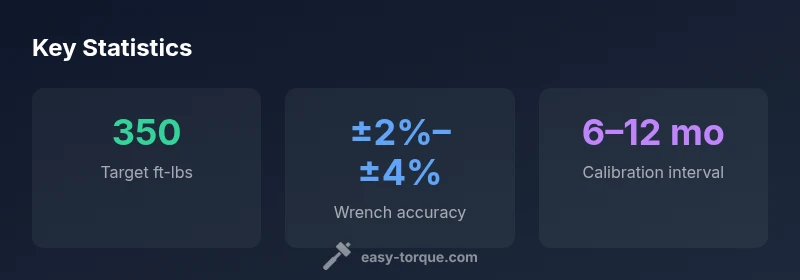
Calibration is the backbone of torque accuracy. For a 350 ft-lbs target, schedule regular calibration checks—typically every 6–12 months for personal shops or after heavy use in a professional setting. Use a certified torque test device or NIST-traceable calibrator to verify the wrench’s accuracy at multiple points near the 350 ft-lbs range. Never rely on non-dedicated torque checks or rough “feel” tests for critical joints. After calibration, re-check the wrench at 350 ft-lbs to ensure stability across the true working range. Environmental factors such as temperature, humidity, and lubricant condition can influence readings, so include these in your verification routine.
Step-by-step: hitting 350 ft-lbs safely
- Inspect the fastener and threads for damage; clean if necessary. 2) Set the wrench to 350 ft-lbs using the instrument’s calibration certificate as reference. 3) Start the snug torque in a smooth, continuous stroke—avoid sudden jerks. 4) When you hear/feel the established cue (click/buzzer), stop and hold for a moment to seat the fastener. 5) Back off slightly and re-torque to verify. 6) Re-check after a few cycles or after loosening and retightening in subsequent service intervals. 7) Record the torque event for maintenance logs if you’re monitoring long-term performance.
Common pitfalls and corrections
A common mistake is over-relying on the wrench without verifying calibration, leading to undershoot or overshoot at 350 ft-lbs. Other issues include using lubricants that change friction coefficients, neglecting thread damage, or failing to reset a digital wrench after a measurement. Keep clean threads, apply only the recommended lubricants, and re-calibrate on a schedule that matches usage intensity. If you suspect drift, retire the tool for a full calibration rather than attempting to compensate with “feel.” A strategic approach to torque control reduces retorque cycles and ensures joint integrity over time.
Maintenance for longevity and accuracy
Store torque wrenches in a protective case at a stable ambient temperature, not in hot vehicles or directly under sunlight. Wipe off lubricant residues and avoid exposure to corrosive environments. After use, release the tension setting to prevent spring fatigue and perform a light check against a known standard before the next job. Regular battery maintenance is essential for digital wrenches, including battery replacement and firmware updates when available. Document calibration dates, service intervals, and any observed drift; this data supports repeatable 350 ft-lbs tightening in critical assemblies.
Real-world scenarios: automotive and industrial applications
In automotive work, 350 ft-lbs commonly applies to engine components, heavy-duty suspension hardware, and some drivetrain fasteners. Industrial settings may use the same torque on large anchor bolts or equipment housings where consistent clamping is essential. The common thread across all these scenarios is repeatability: the same torque value, achieved with a calibrated tool, every time. In practice, teams often pair a torque wrench with a torque-angle gauge for added verification on high-stress joints, ensuring both torque and angular displacement meet design specifications. Keep clear, labeled torque logs for traceability and compliance.
How to convert 350 ft-lbs to Nm and other units
One foot-pound equals approximately 1.3558 newton-meters. Therefore, 350 ft-lbs is about 475 Nm (roughly 474.5–475 Nm in practical terms). For convenience, many manuals round to 475 Nm when converting to SI units. When documenting torque, note both units if your team uses metric fasteners or if the project spans international facilities. Understanding these conversions improves communication with suppliers and technicians who rely on metric torque charts.
Torque wrench types for 350 ft-lbs applications
| Wrench Type | Typical Torque Range | Best For | Pros and Cons |
|---|---|---|---|
| Click Torque Wrench | 20-600 ft-lbs | General-purpose, precise control | +Audible cue; -Requires occasional calibration |
| Beam Torque Wrench | 2-150 ft-lbs | Budget-friendly, simple | -Harder to read at high end; -No audible cue |
| Digital Torque Wrench | 2-1000 ft-lbs | Data logging, ease of use | -Battery dependent; -Higher cost |
Your Questions Answered
What does 350 ft-lbs mean in practice?
It signifies the clamping force achieved by the fastener under the specified conditions. The actual load depends on bolt size, lubrication, and thread engagement. Always refer to the service manual and confirm with a verification pass.
350 ft-lbs indicates the clamp force on a fastener; always check the manual and verify with a test pass.
Can I reach 350 ft-lbs with a basic wrench?
Yes, with a wrench that covers the 350 ft-lbs range and is properly calibrated. Basic wrenches can work, but ensure calibration and readability are adequate for accurate torque.
Yes, as long as the tool covers that range and is calibrated correctly.
How often should I calibrate my torque wrench?
Calibration should be performed regularly based on usage. A typical schedule is every 6–12 months for light to medium use, or after heavy use in professional settings.
Calibrate at least once a year, or sooner if you use it heavily.
Is 350 ft-lbs safe for all large bolts?
Not all bolts are rated for 350 ft-lbs. Always check the specific bolt grade, lubricant state, and manufacturer torque specs to prevent over-tightening or bolt damage.
Only torque bolts to the manufacturer’s spec; 350 ft-lbs isn’t universal for all large bolts.
What mistakes should I avoid when torquing to 350 ft-lbs?
Avoid over-tightening due to poor technique, neglecting calibration, misreading the scale, and failing to re-torque after loosening. Keep threads clean and use the correct lubricant if required.
Don’t rush, check calibration, and re-torque after any loosening.
Do metric wrenches work in ft-lbs?
You can convert between units, but always use the appropriate scale on your wrench or a conversion chart. Many metric wrenches provide Nm, which you can convert to ft-lbs as needed.
Convert Nm to ft-lbs or use a wrench that supports both units.
“Consistent 350 ft-lbs tightening comes from accuracy, discipline, and routine maintenance; tools are only as reliable as the user’s commitment to calibration.”
Top Takeaways
- Plan around the exact bolt specification before tightening
- Choose a wrench with a range that includes 350 ft-lbs and a proven calibration history
- Periodically calibrate and verify with a torque tester to prevent drift
- Use smooth, controlled strokes and re-check after initial torque
- Maintain your tools to preserve accuracy over time