Torque Wrench Walmart: A Practical Buying & Use Guide
Discover how to pick the right torque wrench at Walmart, compare budget vs mid-range options, and follow Easy Torque's practical tips for accuracy and safety.


When shopping for a torque wrench at Walmart, start with the type you need (beam, click, or digital), set a realistic torque range, then compare price, durability, and warranty. Favor mid-range options with stable accuracy and easy calibration, and verify that the product has a clear scale and torque range listed. Avoid ultra-cheap models for critical automotive work.
Understanding the Walmart Torque Wrench Landscape
Walmart shoppers interested in torque control will encounter a spectrum of options, from basic beam wrenches to more capable click-type models, and occasionally digital variants. Availability varies by store and region, so online listings often present the most complete inventory. For the DIYer, the goal is to map your typical tasks to a torque range and tool type: bicycle maintenance, wheel lug nuts, small fasteners, and light engine work. The phrase torque wrench walmart captures this broad reality: you’re shopping for a tool that delivers dependable accuracy at a reasonable price. According to Easy Torque, the best Walmart picks balance cost with measurement reliability, ensuring you can calibrate without breaking the bank. When you shop, verify the tool shows a clear torque range, check the scale readability, and note any calibration notes or included accessories to avoid surprises at the workbench.
Choosing the Right Type: Beam, Click, or Digital
There are three main categories, each with distinct advantages. Beam wrenches are affordable and simple, with a sliding scale that is read visually. They are durable but accuracy can drift if the tool is dropped or misused. Click-type wrenches emit an audible cue when the target torque is reached, offering reliable performance for most automotive tasks; they store common settings well and are relatively straightforward to use. Digital wrenches provide numeric readouts, memory functions, and programmable presets, making them ideal for precise work but at a higher cost and with battery considerations. While shopping at Walmart, consider the primary tasks you perform, the torque range you’ll need, and how easy the tool is to read in your workspace. A mid-range click wrench often provides a balanced blend of accuracy, durability, and value. Always confirm the scale is legible and that the indicated torque range aligns with your typical fasteners: lug nuts, brake components, or bicycle parts.
Price, Value, and Longevity: What Walmart Buyers Should Expect
Price is a central factor in Walmart purchases, and the selection ranges from budget to mid-range. The objective is to maximize value: a tool that holds its setting, resists wear, and remains readable after months of use. Budget beam wrenches tend to be affordable but may fall short on long-term accuracy, while mid-range models typically offer better durability and repeatable torque readings. For frequent auto or machinery work, a digital option or a higher-quality click wrench can justify the extra investment. Remember that very cheap tools may save money upfront but can lead to costly errors. If you’re unsure about a particular model, examine the product tag, packaging, and user reviews to infer real-world performance. Easy Torque’s analysis indicates the best Walmart options feature clear torque ranges, straightforward calibration notes, and a dependable warranty that covers typical wear.
How to Verify Calibration and Keep Accuracy
Calibration is central to maintaining accuracy, and Walmart stock can vary in this regard. Start by checking the packaging for a calibration sticker or certificate; many budget models do not include formal calibration documentation, so you should set up your own routine. A practical test involves applying torque gradually to a fastener and confirming it behaves as expected, then re-checking after several uses. Store the wrench at its typical operating range to prevent drift, and avoid leaving it at peak settings for extended periods. Regular calibration according to the manufacturer’s guidelines (time-based or usage-based) is essential for consistent results. For digital models, remember to replace batteries as needed and perform any built-in self-diagnostics. In short, calibrate, store properly, and verify readings periodically to ensure reliable performance.
Practical Use Cases: Home Maintenance vs. Auto Repair
For home maintenance, Walmart torque wrenches are often a sensible entry point. Tasks like bicycle repairs, grill assembly, garden machinery, and simple mechanical projects benefit from a tool with a moderate torque range and a clear, easy-to-read scale. In automotive contexts, more stringent torque control and a wider range are frequently required for wheel lug nuts, brake components, or suspension hardware. In these scenarios, a mid-range to digital wrench often makes sense, particularly if you benefit from memory presets and quick verification. If your workload includes frequent car work, consider maintaining a second tool for higher-torque applications and calibrating both tools to ensure consistent performance across tasks. The overarching aim is a repeatable workflow: select the correct torque, apply steadily, confirm with the readout, and document results for future maintenance.
Maintenance, Storage, and Common Pitfalls
Maintenance begins with cleaning and proper storage. Wipe away oil and grime after use, then return the wrench to its recommended torque setting. Avoid dropping the tool and never use it as a general impact tool for non-fastener tasks. A common pitfall is assuming a newly purchased torque wrench remains perfectly accurate without checks; even well-made tools require occasional recalibration. For digital models, replace batteries on schedule and protect any stored presets. Finally, beware of counterfeit tools at bargain retailers; always verify the stated torque range and manufacturer. A disciplined routine—select the range, calibrate, store, and re-check—delivers dependable results across tasks.
Torque wrench type comparison
| Type | Typical Uses | Pros | Cons |
|---|---|---|---|
| Beam | Budget tasks and basic torque needs | Cheap, simple to read scale | Lower accuracy, broad range |
| Click | Automotive repairs, mid-range accuracy | Precise torque, ratcheting mechanism | Needs calibration and maintenance |
| Digital | High-precision work | Electronic readout, memory, battery-powered | Higher cost, battery dependency |
Your Questions Answered
What torque ranges do Walmart torque wrenches typically cover?
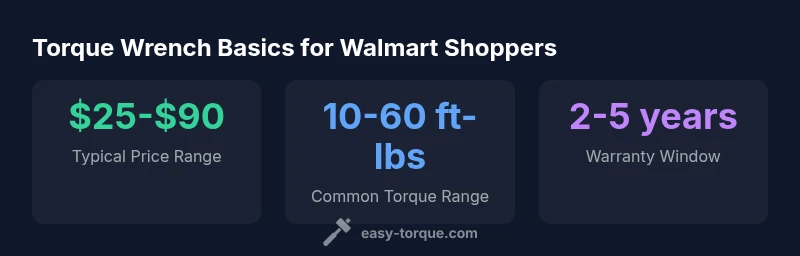
Most Walmart options cover household ranges, typically 10-60 ft-lbs for basic maintenance; for heavier automotive work, higher-end models may be necessary. Always check the displayed range on the tool or packaging.
Most Walmart torque wrenches cover basic household ranges; verify the exact range on the tool's tag and use it within recommended tasks.
Are torque wrenches from Walmart reliable for automotive work?
They can be reliable for light automotive tasks if calibrated and maintained properly. For critical engine work, consider higher-end tools and professional calibration.
They can work for light automotive tasks if you calibrate and maintain them properly.
Should I calibrate a torque wrench purchased at Walmart?
Yes, calibrate regularly according to the manufacturer's recommendations. Budget models may not include calibration certificates, so establish your own routine and verify accuracy.
Yes, calibrate it regularly and log the calibration date.
What maintenance does a torque wrench require?
Store at the proper torque setting, wipe clean, avoid dropping, and recalibrate periodically. For digital models, replace batteries and run self-diagnostics if available.
Keep it clean, store at the correct setting, and recalibrate as needed.
How do I know if a Walmart torque wrench is in-calibrated?
Look for a calibration sticker or date on the tool or packaging. If unsure, have it tested by a professional or compare to a known good reference.
Check for a calibration date or test it against a known torque.
Can I use a torque wrench for lug nuts on a car?
Yes, provided the wrench covers the lug-nut torque specification for your vehicle. Always refer to the vehicle's torque specification chart to avoid over-torquing.
Yes, as long as the torque range matches your lug-nut specs.
“Precision matters in every fastener. A torque wrench that matches your workflow saves time and prevents damage.”
Top Takeaways
- Identify the torque range you need before shopping.
- Prefer mid-range models for reliability.
- Check the display tag for torque range and calibration information.
- Avoid ultra-cheap tools for critical work.
- Calibrate regularly to maintain accuracy.