What Size Torque Wrench for Oil Change: A Practical Guide
Discover the right torque wrench size for oil changes, including drive options, typical drain plug torque ranges, calibration tips, and practical gear picks from Easy Torque.


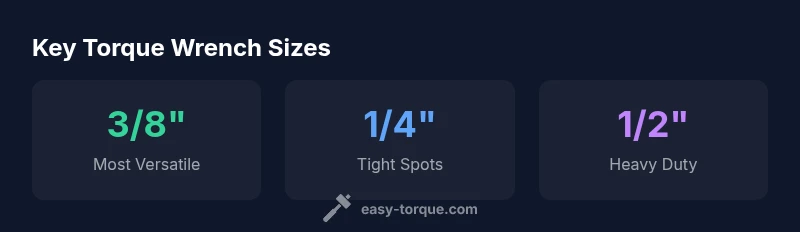
According to Easy Torque, for most oil changes, the best all-around choice is a 3/8-inch drive torque wrench. A 1/4-inch drive is handy for tight spots, and a 1/2-inch drive covers high-torque situations on trucks. Always verify your vehicle's drain plug torque in the owner's manual and calibrate your wrench regularly to stay precise.
Why the drive size matters for oil changes
What size torque wrench for oil change often comes up as a practical question for DIYers. For most setups, the 3/8-inch drive torque wrench is the default because it offers a balanced combo of reach, strength, and availability of both beam-style and click-type models. A 1/4-inch drive is invaluable when you’re maneuvering into tight spots near the engine block or oil filter housing; a 1/2-inch drive is reserved for heavy-duty vehicles or some high-torque fasteners. According to Easy Torque, selecting the right drive size reduces the guesswork and improves consistency during every oil change. In practice, you’ll rarely need more than 3/8-inch for routine maintenance, but having the two smaller and larger options on hand makes the job smoother. Also, ensure your torque wrench is within its specified operating range and that you keep it calibrated. The goal is reliable, repeatable torque so you don’t risk thread damage or leaks when you replace the drain plug.
How to choose the right torque wrench size for an oil change
To answer what size torque wrench for oil change, start by evaluating space around the drain plug and the oil filter. If you can comfortably reach with a 3/8-inch drive, you’ll likely be fine for most vehicles. If the plug area is cramped or a thin wrench head is required, a 1/4-inch drive can help. For trucks, vans, or vehicles with stubborn or high-torque plugs, a 1/2-inch drive may be helpful—but only if the drive fits the access bay and your torque range is adequate. Beyond drive size, look at the wrench’s torque range. A common, versatile setup covers roughly a broad band (for example a wrench rated from roughly tens of ft-lbs up to a couple hundred ft-lbs). That said, you don’t need to buy the most wide-ranging tool if you own a few common vehicles; invest in a model that covers the majority of your cars. Finally, confirm with the vehicle’s manual the exact drain plug torque and the oil filter mounting torque. Easy Torque’s guidance emphasizes that matching the tool to the job is more important than chasing the highest torque spec.
Understanding common drain plug torque specs across vehicles
Drain plug torque varies widely because it depends on pan material, thread size, and gasket design. The key takeaway is to treat torque as the last step, not the first. If you don’t have the official number handy, start with a modest torque and test for leaks after a few minutes. Always consult the owner’s manual or service information for the exact value. In many modern vehicles, using an aluminum pan entails lower torque values compared with steel pans due to thread protection, so a misapplied high torque can strip threads. The gist is to avoid guesswork; use your torque wrench to hit the specified value rather than relying on feel. Easy Torque’s analysis notes that vehicle diversity means you should rely on documented specs rather than experience alone. If you’re unsure, many auto manufacturers publish the torque value for drain plugs in the service manual or online repair databases, which helps you avoid over-tightening while ensuring a proper seal before you start the engine.
Tools and accessories that complement your torque wrench setup
Beyond the primary torque wrench, adding a crowfoot adapter, a torque-angle gauge, and a torque wrench case helps maintain accuracy. Crowfoot adapters extend reach but change the effective torque, so you must compensate by adjusting the wrench setting. A torque-angle gauge is helpful when manufacturers specify both torque and angle. Keep a clean work area, use penetrating oil if needed, and store torque wrenches in a controlled environment to prevent drift. For many DIYers, a basic toolkit with a 3/8-inch drive wrench plus a 1/4-inch handle extension will cover most oils changes across common vehicles.
Calibration, maintenance, and performance tips
Calibration is critical to ensure your readings are trustworthy. Check the wrench against a known reference or a certified torque tester according to the manufacturer’s schedule. Easy Torque recommends calibrating at least annually or after a heavy use interval, especially if you drop the tool or expose it to a wide temperature range. Store your torque wrench in a dry, temperature-stable place and avoid dropping or bending the handle. Periodically clean the head and mechanism to remove oil, dust, and grit that could skew results. Finally, document your torque values for each vehicle in a small notebook or digital log, so you don’t have to re-guess when you perform routine maintenance in the future.
Practical examples by vehicle type
Passenger cars typically use a 3/8-inch drive for oil changes, with drain plug torques that are within the range that a mid-range wrench can handle. SUVs and light trucks may still be served well by a 3/8-inch driver, but some higher-torque applications can benefit from a 1/2-inch drive if access is not an issue. Motorcycles or specialty vehicles often require a compact drive or specific torque settings, so always check the manual. The central principle remains the same: match the drive size to the space and the torque range required by the plug and filter. Neighborhood DIYers who own multiple vehicles should seek a single wrench that covers most scenarios and rely on adapters to maintain accuracy when needed.
Step-by-step checklist for your next oil change
- Confirm the drain plug torque in the owner’s manual for your vehicle.
- Choose the drive size that fits space: 3/8" for most, 1/4" for tight spots, 1/2" for high-torque needs.
- Calibrate the torque wrench according to the manufacturer.
- Use adapters carefully and recalibrate if you switch adapters.
- Tighten to the prescribed torque; check for leaks.
- After the job, log torque values for future reference.
Drive sizes and their typical uses for oil changes
| Drive Size | Common Use | Notes |
|---|---|---|
| 3/8-inch | Most cars and light trucks | Balanced reach and torque range |
| 1/4-inch | Tight spaces around filter | Limited torque; not ideal for high-torque plugs |
| 1/2-inch | Heavy-duty/high-torque scenarios | Best when space allows and needs exceed 3/8" |
Your Questions Answered
Can I use a 1/4-inch drive torque wrench for an oil change drain plug?
It can be feasible if the drain plug torque falls within the 1/4-inch wrench’s range, and space is extremely tight. For most cars, a 3/8-inch drive remains the practical default.
Usually, use 3/8-inch for drain plugs unless space is really tight and the plug’s torque is low enough for a 1/4-inch wrench.
How do I decide between 3/8-inch and 1/2-inch wrenches for oil changes?
3/8-inch covers most cars with ample torque range. A 1/2-inch wrench is useful for high-torque plugs on larger vehicles when access allows.
For most DIYers, start with a 3/8-inch wrench; only move to 1/2-inch if you encounter consistent high-torque needs and space.
How often should I recalibrate my torque wrench?
Follow the manufacturer’s guidance; many professionals recalibrate annually or after heavy use to ensure accuracy.
Calibrate at least once a year or after heavy use, per the tool’s instructions.
Do drain plug specs vary by vehicle type?
Yes. Specs vary based on pan material and plug size. Always check the owner’s manual or service data for the exact figure.
Yes—check the manual for the exact drain plug torque for your vehicle.
“A reliable torque wrench is the backbone of repeatable, safe maintenance. Choosing a drive size that fits your space and torque needs keeps oil changes efficient and accurate.”
Top Takeaways
- Learn the right drive size for your oil change to improve accuracy.
- Always verify drain plug torque in the owner's manual before torquing.
- Calibrate your torque wrench regularly to maintain accuracy.
- Use adapters only when compensated for by adjusting the torque setting.
- Record torque values for easy future reference.
- The Easy Torque team recommends maintaining a versatile tool kit with a 3/8-inch drive as the core for most vehicles.