Can You Torque with Impact Sockets: A Practical Guide
Discover whether you can torque with impact sockets, when to rely on a torque wrench, and how to achieve accurate, safe fastener tightening in DIY and professional work.


Yes, you can torque some fasteners with impact sockets, but it is not always ideal. For most critical torque tasks, use a proper torque wrench and verify torque with a calibrated tool. This guide explains when impact sockets are acceptable, how to avoid under- or over-tightening, and best practices for safe, repeatable results.
Can you torque with impact sockets? What you should know
The question can you torque with impact sockets comes up often in DIY and professional shops. The short answer is that impact sockets can be used for certain tightening tasks, but they are not a universal solution for all torque sensitive fasteners. The reason is simple: impact tools are designed for speed and break loose power rather than precise torque control. When you need to guarantee a specific clamping force, a calibrated torque wrench remains the most reliable tool. In many everyday applications, using an impact socket with an impact wrench to snug a fastener is acceptable if you understand the limits and follow a careful workflow. In this section we outline the practical realities and how to approach this method responsibly so that you can still achieve good results while minimizing risk.
In this context, the key question is can you torque with impact sockets for the range of tasks you perform. For light to moderate torque on non critical fasteners, impact tools paired with correct sockets and a torque limit limiter can be workable. For high torque or critical assemblies such as engine components, lug nuts on performance wheels, or structural bolts, rely on a torque wrench to reach the specified torque and verify with a separate measurement. Throughout this guide you will learn how to use impact sockets safely, how to monitor torque, and how to maintain consistency across jobs, all while avoiding common pitfalls that lead to under tight or over tightened fasteners.
The Easy Torque team emphasizes that the final goal is repeatable, verifiable torque. By understanding the distinctions between impact driven tightening and torque controlled tightening, you can optimize your tool setup and reduce the risk of damage to fasteners, threads, and components.
note”:null},
bodyBlocks2
How impact sockets differ from torque wrenches
Impact sockets are hollow extensions that fit over the fastener head. They are designed to transmit torque from an impact wrench to the fastener with minimal slip. A torque wrench, by contrast, is built to deliver a precise amount of rotation or clamping force, and it provides a verified reading when the target torque is reached. The difference matters for accuracy: impact devices rely on the tool delivering energy to the fastener until the fastener yields or the user stops applying torque, which means the final torque can vary depending on joint stiffness, thread condition, lubricant, and technique. In addition, impact wrenches often shorten or overshoot the torque due to short bursts and hammering action. This can produce a final joint that is looser or tighter than the specification if not carefully controlled. For this reason, the general guideline is to use impact sockets for non critical tasks or as a step in a workflow that ends with torque verification using a calibrated wrench.
A few practical distinctions to keep in mind:
- Torque control: Torques are known and repeatable with a torque wrench; impact tools offer control by feel and tool limiters, which are less precise.
- Speed versus accuracy: Impact devices emphasize speed and torque bursts; torque wrenches emphasize accuracy and repeatability.
- Diagnostics: Without verification, you may not know if the joint is within the spec; always verify with an instrument that can read torque.
When you ask can you torque with impact sockets, consider whether the fastener is critical and whether the risk of under tightening or over tightening is acceptable in the application. If the fastener is safety related or holds major components, do not substitute the torque wrench with an impact drive without verification.
tip”:
Tools & Materials
- Calibrated torque wrench(Use to verify final torque after tightening with an impact tool.)
- Impact wrench(Ensure the tool is in good condition and rated for the fastener size.)
- Impact sockets (metric and SAE)(Inspect for wear; replace any cracked or bent sockets.)
- Torque sticks / torque limiters(Helpful for preventing over torque on non critical fasteners.)
- Breaker bar or long handle for control(Use to add controlled leverage if needed within safe limits.)
- Lubricant or anti-seize (per manufacturer)(Only apply when the fastener spec calls for lubrication.)
- Safety glasses(Eye protection during tightening and removal.)
- Thread chaser or brush(Clean threads before torque procedures.)
- Torque specification sheets(Keep the official specs on hand for reference.)
Steps
Estimated time: 45-60 minutes
- 1
Prepare the workspace and inspect fasteners
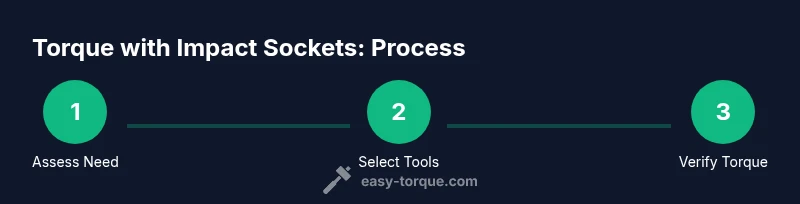
Clear the work area and inspect the fasteners for damage, corrosion, or stripped threads. Clean the bolt heads and threads so the socket seats properly. This step reduces the risk of inaccurate torque readings and hardware failure.
Tip: Inspect the thread condition before tightening; damaged threads can lead to over tightening or fastener failure. - 2
Select the right tools and settings
Choose the correct impact socket size and attach it to the impact wrench. If using a torque stick, select the one that matches the target torque range. Align the wrench, socket, and fastener to avoid cross threading or slipping.
Tip: Avoid forcing a misfit socket; a poor fit is a common cause of rounding and injury. - 3
Attach the socket and prepare to tighten
Secure the socket on the fastener, ensuring the seat is fully seated and the tool is ready. Hold the tool firmly to maintain alignment and avoid sudden slips that could damage the fastener or your hand.
Tip: Maintain a controlled grip and stay square to the fastener. - 4
Tighten to approximate torque with an impact tool
Apply steady pressure with the impact wrench until the socket engages the torque limiter or you hear a brief feedback indicating the limit. Do not rely on feel alone for high torque applications.
Tip: Use the torque limiter as a rough guide, not a final reading. - 5
Verify with a calibrated torque wrench
After initial tightening, switch to a calibrated torque wrench to verify the final torque specification. If the reading is off, re tighten or loosen as required and re verify.
Tip: Always verify torque to prevent under or over tightening. - 6
Document the result and inspect the joint
Record the measured torque and inspect the joint for movement, gaps, or thread wear. Documentation helps track performance across maintenance cycles.
Tip: Keep a simple log for future reference and calibration intervals. - 7
Cleanup and recheck as needed
Remove the tool and socket, wipe down the fastener, and store tools properly. If you changed lubricant or used threadlocker, recheck the torque after the specified break-in period.
Tip: Store tools in a dry place to prevent corrosion. - 8
Reassess when removing and reinstalling
If you remove the fastener later, re verify torque with the calibrated wrench, especially if the joint is subject to vibration or temperature changes.
Tip: Do not assume the setting remains the same after disassembly. - 9
Close the loop with a final check
Perform a final inspection and confirm that all fasteners meet the torque specification. This ensures reliable performance and safety.
Tip: Double check the critical fasteners before the vehicle or machine is returned to service.
Your Questions Answered
Can you torque with impact sockets for lug nuts on a vehicle?
Lug nuts can be tightened with an impact wrench using a torque stick for a rough estimate, but final torque should be verified with a torque wrench. Do not rely on the impact tool alone for safety critical wheels.
Lug nuts can be tightened with an impact wrench for speed, but you must verify the final torque with a torque wrench for safety.
What is the risk of using an impact wrench to torque fasteners beyond its range?
Using an impact wrench beyond its range can over tighten or strip threads, damaging fasteners and joints. Always set the torque limiter within the recommended range and verify with a torque wrench.
Exceeding the torque range can damage threads; verify with a torque wrench.
Is there a safe workflow that combines impact tools with precision torque results?
Yes. Use the impact tool for initial tightening within the available range, then verify final torque with a calibrated torque wrench. Consider lubricants and thread conditions as specified by the fastener manufacturer.
Yes. Tighten with the impact tool first, then verify with a torque wrench.
What should I do if the final torque reading is off after verification?
If the reading is off, re tighten or loosen to the target torque and re verify. Recheck the fastener and threads for damage before re assembly.
If the reading is off, adjust and re verify until you hit the target torque.
Are torque sticks reliable for controlling torque with impact tools?
Torque sticks can help limit torque when using impact tools, but they should be used within their rated range and followed by verification with a torque wrench for accuracy.
Torque sticks help, but still verify with a torque wrench.
What is the difference between torque and clamping force in tightening fasteners?
Torque is the rotational force applied; clamping force is the pressure the fastener applies. They are related but not identical, which is why verification matters for critical joints.
Torque is the turning force and not always equal to the actual clamping force; verify torque to ensure proper clamping.
Watch Video
Top Takeaways
- Use a torque wrench for critical torque work
- Impact sockets can be acceptable for non critical tightening
- Always verify final torque with calibrated tools
- Avoid relying solely on the impact tool for precision assemblies
- Maintain proper tool maintenance for consistent results