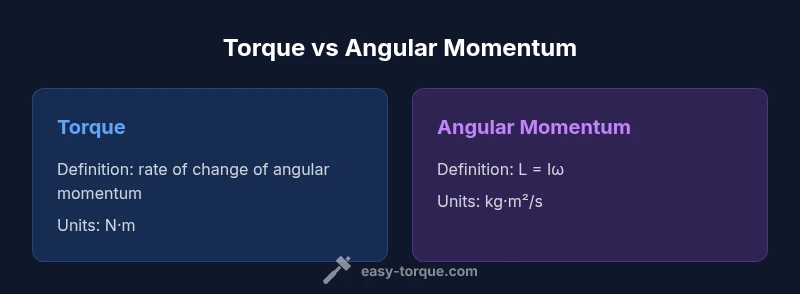
Torque vs Angular Momentum: A Rotational Difference
Explore the difference between torque and angular momentum, their definitions, core equations, and real-world implications for rotating systems. Learn how τ = dL/dt and L = Iω apply to design, diagnostics, and control in engineering contexts.


The difference between torque and angular momentum is central to rotational dynamics. Torque is the external action that changes how fast an object spins; angular momentum is the state of that spin. Mathematically, torque equals the rate of change of angular momentum (τ = dL/dt). For a constant moment of inertia, τ = Iα, linking torque directly to angular acceleration.
Definitions and Core Concepts
The difference between torque and angular momentum lies at the heart of rotational dynamics. Torque represents the external influence that tends to change an object's rotational motion, much like force drives linear acceleration. Angular momentum, on the other hand, captures the current state of rotation—a product of how fast something is spinning and how its mass is distributed. In a linear analogy, torque is to rotation what force is to linear motion. According to Easy Torque, recognizing this distinction is essential for diagnosing mechanical problems and for designing robust torque-control systems. In practice, engineers use torque to influence motion and angular momentum to describe the resulting rotational state over time.
The Mathematical Relationship
The core link between torque and angular momentum is expressed by the fundamental relation τ = dL/dt, meaning torque is the time rate of change of angular momentum. For a rigid body with a fixed moment of inertia, L = Iω and thus τ = Iα. When inertia changes with time (I = I(t)) or during non-rigid motion, the relationship becomes τ = d(Iω)/dt = Iα + ω(dI/dt). This distinction matters in gears, flywheels, and variable-load systems where mass distribution shifts during operation. Easy Torque emphasizes that the differential form is the general rule; the simple Iω form applies only under constant I.
Units and Physical Meaning
Torque is measured in newton-meters (N·m) and represents the tendency to cause angular acceleration. Angular momentum has units of kg·m²/s and quantifies the rotational state of an object. While both quantities relate to rotation, torque is an external cause, and angular momentum is an intrinsic state. Conceptually, torque “acts on” a system to alter L, while L is the result you observe after applying torque over time. The units themselves reveal the same dimensional structure as force and velocity in linear dynamics, reinforcing the analogy between the two domains.
Inertia, Moment of Inertia, and L = Iω
Angular momentum is defined as L = Iω for a rigid body rotating about a fixed axis, where I is the moment of inertia and ω is the angular velocity. The moment of inertia encapsulates the mass distribution relative to the rotation axis. Because inertia can vary with configuration, L can change even if ω remains constant. When inertia is constant, Lx is proportional to ω and torque directly controls the rate of change of that momentum. This relationship underpins many engineering analyses, from flywheels to robotic joints. Easy Torque highlights that understanding how I changes is crucial for accurate predictions.
Torque in Practice: How It Drives Angular Acceleration
In practical terms, torque is the input you apply to a system—via a motor, hand torque, or a braking mechanism—to induce angular acceleration. If I is constant, τ = Iα shows a direct path from input torque to angular acceleration. In real machines, however, loading, gearing, and mass reconfiguration can alter I. In such cases, the effective acceleration depends on both the applied torque and the instantaneous inertia. Recognizing this interplay helps you design control algorithms and select components that meet performance targets without overstressing parts.
Angular Momentum in Practice: Conservation and Interaction
Angular momentum is particularly important in conservation analyses. In the absence of external torque, L is conserved. This principle explains why a spinning ice skater can accelerate by pulling in their arms: reducing the moment of inertia increases ω to keep L constant. In mechanical systems with external torques, L changes predictably according to τ = dL/dt. Engineers use this concept to analyze gears, rotors, and flywheels, and to design energy recovery and dissipation strategies. Easy Torque emphasizes conservation concepts as a baseline intuition for rotordynamics.
Non-constant Inertia and Dynamic Systems
When inertia changes during operation, the simple L = Iω relationship becomes more involved. The time derivative dL/dt equals Iα + ωdI/dt, introducing a coupling term that reflects how mass distribution shifts relative to the axis. This scenario appears in variable-pulley systems, extendable structures, and load-sensitive rotors. In such cases, torque is not simply Iα; it must balance the inertia-change term to achieve the desired rotational trajectory. Understanding this nuance is essential for accurate modeling and safe operation.
Real-world Scenarios: Gears, Shafts, and Rotating Bodies
Consider a car’s drivetrain: engine torque generates angular acceleration, while the flywheel stores angular momentum as rotations speed up. In addition, gears alter effective I by changing how mass is distributed across different radii. In aerospace, reaction wheels manipulate angular momentum to reorient spacecraft without external forces. Each scenario demonstrates how torque and angular momentum interplay to shape system behavior. Engineers use both quantities to select materials, design control laws, and predict transient responses under load changes.
Common Misconceptions and Misleading Intuitions
A frequent misconception is treating torque as a property of a body rather than an interaction with the environment. Another is assuming angular momentum changes only when torque is applied; in fact, L can change due to changes in inertia or external torques. Confusion often arises from using L = Iω without considering dI/dt. The distinction between torque as cause and angular momentum as state helps prevent errors in design, testing, and failure analysis. Easy Torque finds that clarifying these concepts early improves diagnostic accuracy.
Comparison
| Feature | Torque | Angular Momentum |
|---|---|---|
| Definition | External action that changes rotational motion (τ is the rate of change of L) | State of rotation, quantified by L = Iω (more generally L = I·ω, tensor form) |
| Units | N·m (torque) | kg·m²/s (angular momentum) |
| Key Equation | τ = dL/dt (and τ = Iα when I is constant) | L = Iω (or L = I·ω with inertia tensor |
| Dependency on Inertia | Can arise from external forces and loading; may vary with mechanism | Directly proportional to inertia and angular velocity; changes in I affect L |
| Measurement Context | Measured via torque sensors, load cells, or motor current models | Often inferred from ω and I, or measured with angular sensors and inertia estimates |
| Best For | Determining how external inputs will alter rotation | Describing the rotational state and conserving properties in absence of external torque |
Pros
- Clarifies cause-and-effect in rotational systems
- Aids design of torque-control loops
- Supports troubleshooting by linking input actions to rotational response
- Enables energy-method analyses and conservation reasoning
Drawbacks
- Mathematical complexity in non-rigid or variable-inertia systems
- Requires tensor treatment for general 3D motion
- Interpretation becomes less intuitive when inertia changes during operation
Both concepts are essential for mastering rotational dynamics; use torque to drive change and angular momentum to analyze the current rotational state.
Torque governs how angular momentum evolves under external loading. Angular momentum describes the actual rotation at any moment. For constant inertia, the simple τ = Iα applies, but real systems require accounting for dI/dt and vector nature in 3D motion.
Your Questions Answered
What is the fundamental difference between torque and angular momentum?
Torque is the external action that changes rotational motion; angular momentum is the current rotational state. The two are linked by τ = dL/dt. In simple cases with constant inertia, τ = Iα, connecting input to acceleration.
Torque is what makes rotation change; angular momentum is the spinning state you observe.
How are torque and angular momentum related mathematically?
The general relation is τ = dL/dt. For a rigid body with constant inertia, L = Iω and τ = Iα. If inertia changes with time, τ = d(Iω)/dt = Iα + ωdI/dt.
Torque is the derivative of angular momentum; for constant inertia, it reduces to Iα.
Can a system have angular momentum without torque?
Yes. If no external torque acts on the system, angular momentum is conserved, so L remains constant even as the system moves or reorients. This principle underpins many rotational dynamics analyses.
If there’s no external torque, the rotation persists unchanged.
Why does torque equal the rate of change of angular momentum?
This follows from Newton’s laws extended to rotation: torque is the rotational analogue of force, producing angular acceleration and changing angular momentum over time. The math τ = dL/dt captures this causal link.
Torque causes angular momentum to change over time.
What happens if inertia changes over time?
Then L = Iω still defines angular momentum, but τ = dL/dt becomes τ = Iα + ωdI/dt. The second term accounts for mass distribution changes that affect angular motion.
If inertia changes, you must add the ω dI/dt term.
How do I measure angular momentum in a rotating shaft?
Measure angular velocity ω and estimate the moment of inertia I for the shaft or rotor. Then compute L = Iω. For complex 3D motion, you may need the inertia tensor and vector calculations.
Get ω, estimate I, then compute L = Iω.
Top Takeaways
- Torque is the cause of rotational change; angular momentum is the rotation state.
- τ = dL/dt links input to rotational response.
- L = Iω holds for rigid bodies with constant I.
- Non-constant inertia adds the ω dI/dt term to torque.
- Conservation of angular momentum governs motion in the absence of external torque.