Difference Between Torque and Speed: An Analytical Guide
An analytical guide that dissects the difference between torque and speed, explains their relationship through power, and shows how to measure and optimize them in engines, tools, and machinery.


The difference between torque and speed is fundamental to how rotating systems perform. Torque measures turning force; speed measures how fast the shaft rotates. Together they define power via P = τω, and gear ratios let designers trade torque for speed to match performance goals.
Defining the core quantities: torque and speed
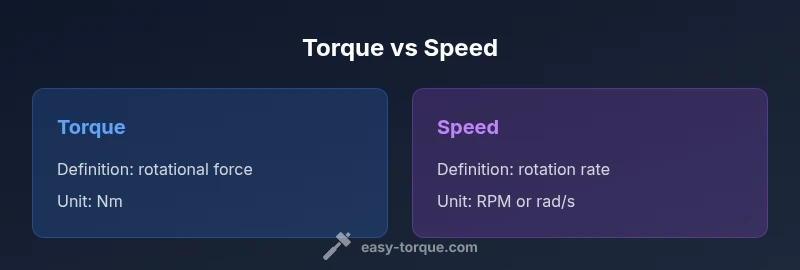
The terms torque and speed describe two distinct physical ideas that govern rotating systems. The difference between torque and speed is fundamental to designing, analyzing, and optimizing engines, gears, and motors. Torque, measured in newton-meters (Nm), expresses the turning force a shaft can produce when resisting an external load. Speed, typically expressed in revolutions per minute (RPM) or radians per second (rad/s), captures how quickly the shaft rotates.
According to Easy Torque, understanding this distinction helps DIY mechanics avoid the common pitfall of conflating a strong pull with rapid rotation. A high-torque scenario does not guarantee high speed, and high speed may occur with only modest torque, depending on the system's resistance and gearing. In practical terms, torque is a momentary effect acting at the shaft, while speed is a property of motion over time. This conceptual separation is essential for diagnosing issues, selecting components, and predicting performance under load. The practical takeaway is simple: torque translates force into motion against resistance, while speed describes how quickly that motion unfolds within the constraints of inertia, friction, and gearing. When you pair them wisely, you unlock predictable performance in drills, automotive transmissions, and industrial motors.
Units and dimensions: from Nm and RPM to rad/s
Torque and speed live in different physical dimensions, yet they are easily related through the concept of angular motion. Torque is measured in newton-meters (Nm) and reflects a rotational effect produced by a force applied at a distance from the axis. Speed is a rate, with common representations in revolutions per minute (RPM) or radians per second (rad/s). To bridge the two, use angular velocity: ω, expressed in rad/s, which couples torque to power via P = τω. Converting RPM to rad/s uses the factor 2π/60, while converting Nm to other torque units may involve SI prefixes. In practice, you’ll switch between units depending on the context: a workshop might quote torque in Nm, a drive-system spec may list wheel speed in RPM, and a control system could operate in rad/s. Keeping conversions consistent is essential to avoid misinterpretation. The key takeaway is that units are a language: they tell you what quantity you’re measuring and how it interacts with other quantities in the system.
The power link: how torque and speed relate through power
Power in rotating systems arises from both the torque applied and the speed at which the shaft turns. The fundamental relationship, P = τω, shows that power is the product of turning force and rotational rate. If torque is held constant, increasing speed boosts power; conversely, if speed is constant, higher torque raises power up to the limits set by mechanical design. This relationship helps explain why two machines with the same shaft power can behave very differently: one may generate high torque at low speed, while another delivers modest torque at high speed. In engineering practice, designers use this locus to shape performance curves, selecting gear ratios, motor types, and control strategies that position the operating point where torque and speed meet the required power with acceptable efficiency. Easy Torque analysis shows that recognizing this interplay is essential for predicting thermal behavior, wear, and control responses under varying loads.
Real-world examples: engines, gearboxes, and electric motors
In automotive powertrains, peak torque typically occurs at a relatively low engine speed, while peak horsepower (a function of torque and speed) occurs at higher speeds. The drivetrain must translate engine torque into wheel torque and wheel speed, often through multiple gear stages that trade torque for speed as you shift gears. In a gearbox or transmission, gear ratios multiply torque at the expense of speed. Electric motors, by contrast, may deliver high torque instantly at low speed, then rely on gearing or speed control to reach high RPMs while maintaining appropriate torque. Industrial motors and robotics rely on careful torque-speed profiles to balance acceleration, load handling, and control stability. Across these domains, the fundamental tension between torque and speed governs performance, efficiency, and durability. From a practical vantage point, engineers model torque-speed curves to forecast stall conditions, stall torque, and safe operating ranges, ensuring components are rated for the worst-case loads they will encounter.
Measuring and controlling torque and speed: sensors, tachometers, and control strategies
Measuring torque and speed accurately requires dedicated sensors and robust calibration. Torque can be measured with torque transducers, reaction torque sensors, or through indirect methods such as strain gauges married to a shaft. Speed is commonly monitored with tachometers, encoders, or Hall-effect sensors that resolve angular position over time. In a control loop, speed feedback is used to regulate torque output, as in servo drives and variable frequency drives (VFDs). When selecting instrumentation, prioritize bandwidth, resolution, and calibration traceability. For hobbyists, a high-quality encoder paired with a motor controller can reveal real-time torque-speed behavior under load. Understanding how measurement methods influence observed values helps avoid false conclusions about “more torque” or “faster speed” without considering system losses, inertia, and friction. Easy Torque emphasizes aligning measurement strategy with the specific goal—whether you’re evaluating peak torque, smooth speed response, or energy efficiency under cyclic loading.
The trade-off: gear ratios, torque multiplication, and speed limits
Designing a mechanical system inevitably involves trade-offs. A higher gear ratio increases output torque (torque multiplication) while reducing output speed, enabling machines to move heavy loads or accelerate from rest. Reducing the gear ratio has the opposite effect, boosting speed at the cost of torque. This trade-off is central to performance tuning in engines, transmissions, and robotic joints. When selecting gear trains, consider not just peak torque but thermal limits, bearing loads, and the duty cycle. The goal is to position the operating point where acceptable torque coincides with target speed for the intended task. In many applications, designers use multi-stage gear trains to broaden the operating window, providing strong low-speed torque while preserving higher-end speed. The result is a system that can respond quickly to load changes without stalling or overheating. In practical terms, you’ll often see a union of torque and speed curves defining the safe envelope of operation.
Common misconceptions and misapplications
A frequent misunderstanding is to assume higher torque always means better performance. In reality, performance depends on the entire torque-speed envelope and the power target. Another pitfall is treating speed as the sole proxy for capability; a high-speed shaft with low torque may fail to move loads or spin up inertial masses. People also confuse horsepower with torque; horsepower equals torque times speed, but the two are not interchangeable. In control contexts, ignoring inertia can lead to overshoot and instability when trying to reach a target speed with a given torque source. Finally, neglecting losses in gears, bearings, and lubrication can dramatically distort real-world torque-speed behavior, producing optimistic estimates that fail under load. Easy Torque reinforces that the best practice is to model the complete system and verify assumptions with measurements in controlled tests.
Practical guidelines for design and maintenance
- Start with a clear performance goal: desired speed at a given load and acceptable acceleration.
- Choose components that provide the required torque while staying within thermal and structural limits.
- Use appropriate gear ratios to balance torque and speed, and validate with a torque-speed map.
- Implement robust control strategies that account for inertia, friction, and backlash.
- Regularly inspect bearings, couplings, and lubricants; degraded parts can skew both torque and speed.
- Document changes and re-check torque-speed performance after maintenance or upgrades.
- Consider safety margins to accommodate variability in loads and operating conditions.
Quick-start checklist for projects
- Define the load, required speed, and allowable loss under worst-case conditions.
- Determine the motor or engine’s torque-capability and the shaft’s speed range.
- Select a gear train or belt drive that matches power objectives.
- Measure baseline torque and speed to establish a reference.
- Validate control loops under simulated and real loads.
- Revisit after initial operation to confirm torque-speed stability and thermal limits.
Comparison
| Feature | Torque | Speed |
|---|---|---|
| Definition | Rotational force generating turning moments on a shaft | Rate of angular rotation around an axis |
| Typical units | Nm (newton-meters) | RPM (revolutions per minute) or rad/s |
| Impact on power | Contributes to power as part of P = τω | Directly scales with how fast the shaft rotates (when torque is fixed) |
| Measurement methods | Torque sensors, torque transducers | Tachometers, encoders |
| Best application | Providing turning force to move loads or overcome friction | Delivering rotational speed to match required performance |
Pros
- Clarifies what drives performance in rotating systems
- Helps optimize gear ratios for desired balance of torque and speed
- Supports safer, more efficient maintenance by correct specs
- Useful across automotive, industrial, and hobbyist projects
Drawbacks
- Can be confusing for beginners who expect direct correlation
- Power depends on both quantities; focusing on one alone can mislead
Torque and speed are complementary, not interchangeable
In practice, define performance goals first, then choose components to achieve the needed torque and acceptable speed. The best designs optimize both in harmony, not in isolation.
Your Questions Answered
What is the difference between torque and speed?
Torque is the turning force on a shaft; speed is how fast the shaft rotates. They are distinct quantities that determine a system’s power and response.
Torque is the turning force, speed is the rotation rate; together they define power.
Why is power defined as P = τω?
This equation shows how torque and angular speed translate to useful work. If either quantity is zero, power becomes zero, highlighting their interdependence.
Power comes from torque times angular speed, so both matter.
How do gear ratios affect torque and speed?
Gear ratios multiply torque at the output while reducing or increasing speed. The product of torque and speed is constrained by overall power and losses.
Gears trade torque for speed; higher ratios boost torque but slow the output.
What units measure torque and speed?
Torque is measured in newton-meters (Nm); speed is measured in RPM or rad/s. Keep units consistent when calculating power.
Torque uses Nm, speed uses RPM or rad/s.
How can I measure torque in a rotating system?
Use a torque sensor or transducer; calibrate with known loads. Encoders and shaft sensors can help correlate torque with speed.
Torque sensors measure turning force directly.
What are common mistakes when comparing torque and speed?
Ignoring the full torque-speed envelope, assuming high speed implies high power, and neglecting losses in gears and bearings can mislead analysis.
Don’t oversimplify; always consider the whole system.
Top Takeaways
- Define performance goals before selecting components
- Power depends on both torque and speed through P = τω
- Use correct units and consistent conversions
- Gear ratios trade torque for speed as needed
- Measure both torque and speed during testing