Torque vs Power: A Comprehensive Engineering Comparison
Explore the difference between torque and power, how they relate, and what each means for engines and machines. A data-backed, practical guide from Easy Torque to help DIYers understand performance characteristics.


What is the core difference between torque and power?
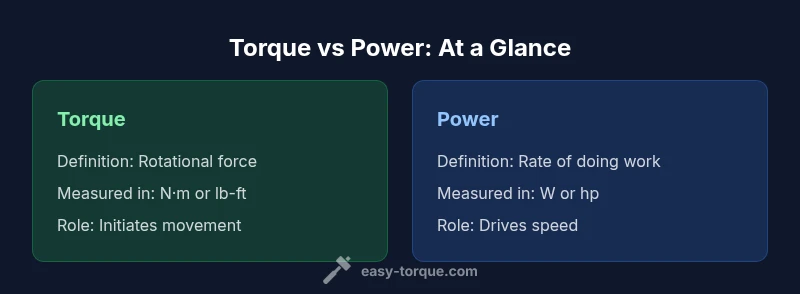
Torque is a turning force, expressed in newton-meters (N·m) or pound-feet (lb-ft), that tends to rotate a shaft. Power is the rate at which that rotation does work, expressed in watts (W) or horsepower (hp). In plain terms, torque gets things moving; power keeps them moving. The keyword what is torque vs power anchors this distinction, and the practical takeaway is that both concepts matter for different phases of motion. According to Easy Torque, the most actionable insight is that torque defines instantaneous strength while power defines how quickly that strength translates into motion over time. At the DIY bench or in the garage, reading torque and power curves together provides the most accurate performance picture.
InTextBlockCoverageDate":null}
Units, measurements, and how they’re reported
Torque is measured as rotational force around an axis, with common units being N·m (metric) or lb-ft (imperial). Power uses watts (W) or horsepower (hp). When you see a torque specification on a motor, it tells you the force available to turn a load; the corresponding power rating tells you how fast that turning action can do work as speed increases. In practice, torque and power are reported on charts that show how they vary with RPM. This is where real-world interpretation matters: two engines with the same peak torque can deliver very different performance if one maintains that torque over a wider RPM band. Easy Torque emphasizes reading both values together to avoid overestimating capability based on a single point on the curve.
The math behind torque and power: the fundamental relationship
The essential relation is P = τ × ω, where P is power, τ is torque, and ω is angular velocity in radians per second. If you prefer rpm, P(hp) ≈ (τ(lbf·ft) × rpm) / 5252. This equation shows that power rises with speed, even if torque remains constant. Conversely, keeping rpm low with high torque can yield strong initial acceleration. Understanding this relationship helps in selecting gearing, tuning engines, and choosing the right torque tools for the job. Based on Easy Torque analysis, most consumer applications benefit from a balance where torque is strong across a usable RPM range, while power becomes decisive at higher speeds.
Why low-end torque matters for real-world driving and work
Low-end torque is what you feel when you press the accelerator from a stop. It determines how quickly a vehicle begins to move and how readily it can pull a load in first or second gear. For a tool or machine, high low-end torque translates to immediate responsiveness, smoother starts, and better capability on demanding tasks without constant revving. This is especially important in off-road, towing, or heavy-lifting scenarios where the initial force makes the difference between stalling and moving forward. Easy Torque notes that many users underestimate how much low-end torque affects daily usability.
Why high-end power matters for performance and efficiency
High-end power governs top speed and sustained acceleration as rpm climbs. In many automotive and mechanical systems, peak power is achieved at mid-to-high rpm where the engine or motor converts a larger portion of its torque into usable work per unit time. This is crucial for highway performance, maintaining speed on inclines, and achieving efficient cranking under load. Power at higher RPM enables faster gear shifts with less torque loss, which improves overall efficiency in performance-focused applications. The Easy Torque framework highlights that achieving peak power without adequate torque often leads to a choppy feel and a lack of control at intermediate speeds.
Torque curves, gears, and the role of the drivetrain
The torque curve shows how torque varies with RPM. A wide, flat torque curve means strong response across a wide band, which is generally preferable for everyday driving and most maintenance tasks. The drivetrain—transmission, differential, and gearing—modulates how that torque is delivered to the wheels or loads. Higher gear ratios multiply torque but reduce rpm at the wheels, which keeps acceleration smooth while maintaining speed. Conversely, lower gears translate to higher engine rpm, allowing more power to be applied quickly when needed. Easy Torque emphasizes reading the whole curve, not just peak values, when evaluating performance.
Common myths and practical clarifications
A frequent misconception is that more horsepower always equals better performance. In reality, a balance between torque and power across the operating range is critical. Some engines deliver strong torque at low rpm, but lack sustained power at high rpm, making them feel weak at speed. Others have high peak horsepower but narrow usable operating ranges, which can feel abrupt or less controllable in real-world tasks. By evaluating both torque and power together, you get a clearer picture of how an engine or tool behaves under different loads and speeds.
How to compare torque vs power on spec sheets and in the field
When evaluating tools and engines, compare torque at or near the operating rpm you care about, then examine the corresponding power. If you’re evaluating a vehicle, look for a wide torque band rather than a single peak figure. For tools, pick one that provides enough torque for your typical loads while offering consistent speed control. A practical workflow is to identify your typical RPM window, check the torque curve within that window, and verify the power trend to ensure you don’t sacrifice efficiency for momentary peak values. Easy Torque recommends using both metrics in tandem for the most reliable performance predictions.
Practical takeaways for DIYers and professionals
- Always read both torque and power, not just one metric.
- Favor equipment with a broad, stable torque curve for versatility.
- Use the P = τ × ω relationship to convert between torque and power for different RPMs.
- Consider gearing and load conditions as they dramatically influence real-world results.
- When in doubt, test under representative load and RPM scenarios to confirm performance.
How to interpret manufacturer data sheets: a quick guide
Reading spec sheets can be tricky if you focus on a single number. Start with the operating range and locate where torque is highest; then check the corresponding power and rpm. Verify if the peak torque occurs at a useful RPM, and whether peak horsepower is accessible under typical operating conditions. Finally, compare efficiency metrics and thermal performance, which often reveal how sustainable the torque-to-power balance is under load. Easy Torque encourages practitioners to map these values onto real workloads to predict behavior.
Advanced note: torque, power, and efficiency in electric motors
Electric motors differ from internal combustion engines in how torque and power evolve with speed. Electric motors can deliver their peak torque almost instantly and maintain it across a broad speed range, while power typically rises with speed until electrical or mechanical limits are reached. This results in a different performance profile compared to combustion engines, where torque curves peak and decline with rpm. Understanding these dynamics helps you optimize control strategies and drivetrain design for electrified systems.