Torque vs Power: Understanding the Difference and When It Matters
Learn the difference between torque and power, how they relate, and when each matters for performance, efficiency, and drivability in real-world driving scenarios.


Torque and power describe different aspects of engine performance. Torque is the twisting force that gets a vehicle moving, while power is the rate at which work is done, especially at higher RPMs. For daily driving, torque matters for acceleration off the line and hills; for high-speed cruising, power becomes more influential. This comparison explains when each metric dominates and how they relate.
What torque and power mean in plain language
Torque is the twisting force that causes rotation. Power is the rate at which that rotation can perform work, which grows with engine speed. In everyday terms, torque helps you feel the car moving from a standstill, especially when carrying a load or climbing grades. Power matters when you want to sustain higher speeds or accelerate aggressively at higher RPMs. When we compare torque versus power, the distinction is not a contest between one metric and another; it is about the specific driving task and the engine's design intent. According to Easy Torque, the right way to think about this is to separate the twisting force from the pace at which that force can be delivered. For torque or power to translate into real performance, you must consider drivetrain layout, gearing, and vehicle weight. Throughout this guide, we’ll examine how each metric influences behavior on the road and what you can realistically expect from different engines in 2026.
altText":null},
How torque and power relate mathematically
Power and torque share a fundamental relationship. Power (P) equals torque (τ) times angular velocity (ω). In SI units, P = τ · ω, where τ is measured in newton-meters and ω in radians per second. In automotive practice, power is often expressed in horsepower and torque in either newton-meters or pound-feet. The familiar automotive conversion is P_hp = (T_lb-ft × RPM) / 5252. This formula arises from P(W) = τ × ω, with W to hp and mks unit conversions. It explains why engines with high torque at low RPM feel strong off the line, while peak power at higher RPM enables faster acceleration after the engine spins up. When you chart the curves, note that both torque and horsepower shift with throttle, gearing, altitude, and transmission. The key takeaway is the balance: the engine’s torque curve can be broad, but the practical performance depends on where the power peak sits relative to the gearing. In 2026, drivers should interpret the full curve rather than a single peak.
altText":null}
Real-world implications: when torque matters vs when power matters
In the real world, torque is what plants the seeds of motion. It dominates when pulling away from a stop, climbing a steep grade, or moving a heavy load. A diesel engine or a turbocharged gasoline engine with strong low-end torque can feel decisive at low speeds. Power, by contrast, is what sustains acceleration as speed climbs. A high-revving performance engine often delivers strong linear acceleration at mid to high RPM, enabling higher top speeds and quicker overtakes. For most daily drivers, the ideal is a blend: sufficient low-end torque for responsiveness in traffic and hills, with a healthy power band to keep acceleration smooth as speed grows. Easy Torque’s analysis shows that the perceived difference is often about where the torque peak lies and how fast the power rises with RPM. Unknowns such as gear ratios, weight, aerodynamics, and tire grip determine the practical effect, so a car with strong torque but poor gearing may feel slower than one with a more balanced curve.
altText":null}
Applications across different engines and drivetrains
Different engine families emphasize torque or power for reasons tied to their intended role. Diesel engines, with higher compression and torque at lower RPMs, are favored for towing and hauling. Turbocharged gasoline engines can deliver broad torque after boost comes in, while maintaining strong peak power at high RPM for sportier performance. Naturally aspirated engines tend to have a narrower power band, requiring careful gear selection to stay in the sweet spot. In front-wheel-drive cars, torque delivery interacts with grip and weight transfer, making low-end torque pivotal for everyday usability. In rear- or all-wheel-drive setups, the effect of torque is distributed differently, altering the perceived acceleration. Drivetrain architecture, including manual, dual-clutch, or conventional automatics, shapes how torque and power reach the wheels. The takeaway: engine design, compressor or turbo sizing, and transmission strategy combine to shape the real-world experience more than any single peak value.
altText":null}
Common myths about torque and horsepower
One common myth is that more horsepower alone guarantees faster acceleration. In practice, torque, weight, gearing, and traction determine how that power translates to motion. Another myth is that higher rpm always means better performance; many engines reach their best power a few hundred RPM before redline and then fall away if the gearing is not matched. Some believe diesels are only for towing; modern diesel engines offer impressive torque and acceptable peak power for varied driving. Finally, a peak horsepower number stored on a spec sheet may look impressive, but it tells only part of the story if the curve is narrow or misaligned with the transmission. Understanding torque and power curves reveals the full story behind acceleration, fuel economy, and drivability.
altText":null}
How to optimize torque and power in practice
Improving torque at low RPM often involves increasing low-end pressure, boosting boost, optimizing cam timing, and reducing parasitic losses (friction, drivetrain losses). Enhancing peak power focuses on high-RPM efficiency, boosting intake and exhaust flow, refining turbocharger sizing, and reducing internal losses. Transmission tuning matters: gearing that holds the engine in its optimal torque window when you step on the throttle improves both perceived torque and power. Aerodynamics and weight reduction can improve both, because power requirements rise with speed but drag is a major drain at high speeds. Realistic approaches include user-friendly modifications like ECU remapping, intake and exhaust upgrades, and careful turbo sizing, all while ensuring engine safety and reliability. Always verify with dyno testing and track results to ensure changes deliver the desired balance of torque and power.
altText":null}
Measuring torque and power: tools and units
Measuring torque at the crank demands a dynamometer or engine test stand; wheel torque and power require a chassis dyno. Torque is measured in newton-meters (N·m) or pound-feet (lb-ft); power is in watts, horsepower (hp), or kilowatts (kW). Dyno data illustrate the full torque curve across RPM; this helps tailor gearing, boost, or cam timing for the desired response. In everyday practice, reading the spec sheet for turbochargers and engines is useful, but the true performance comes from the actual curve. You should consider test conditions like ambient temperature, altitude, and the gear ratio used during testing, as these factors influence the measured curves. In 2026, the science of measurement emphasizes repeatability and proper calibration to ensure data integrity.
altText":null}
Case studies: everyday driving scenarios
Scenario A: urban commuting with frequent stops. Torque is critical for quick off-the-line response; you want enough torque to accelerate smoothly without a long pause at intersections. Scenario B: highway merging and overtaking. High-end power matters as you surpass other vehicles at speed. Scenario C: towing a trailer or carrying heavy loads. A broad torque band at low and mid RPM improves control in hills. Scenario D: performance driving on winding roads. A balance between torque and power, plus a responsive gearing, yields confidence in varied elevations. In each case, the engine design, turbo sizing, and transmission tuning determine the perceived performance. For DIY enthusiasts, this means you should prioritize the drive cycle you perform most and select a power/torque curve that aligns with your goals.
altText":null}
Implications for tuning and modifications
Modifications to improve torque include cam adjustments, exhaust optimization with reduced backpressure, and forced induction choices that boost low-end torque. To raise peak power, you typically improve airflow, use larger turbochargers or cams optimized for high RPM, and recalibrate the ECU for the new turbo schedule. It's essential to maintain balance; increasing peak power without sufficient low-end torque can degrade drivability. When planning modifications, consider the entire drivetrain: torque delivery to the wheels depends on gearing, differential ratios, and tire grip. Always validate with dyno testing and on-road measurements to verify that the changes translate into meaningful performance gains in the real world.
altText":null}
How gear ratios influence torque and power delivery
Gear ratios do not create torque or power; they change how the engine's torque and power are delivered to the wheels. Shorter gears (lower final drive) increase torque at the wheels and improve off-the-line response, but they can reduce top speed and raise engine speed. Taller gears reduce engine speed at a given road speed, preserving fuel economy but potentially masking the engine's torque peak. The optimal gearing depends on the engine's torque curve and the vehicle's weight and drag. Numerical examples illustrate how a torque-rich engine with a tall final drive can reach higher speeds with modest engine revs, while a torque-limited setup may stall in first gear under heavy load. In performance applications, gear choice can meaningfully alter the perceived torque and power balance.
altText":null}
Efficiency, emissions, and the torque-power trade-off
Engineers must balance torque and power with efficiency targets and emission constraints. Turbocharging and downplaying pumping losses can boost power without increasing fuel consumption, but the real-world impact depends on throttle input, driving style, and ambient conditions. A smooth torque curve improves drivability and reduces stall risk, while a broad power band can allow leaner fueling strategies and better efficiency at cruise. Ultimately, a well-designed engine can deliver satisfactory torque and adequate power without excessive fuel use or emissions. As always, the details matter: a given torque peak in lb-ft can map differently to road performance depending on weight, tires, and aerodynamics.
altText":null}
Summary of key takeaways for builders and drivers
This section ties the concepts together and prepares you to apply them in the real world. The torque-power relationship isn’t a simple winner-takes-all story; it’s about matching the curve to the task, the gear, and the weight. A practical mindset is to evaluate full curves across RPM, not just peak values, and to test changes under realistic loads and speeds. The right balance yields better drivability, efficiency, and performance across everyday driving and specialized tasks.
altText":null}
How to choose between torque-focused and power-focused setups
When you aim for low-end responsiveness, prioritize engines and tuning that maximize torque at lower RPMs, with a gearing strategy that keeps the engine in its sweet spot. If your goal is top-end speed and sustained acceleration, target a strong power peak at higher RPMs, coupled with a transmission that can keep the engine within that range. The best approach for most vehicles is a balanced curve that provides sufficient low-end torque and a usable power band across the RPM range. This balance is achievable through thoughtful turbo sizing, cam timing, exhaust design, and careful transmission tuning. In 2026, drivers benefit from tools like dyno plots and real-world testing to verify that theoretical gains translate into tangible on-road improvements.
altText":null}
Final note on interpretation and next steps
Interpreting torque and power requires context. Look past single-number specs and examine the full curve, the gearing, the vehicle weight, and the intended use. If you’re a DIY mechanic or performance enthusiast, start with a clear goal—towing, daily efficiency, or track capability—and modify in small, measurable steps with tests at multiple RPM ranges. This disciplined approach aligns with Easy Torque’s philosophy: practical, data-driven guidance that helps you make informed decisions about torque and power in real-world driving.
altText":null}
Comparison
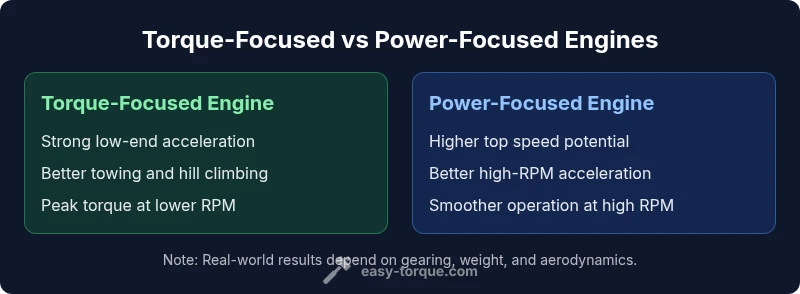
| Feature | Torque-focused engine | Power-focused engine |
|---|---|---|
| Best use case | Low-end response, towing, steep climbs | High-speed cruising, rapid overtakes, wide power band |
| Where peak happens | Peak torque at lower RPM | Peak power at higher RPM |
| Measured units | Torque (lb-ft or N·m) | Power (hp or kW) |
| Driving feel | Strong roll-off, quick acceleration from stop | Smoother acceleration at high speed |
| Gearing impact | Geared to amplify torque feel | Geared to exploit high RPM power |
| Efficiency influence | Depends on load and drag during torque delivery | Depends on cruising power demand and aerodynamics |
| Ideal engine type | Diesel, turbocharged low-end torque | High-revving gasoline or hybrid with strong RPM lift |
Pros
- Helps make informed choices by comparing two core performance aspects
- Highlights how gearing and weight alter perceived results
- Encourages evaluating full torque and power curves, not just peaks
- Supports practical goals like towing, commuting, or track days
- Promotes data-driven tweaking rather than guesswork
Drawbacks
- Requires access to dyno data or reliable test results to be truly useful
- Can overwhelm beginners with curves and terminology
- May lead to overemphasis on one metric if the other is ignored
- Modifications can shift curves unpredictably without proper validation
Balanced torque and power strategies provide the best real-world performance.
There is no one-size-fits-all winner. For most drivers, a well-tuned balance between low-end torque and high-RPM power, matched with appropriate gearing, delivers reliable daily performance and strong acceleration across a range of speeds.
Your Questions Answered
What is the practical difference between torque and horsepower?
Torque measures the immediate twisting force, influencing low-end acceleration and hill climbing. Horsepower measures the engine’s ability to do work over time, affecting top speed and sustained acceleration. Together, they describe how an engine moves a vehicle across RPM ranges.
Torque gets you moving quickly at low speeds, horsepower keeps you moving fast as you climb through gears.
How does RPM affect torque and power curves?
Torque typically peaks at a certain low-to-mid RPM and then declines, while power often peaks at higher RPMs. As RPM rises, both curves can shift with throttle, boost, and gearing, changing how the car feels in different driving situations.
RPM shifts where the engine feels strongest—torque at low end, power at high end.
Can you have high torque and high power at the same time?
Yes, many modern engines are designed to deliver strong torque across a broad RPM range and maintain good peak power at higher RPMs. The trick is balancing turbo sizing, cam timing, and gearing so neither becomes a bottleneck.
A broad, well-balanced curve can deliver strong torque and high power together.
Why do diesel engines feel different from gasoline engines?
Diesel engines typically produce higher torque at lower RPM due to higher compression, delivering strong initial acceleration and towing performance. Gasoline engines may deliver higher peak power at higher RPMs, offering brisk acceleration at highway speeds.
Diesels feel stronger off the line; gas engines rev higher for speed.
How do gearing and transmissions influence the torque-to-power experience?
Gearing shapes how engine torque and power translate to wheels. Short gears boost wheel torque and acceleration; tall gears improve fuel efficiency and top speed. Transmission strategy must align with the engine’s torque curve for best response.
Gearing makes the engine’s strength feel bigger or smaller on the road.
What is a dyno test and what does it measure?
A dyno test measures the engine’s torque and power across RPM, either at the crank (engine dyno) or at the wheels (chassis dyno). It provides a complete torque curve, helpful for tuning and verifying real-world performance.
A dyno shows how torque and power actually behave across RPM on a test stand.
Top Takeaways
- Understand torque as twist-focused movement
- Recognize power as speed-at-work across RPMs
- Read full torque and power curves, not single peaks
- Tune gear ratios to align curves with driving goals
- Test changes with real-world driving and dyno data