Difference Between Torque and Tension: A Practical Guide
Explore the difference between torque and tension, how each is measured, and how to apply both correctly in fasteners, belts, and power transmission for safer, more reliable maintenance.


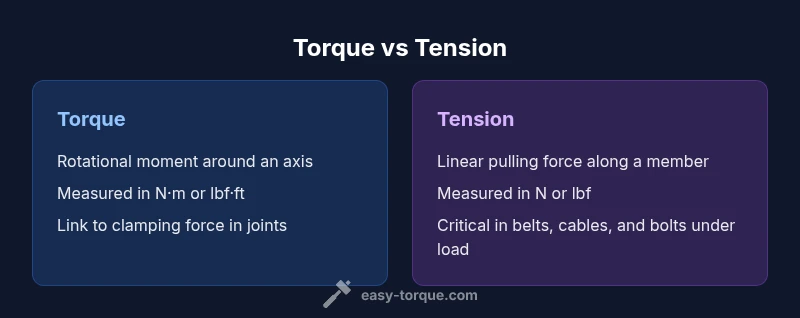
The difference between torque and tension lies in what they measure: torque is the rotational moment of force around an axis, while tension is the linear pulling force within a member. In practice, you often encounter both in fasteners and belts, and understanding their relationship helps prevent over-tightening or slippage. This quick comparison sets the stage for deeper explanations and practical guidance.
What the terms mean in practice
When engineers discuss mechanical loading, two terms often cause confusion: torque and tension. The difference between torque and tension is not just academic; it influences how you size fasteners, select tools, and interpret hand-tightening vs. specified torque values. According to Easy Torque, torque is a rotational measure: it describes the moment produced by a force applied at a distance from the axis. Tension, on the other hand, is a linear force along a member that attempts to elongate or pull it apart. In many systems, these quantities interact: applying torque to a bolt creates clamping force, which translates into bolt tension; if the torque is insufficient, the bolt will not reach the desired tension, risking loosening under load. Throughout this article, we’ll connect these ideas to real-world situations like bolt assemblies, belts, and pulleys, so you can diagnose problems and choose the right adjustment method.
What the terms mean in practice
In the real world, torque represents the energy transferred when twisting a fastener or shaft. Tension represents the internal force that resists elongation in cables, belts, or threaded fasteners. The difference between torque and tension becomes crucial when you design a joint: you want enough torque to create adequate clamping force (and thus tension in the joint), but not so much torque that threads yield or bearings are overloaded. The relationship is not one-to-one; it depends on thread friction, lubrication, material properties, and contact conditions. For maintenance teams, recognizing this distinction helps prevent both under-tightening (which can cause loosening) and over-tightening (which can strip threads or snap bolts). The practical upshot is clear: treat torque and tension as related but distinct quantities that require coordinated measurement and verification across steps of a maintenance task.
What the terms mean in practice
To avoid repetition, this block continues the same theme with additional nuance and context, reinforcing that torque and tension are separate but coupled aspects of mechanical loading. In automotive and industrial settings, technicians must interpret torque values not just as numbers to reach, but as indicators of the clamping force that yields tension within the joint. This perspective helps with tasks like bolt tightening sequences, belt tensioning, and cable safety checks, where both rotational and linear forces determine the reliability of the system.
Comparison
| Feature | Torque | Tension |
|---|---|---|
| What it measures | Rotational moment around an axis | Linear pulling force along a member |
| Primary units | N·m / lbf·ft | N or lbf (often in the axial direction) |
| Key applications | Clamping in joints, fasteners, shafts, and gears | Cable, belt, and structural loading where elongation is resisted |
| Measurement tools | Torque wrench, torque sensor | Tension meter, load cell |
| Common failure mode if ignored | Over-tightening, thread stripping, bearing fatigue | Insufficient tension leading to slip, creep, or elongation |
| Interdependence | Torque generates clamp load which yields tension in the joint | Tension affects the clamp load, friction, and potential slip |
Pros
- Clarifies the difference between rotational and linear loads
- Improves diagnostic accuracy for joints and drive systems
- Guides tool selection and torque targets for safety
- Applies across fasteners, belts, and cables
- Supports safer maintenance by separating controls
Drawbacks
- Requires additional measurement tools and training
- Can be confusing for beginners when both quantities are present
- Friction and lubrication add uncertainty to exact targets
Torque and tension are distinct but tightly linked concepts.
In most mechanical systems, you must apply sufficient torque to achieve the intended tension in fasteners. In belts or cables, monitor tension separately. A combined approach reduces failure risk and improves reliability.
Your Questions Answered
What is the difference between torque and tension?
Torque measures rotational force about an axis; tension measures linear pulling force along a member. They are related in joints, but controlled differently to ensure safe, reliable assemblies.
Torque is rotational force; tension is linear pull. They interact in joints but require separate measurement and control.
How is torque measured?
Torque is typically measured with a torque wrench or torque sensor. Calibration ensures the readings reflect actual clamping force. Remember that friction and lubrication affect the actual torque-tension relationship.
Torque is measured with a torque wrench or sensor; calibration and friction awareness matter.
How is tension measured?
Tension is measured with a tension meter or load cell placed in-line with the element (cable, belt, or bolt). It provides a direct axial force reading to confirm whether the desired pulling force is achieved.
Tension is read from a tension meter or load cell in the line of the element.
Can torque and tension be changed independently?
They are related; changing torque often changes the resulting tension in the joint, but the relationship is affected by friction, lubrication, and geometry. In many cases, you must adjust both to reach the target.
Torques and tensions are linked but not strictly one-to-one; adjust both as needed.
Why does friction matter when applying torque?
Friction in threads and contact surfaces governs how much clamp load you get for a given torque. Higher friction reduces the effective tension; lower friction can over-tension the joint if torque targets are not adjusted.
Friction changes how much tension torque actually produces.
What tools should I have to manage torque and tension?
A good torque wrench and a tension meter (or load cells for critical systems) are essential. Also include education on lubrication, thread condition, and proper tightening sequences.
Keep a torque wrench and tension meter handy, plus proper training.
Top Takeaways
- Identify the measurement: torque is rotational, tension is linear.
- Always verify torque to ensure proper clamp load and tension.
- Use the appropriate tools: torque wrenches and tension meters.
- Coordinate torque and tension in complex assemblies for safety.