Torque vs Tension: Practical Differences for DIYers
Compare torque vs tension: definitions, measurement methods, typical applications in automotive and mechanical work, common pitfalls, and how to choose the right metric—with practical tips from Easy Torque.


Torque vs tension: torque is rotational force at a fastener, while tension is axial force along a line. They’re not interchangeable; using the wrong metric can over-tighten, under-tighten, or misload components. See our detailed comparison for practical guidance and tool selections. This quick lens prepares you to pick the right metric for each task and avoid common mistakes.
Defining torque and tension
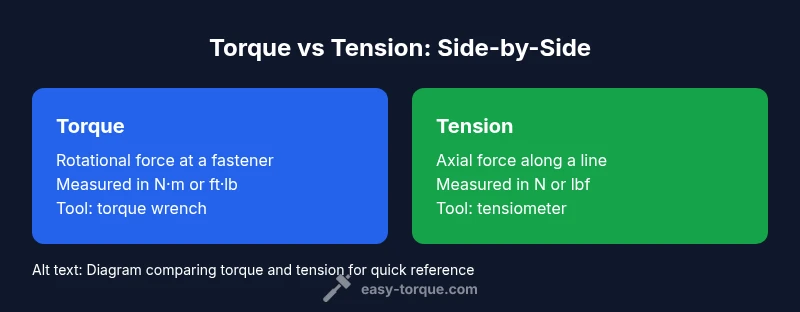
According to Easy Torque, torque and tension describe different kinds of load: rotational vs axial. Torque is the rotational force you apply to a bolt or fastener, which translates into clamping load through thread friction. Tension, by contrast, is the straight-line force transmitted along a cable, strap, or structural member, typically measured as load in newtons or pounds-force. These measures operate in different directions and manners, yet both influence performance, safety, and lifespan of components. In practice, most DIY projects involve both concepts in the same system, so confusion can lead to improper maintenance. A wheel lug, for example, experiences torque as you tighten, but the belt or chain in the same system experiences tension along its length. Understanding when to use each metric helps you set correct specifications, select appropriate tools, and avoid common mistakes such as overtightening or under-tightening. The rest of this section breaks down definitions, units, and real-world implications for torque vs tension in everyday tasks.
Units, scales, conversions, and what matters
Torque is typically measured in newton-meters (N·m) or foot-pounds (ft·lb), while tension is measured in newtons (N) or pounds-force (lbf). In SI practice, you often convert to N·m for torque calculations and to N for tension in structural specs. The same fastener can behave differently depending on lubrication and surface finish, so a direct numeric conversion between torque and tension is not straightforward. Easy Torque analysis shows that the relationship between torque and clamp load depends on friction, thread pitch, diameter, and lubrication state. For this reason, many manufacturers provide torque specifications that are validated under specific conditions; do not assume a single torque equals a fixed clamp force across all jobs. When you switch from dry to lubricated threads, you will likely change the torque required to achieve the same clamping force. The key takeaway: know the context, consult manufacturer data, and be prepared to adjust torque or tension targets accordingly.
Measurement methods and tools for torque and tension
Torque measurement relies on torque wrenches, which can be click-type, analog beam, or digital. A correct choice depends on accuracy, ease of use, and calibration intervals. For tension, you typically rely on tensiometers, load cells, or dynamometers to measure axial load in cables, straps, or structural members. Each device has a calibration cycle and a proper scale: torque wrenches calibrate with traceable standards; tensiometers require baseline tension checks to avoid drift. In practice, you often validate tension readings by cross-checking with known weights or pulleys to ensure system geometry is accounted for. The take-home is: use purpose-built tools for the quantity you intend to measure, maintain calibration, and document your measurement conditions to interpret results correctly.
Friction, lubrication, and the torque reading
Friction plays a central role in torque readings. The standard equation T = K·F·D captures how clamping force F relates to torque T through a geometry factor K and the fastener diameter D. Lubrication lowers friction, which means the same torque may produce a smaller clamping force unless compensated. Clean, dry threads behave differently than oiled or anti-seize coated threads. Surface finish, thread condition, and contamination also affect K, so consistent preparation is essential. When planning repairs or assemblies, record the state of lubrication and material interfaces to justify torque choices. In short, friction is the unpredictable variable that makes torque a proxy for clamp load rather than a direct measurement; treat it accordingly.
Automotive applications: fasteners vs belts
In automotive work, torque is most commonly used to specify fastener clamping on lug nuts, crank bolts, and engine components. Correct torque ensures the joint remains secure under vibration without causing thread stripping. Tension plays a bigger role in belt drives, timing belts, and accessory belts where the belt’s tightness determines power transfer and wear. Misapplying torque to a belt or underestimating tension can cause slipping, noise, or premature failure. For DIYers, the practical rule is to use torque specs for fasteners and tension guidelines for belts and cables. Always consult vehicle-specific service data and, when possible, verify with the right tool under controlled conditions.
Industrial and structural applications: cables and hoses
Beyond vehicles, tension is critical in cables, hoses, and strap assemblies used in hoisting, rigging, and hydraulic systems. Tensile loads must be verified with load cells or tensiometers to prevent over-stress and failure. In crane lines, guy wires, or load-bearing slings, consistent tension helps maintain geometry and safety. Operators should calibrate sensors regularly and account for environmental factors such as temperature and wind that can influence tension readings. The key distinction remains: torque governs fastener clamping; tension governs axial loads along lines and straps. Mastery comes from applying the correct metric to each subsystem.
From torque to clamp load: the friction model
Torque converts to clamp load through friction at the thread interface. The relationship is not fixed; it varies with lubricant, pitch, diameter, and surface condition. The common approximation T = K·F·D expresses this, but K is not a universal constant. When you need a high clamping force, you may need to adjust torque upward if friction decreases (e.g., from lubrication) or reduce torque when friction increases (e.g., from corrosion). Understanding this relationship helps you predict outcomes more reliably and select the right metric for joint integrity. Always treat torque as a proxy for clamp load unless you’ve validated it for your specific hardware and condition.
Measuring tension in lines and cables: practical tips
Tension measurements rely on dedicated equipment like tensiometers and load cells connected to the line under test. Use calibrated sensors and ensure the line is aligned to minimize bending and unwanted angles, which can skew readings. For ongoing maintenance, establish a baseline tension for critical lines and monitor deviations over time. In many systems, tension must be checked under realistic operating conditions, including load cycles and temperature variations. Remember: tension is direct axial load; torque only relates to it indirectly through components that convert rotational energy into linear force. Integrate both metrics in a maintenance plan when a system contains both fasteners and lines.
Common mistakes and how to avoid them
Common mistakes include treating torque as a direct measure of clamp load without accounting for friction, failing to calibrate tools, tightening beyond the manufacturer’s spec due to lubrication changes, and ignoring system geometry. In tension measurements, errors arise from misalignment, not accounting for pulley radius, or using a sensor outside its calibrated range. To avoid these, calibrate tools regularly, follow manufacturer procedures, document environmental conditions, and use task-specific methods for each metric. When in doubt, verify with a secondary measurement or consult a reference table from a trusted source.
Comparison
| Feature | Torque | Tension |
|---|---|---|
| Definition | Rotational force applied to a fastener | Axial force along a line (cable/strap) |
| Primary unit | N·m or ft·lb | N or lbf |
| Typical measurement tools | Torque wrench (click/digital/beam) | Tensiometer, load cell, dynamometer |
| Primary use case | Bolt/fastener clamping | Line/cable or strap load |
| Effect of lubrication | Changes clamping efficiency via friction | Affects how line loads translate to measured tension |
| Key relationship to load | Indirect via friction and thread geometry | Direct axial load along the line |
| Common errors | Over/under-torque due to friction state | Misreading tension due to geometry or angle |
| Best for | Joint integrity and repeatable fasteners | Cable/strap integrity and safe load limits |
Pros
- Clear distinction between rotational and axial loads
- Reduces risk of over-tightening and under-tightening
- Supports precise fastener specs and safe load planning
- Applicable across automotive, industrial, and structural tasks
Drawbacks
- Requires different tools and training for torque vs tension
- Potential misapplication if the relationship to clamp load isn’t validated
- Friction and geometry can complicate direct conversions
- Calibration and procedure adherence are essential for accuracy
Torque is the practical default for fastener joints; tension is the go-to for lines and structural loads
Use torque to secure bolts when you need repeatable clamp force. Use tension when the load path is along a line. Validate with proper tools and calibration, and document conditions to ensure safety and reliability.
Your Questions Answered
What is the difference between torque and tension, and why does it matter for my project?
Torque measures rotational force at a fastener, translating to clamp load through friction. Tension measures straight-line axial force along a cable or strap. Using the wrong metric can lead to loosening, component damage, or unsafe loads. Knowing which metric applies helps you select the right tool and target.
Torque is rotation, tension is straight-line pull. Use the right one for the job to stay safe and accurate.
Can you directly convert torque to tension?
There is no universal direct conversion. The relation depends on thread geometry, lubrication, and friction. You can estimate clamp load from torque only after validating the specific fastener and conditions, usually via manufacturer data or test measurements.
No direct conversion; you must account for friction and geometry.
What tools measure torque?
Torque is measured with torque wrenches (click, beam, or digital) and calibrated against standards. Choose based on accuracy needs, ease of use, and the calibration cycle.
Use a torque wrench and keep it calibrated for accuracy.
What tools measure tension?
Tension is measured with tensiometers, load cells, or dynamometers. Ensure proper line alignment and calibration for accurate axial load readings.
Use a tensiometer or load cell to measure line tension.
Why does lubrication change torque requirements?
Lubrication reduces friction, which lowers the torque needed to reach the same clamp load. If you lubricate threads, you may need to adjust torque upward to achieve the same joint security.
Lubrication lowers friction, so you may need more torque to clamp the same amount.
What are common torque mistakes to avoid?
Common mistakes include ignoring friction states, using incorrect lubrication assumptions, and failing to check tool calibration. Always follow manufacturer data and verify with a secondary check when possible.
Follow the data and calibrate your tools to avoid mis-tightening.
Top Takeaways
- Identify whether your task is rotational (torque) or axial (tension)
- Use torque specs for fastener clamping and tension specs for lines
- Calibrate tools regularly and account for lubrication and geometry
- Validate torque-to-clamp-load assumptions with manufacturer data
- Measure tension directly when possible for critical lines
- Avoid mixing metrics without understanding the load path and device limitations