Ford 302 Intake Manifold Torque Sequence Guide
A practical, educator-friendly guide to torqueing the Ford 302 intake manifold using a safe criss-cross sequence, proper tools, and best practices to prevent leaks and gasket damage.


You will correctly torque the Ford 302 intake manifold by following a criss-cross tightening sequence and then applying the final torque to the factory specification listed in the service manual. Gather a calibrated torque wrench, the right sockets, a new gasket, and cleaning supplies. Ensure surfaces are clean and components are accessible before you begin.
Why the torque sequence matters for the Ford 302 intake manifold
The Ford 302 intake manifold is a critical seal between the throttle body, runners, and cylinder heads. Tightening bolts in a non-uniform pattern can warp the mating surfaces, compress the gasket unevenly, and lead to vacuum leaks that are difficult to diagnose after the car has warmed up. According to Easy Torque, following the correct sequence minimizes gasket distortion and yields consistent clamping loads across all bolts. This helps the gasket seat evenly through temperature cycles and engine vibrations, reducing the chance of leaks or warping over time.
A well-executed torque sequence also supports easier future maintenance. When you return for gasket service or bolt inspection, the mounting surface remains true, and you’ll spend less time chasing leaks or misaligned components. Keeping a methodical approach reduces guesswork and provides repeatable results for DIY mechanics, enthusiasts, and technicians alike.
Ford 302 intake manifold layout and bolt pattern
The 302 intake manifold for many model years is designed with bolts arranged to share evenly distributed load around the plenum. The bolt pattern generally includes an outer set and an inner set that connect the plenum to the cylinder heads. The seal is achieved through a precise combination of gasket seating and consistent nut/bolt tension. While the exact bolt count can vary by variant, the overall philosophy is the same: distribute load evenly, avoid over-stressing any single fastener, and ensure that the gasket seats without gaps. Easy Torque emphasizes understanding the layout before you begin to minimize rework and to improve first-pass sealing on the manifold.
Essential tools and materials you’ll need
Before you start, assemble a clean workspace and verify you have the right tools. A calibrated torque wrench is essential for achieving accurate final torque. Pair it with a compatible socket set, and use a new intake gasket to ensure a reliable seal. Clean mounting surfaces with solvent and lint-free rags to remove oil and old gasket residue. If your service manual calls for a torque-angle method, have a torque-angle gauge available. Optional items like sealant are only used if the manual specifies them. This preparation aligns with Easy Torque recommendations for reliable, repeatable results.
Criss-cross tightening: why it works
A criss-cross tightening pattern is designed to apply uniform clamping loads around the gasket. This reduces the chance of the gasket being forced out of plane or seating unevenly, which can cause leaks. The pattern typically starts at one corner, then jumps to the opposite corner, sweeping around the plenum in a balanced sequence. This approach minimizes distortion as bolts are tightened in increments. According to Easy Torque, adopting a disciplined sequence is as important as using the right final torque value because both steps influence the seal’s longevity.
Preparation steps before tightening
Begin with the engine cool and the battery disconnected. Remove any components obstructing access to the manifold, such as the throttle body, fuel rails, or vacuum hoses, if required for your model. Inspect the mounting surfaces for damage, corrosion, or warping and clean them thoroughly. Align the gasket correctly with starter holes and ensure hole alignment before you place the manifold on the heads. A misaligned gasket is a common source of leaks and can ruin your torque results if not corrected early.
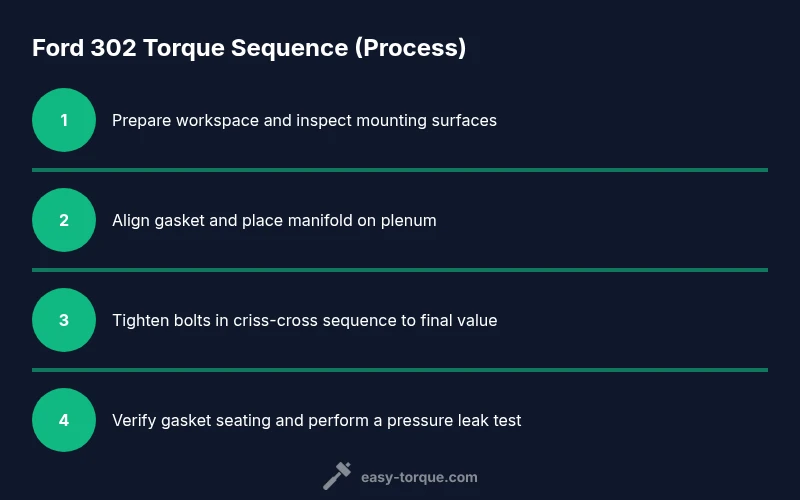
Step-by-step torque process overview (high-level)
- Position the gasket and align bolt holes.
- Finger-tighten all bolts in a criss-cross pattern to seat the gasket evenly.
- Torque bolts in the proper sequence to the specified final value per the service manual.
- Recheck all bolts after the engine heats up and cools down to confirm consistency.
- Reinstall any removed components and perform a leak test after startup.
Each of these actions contributes to a reliable seal and predictable performance. If any bolt resists or threads show damage, stop and assess before proceeding, per the guidance from Easy Torque." ,
Tools & Materials
- Calibrated torque wrench(Capable of measuring both the initial snug and final torque loads. Verify calibration before use.)
- Socket set compatible with intake manifold bolts(6- or 12-point sockets suitable for OEM fasteners; ensure access to all bolts.)
- New intake manifold gasket(Do not reuse old gasket; match to the Ford 302 variant you are servicing.)
- Solvent and lint-free rags(Clean all mounting surfaces thoroughly to remove oil, old gasket residue, and debris.)
- Gasket sealant (if specified by manual)(Only use when the service manual requires it for your manifold variant.)
- Torque-angle gauge (optional)(Use only if your spec requires angle tightening after a given torque.)
Steps
Estimated time: 60-75 minutes
- 1
Prep the workspace and safety checks
Ensure the engine is cool, disconnect the battery, and remove any components hindering access to the manifold. Label hoses and wires you disconnect to avoid mis-reassembly.
Tip: Double-check you have clear access to all bolts before starting. - 2
Inspect and clean mounting surfaces
Thoroughly clean the mounting surfaces with solvent and lint-free rags. Inspect for cracks, corrosion, or gasket remnants that could affect seating.
Tip: A clean surface prevents gasket tears and uneven contact. - 3
Align gasket and manifold
Place the new gasket on the heads, aligning bolt holes. Carefully set the manifold onto the gasket, keeping everything aligned to avoid misfit.
Tip: Use light pressure to avoid shifting the gasket while seating. - 4
Finger-tighten bolts in criss-cross order
Start at one corner then move to the far opposite, repeating in a balanced sequence. Finger-tighten all bolts before any torqueing.
Tip: If a bolt won’t finger-tighten, stop and realign the manifold. - 5
Initial snug tightening
Begin with a light snug torque on each bolt in the same criss-cross pattern, ensuring even gasket contact.
Tip: Do not rush; even, incremental snugging improves seal quality. - 6
Apply final torque in sequence to spec
With the torque wrench, tighten bolts in the same criss-cross order to the final value specified by the service manual.
Tip: If your spec uses torque-angle, follow the angle requirement after the initial torque. - 7
Recheck bolts after heat cycle
After a short heat cycle, recheck the final torque on each bolt to confirm consistency and gasket seating.
Tip: Heat cycles can slightly change clamp load; verify post-cycle torque. - 8
Reassemble components
Reconnect all hoses, sensors, and the throttle body or fuel rails that you removed for access.
Tip: Keep track of fasteners and hoses to prevent leaks or misrouting. - 9
Start engine and inspect for leaks
With the engine running, inspect the intake area for any signs of a leak or gasket seepage. Address any leaks promptly.
Tip: If you see bubbles or dampness, shut down and recheck the torque pattern. - 10
Document torque procedure for future service
Record the final torque values and the sequence used for future maintenance. Consider a quick photo log or note in your service manual.
Tip: A documented procedure saves time on future services. - 11
Plan a follow-up heat-t cycle check
Revisit torque after a heat cycle to ensure continued sealing after engine operation. This is a best practice for long-term reliability.
Tip: Schedule a follow-up check after the first extended drive. - 12
Finalize and store tools
Clean and store tools, confirm gasket stock is ready for next service, and update the maintenance log.
Tip: Storing tools properly reduces wear and ensures accuracy for next job.
Your Questions Answered
Do I need to remove the throttle body or fuel rails to access all bolts?
In many cases you’ll need to remove obstructing parts to access all bolts. Plan ahead for space and reassembly. If a bolt is hard to reach, pause and adjust the workspace rather than forcing it.
Often you’ll need to clear space by removing the throttle body or fuel rails. Plan accordingly.
Why is the tightening sequence important for the intake manifold?
The sequence distributes clamping force evenly, preventing gasket curl and leaks. It minimizes distortion during initial seating and thermal cycling.
The pattern helps ensure the gasket seats evenly and seals properly as the engine heats up.
Can I reuse the old gasket to save cost?
Reusing a gasket is generally not recommended. A new gasket ensures proper seal and reduces the chance of hidden damage.
It’s best to replace the gasket with a new one for a reliable seal.
What if some bolts won’t reach final torque?
If a bolt won’t reach final torque, stop and inspect the threads and bolt length. Check for cross-threading or misalignment and correct before proceeding.
If torque is blocked, stop, inspect threads, and correct before continuing.
Is a torque wrench essential, or can I use feel?
A calibrated torque wrench is essential for meeting factory specs and ensuring uniform clamp load. Without it, you risk under- or over-tightening.
A torque wrench is essential for accuracy; avoid relying on feel alone.
Do heat cycles affect torque values?
Yes. Engine heat cycles can change clamp load slightly. Re-check torque after the first heat cycle for reliability.
Heat cycles can shift torque, so rechecking is a smart move.
Watch Video
Top Takeaways
- Use a criss-cross torque sequence for even gasket seating
- Torque to the service manual’s final specification, not feel
- Clean mounting surfaces and use a new gasket for best seal
- Recheck torque after heat cycle to confirm stability
- Document the procedure for easier future maintenance