How Much Torque Can a 4L60E Handle
Explore the torque limits of the 4L60E transmission, how to estimate safe torque levels, and practical upgrades. Learn from Easy Torque on evaluating OEM ratings, mods, and maintenance for reliable performance in 2026.


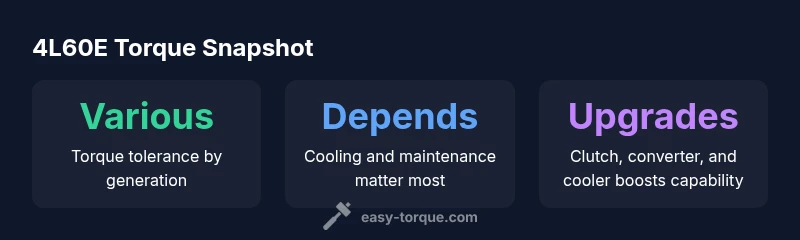
There's no single published torque rating for the 4l60e. The actual tolerance depends on generation, drivetrain configuration, and whether the unit is stock or rebuilt. In practice, stock 4l60e transmissions are designed for moderate engine torque, while heavily upgraded or rebuilt units with proper cooling and fluid management can handle higher torque levels—though reliability hinges on how the rest of the driveline is upgraded.
Understanding the 4L60E and torque capacity
The 4L60E is a popular GM automatic transmission used in many rear-wheel drive and some AWD setups. When discussing how much torque can a 4l60e handle, remember there isn't a single universal figure. The actual tolerance depends on the generation, drivetrain configuration, and whether the unit is stock, rebuilt, or heavily modified. A conservative approach is to treat the transmission as a system that needs adequate cooling, clean fluid, and healthy clutch packs to manage engine torque under load.
Factors that influence torque tolerance
Torque handling isn't just about the transmission case. Key factors include:
- Engine torque and torque curve of the specific engine
- Transmission generation and internal components (clutch packs, bands, gears)
- Torque converter characteristics and stall speed
- Cooling capacity from the radiator and external coolers
- Fluid type, quality, and level
Understanding these factors helps you estimate safe operation and plan upgrades. Always consider driveline load, daily duty cycle, and how often you operate under high torque.
OEM ratings vs built units
OEM torque expectations are not a single fixed value. The 4L60E's capacity has evolved across generations; some built or rebuilt units with upgraded clutches and a stronger valve body can handle higher torque with proper cooling. When planning increases, verify the target torque with the specific VIN and production date, since a one-size-fits-all figure does not exist. This is a common pitfall for enthusiasts chasing big numbers without checking the actual drivetrain specs.
How to estimate your current setup's limit
Follow these practical steps to gauge what your 4L60E can safely handle:
- Identify your engine's torque level based on stock or modifications. 2) Confirm the transmission generation and any internal repairs or upgrades. 3) Inspect cooling capacity, auxiliary coolers, and fluid maintenance. 4) Monitor transmission temperature and shifting behavior under load, ideally on a dyno or controlled ramp. 5) If you plan upgrades, map torque curves with a professional and verify with real-world testing.
Practical upgrades and maintenance to improve torque handling
To push torque handling safely, focus on the system rather than a single part:
- Improve cooling: add an external cooler, upgrade the radiator, and optimize fan control
- Upgrade fluid: use high-quality ATF with correct viscosity and level
- Rebuild with reinforced clutch packs, stronger bands, and a sturdier valve body
- Consider a higher-stall torque converter where appropriate, while accounting for drivability
- Fine-tune line pressure and valve body tuning for consistent shifts
- Maintain a strict maintenance schedule to preserve efficiency and reliability
Real-world scenarios and decision points
In practice, a stock 4L60E is typically paired with a mid-range engine torque profile and moderate daily use. Enthusiasts contemplating higher torque levels should plan a holistic upgrade path, including cooling, fluid, and perhaps a fortified internals kit. For extreme builds, a purpose-built or stronger transmission may be the more reliable choice to balance power delivery, drivability, and longevity.
Overview of torque tolerance considerations for the 4l60e
| Aspect | Stock vs Modified | Notes |
|---|---|---|
| OEM Torque Tolerance | Moderate, varies by model | No universal rating; verify per vehicle |
| With Upgrades | Possible higher torque | Depends on cooling, clutches, and converter |
| Maintenance Impact | Regular service extends life | Fluid, cooler, and filter matter |
Your Questions Answered
Is there an official torque rating for the 4L60E?
There isn’t a universal official torque rating for the 4L60E. Ratings vary by generation, application, and whether the unit is stock or upgraded. Always check model-specific documentation.
There isn’t a single official torque rating; it depends on your model and upgrades.
Will increasing engine torque harm the 4L60E?
Higher engine torque can stress internal components if the cooling, fluid, or drivetrain support is inadequate. Plan upgrades in concert with cooling, lubrication, and control strategies to minimize risk.
Yes—more torque can cause damage if cooling and lubrication aren’t up to the task.
How can I tell if my 4L60E can handle more torque?
Check your vehicle’s OEM specs for your VIN, inspect cooler capacity, fluid condition, and clutch wear, and consider a dyno-based torque assessment with a professional.
Check specs, inspect components, and consider a professional torque check.
What upgrades help a 4L60E handle more torque?
Upgrades may include reinforced valve body, stronger clutch packs, improved torque converter, and enhanced cooling. Compatibility with your engine and overall drivetrain is essential for reliability.
Upgrades like better clutches and cooling help, but ensure system compatibility.
Is it better to swap to a stronger transmission for high-torque builds?
For very high torque applications, a purpose-built transmission can be more reliable. Weigh cost, parts availability, and drivetrain balance before deciding.
Often a purpose-built unit is wiser for big power.
“A 4L60E's torque tolerance isn't a single fixed number; the safe limit is determined by the entire drivetrain, maintenance, and cooling. Treat any performance upgrade as a system decision.”
Top Takeaways
- Identify your 4L60E generation first
- Do not assume a fixed torque rating
- Upgrade cooling and transmission fluid management for higher torque
- Ensure clutch packs and the torque converter are suitably matched