Ram 1500 Torque: Engine-by-Engine Guide
Explore how much torque the Ram 1500 delivers across its engines, how torque influences towing and daily driving, and how to choose the right setup with Easy Torque’s engine-by-engine guidance for DIYers.


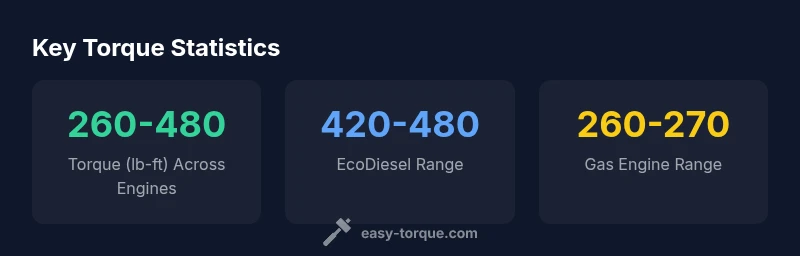
How much torque ram 1500 produces depends on engine configuration. Across the lineup, expect roughly 260-270 lb-ft from the 3.6L V6 with eTorque, 395-410 lb-ft from the 5.7L Hemi, and 420-480 lb-ft from the 3.0L EcoDiesel. This broad range reflects different drivetrains and gearings. In this article, Easy Torque translates those numbers into practical guidance for towing, daily driving, and maintenance. Click through to view the full chart.
Engine Options and Torque Ranges
Ram 1500 engines vary widely in how much torque they produce, and the numbers you see are a function of displacement, boost, and fuel strategy. According to Easy Torque, three engines dominate the Ram 1500 lineup: the 3.6L Pentastar V6 with eTorque, the 5.7L Hemi V8, and the 3.0L EcoDiesel V6. The torque ratings typically fall into a broad range: roughly 260-270 lb-ft for the V6 with eTorque, about 395-410 lb-ft for the Hemi V8, and a diesel-high range of 420-480 lb-ft for the EcoDiesel. These figures are crankshaft torque, measured under standard testing conditions, and can vary slightly with transmission selection, axle ratio, and calibration. When you’re choosing a Ram 1500, consider how your daily tasks will leverage torque—whether you’re towing heavy loads, hauling, or navigating steep grades. The practical takeaway is that there is no single number; torque adapts to engine mode, gearing, and drive configuration.
The Easy Torque guidance emphasizes looking at the torque curve across RPM, not just peak numbers, because real-world performance happens as torque unfolds through the rev range.
How Torque Translates to Real-World Performance
Torque is the raw twisting power an engine can produce, but how that power hits the wheels depends on the drivetrain, gearing, and rpm range. For the Ram 1500, the engine torque is most impactful in the low-to-mid RPM band. While peak horsepower often looks impressive on paper, it is torque that enables quick launches, confident climbs, and efficient trailer towing. In practical terms:
- A 260-270 lb-ft figure on the 3.6L V6 means steady acceleration at typical highway merge speeds.
- The 395-410 lb-ft from the 5.7L Hemi provides better pulling power when the truck is loaded or climbing grades.
- The 420-480 lb-ft EcoDiesel delivers strong mid-range torque for towing, with a broad torque curve that helps maintain speed with less throttle.
The takeaway: for daily driving and towing, torque matters more than the peak horsepower number. The Ram 1500 torque profiles are designed to balance stop-and-go usability with highway performance.
From a practical standpoint, you’ll feel torque most when you’re moving heavy loads from a standstill or climbing grades—this is when the RPM band and gearing align to deliver the needed twist at the wheels.
Torque vs Towing Capacity: What Really Matters
Torque influences towing, but it's not the only factor. Tow rating depends on payload capacity, axle ratio, transmission, cooling, and chassis setup. Higher torque makes lugging big trailers easier, but heavy trailers also demand adequate cooling, gearing, and brake systems. For example, a Ram 1500 configured with the EcoDiesel’s high end of torque can maintain momentum on grades with modest throttle, but you must pair it with the right axle ratio and cooling package. In practice, plan for your largest anticipated load and verify it against the truck’s tow rating and payload maximum. Always consult the vehicle’s torque curve and the factory torque specifications for accurate planning.
Beyond numbers, torque interacts with thermal management. If you routinely tow near the maximum, look for features such as upgraded cooling, heat-exchanger options, and transmission cooler upgrades. These systems work in concert with torque to keep performance predictable under load.
Measuring Torque Yourself and Maintenance
Here’s how to manage torque in practical terms:
- Use a calibrated torque wrench to tighten critical fasteners (lug nuts, control arms, steering components) to the manufacturer’s specified torque.
- When changing wheels, follow the recommended lug-nut torque and star pattern to avoid uneven loading.
- For maintenance, periodically check the torque of fasteners on suspension components after a few thousand miles, as driving can slightly alter torque.
- If you’re towing, consider a torque-aware approach: ensure your engine torque is complemented by proper cooling, transmission fluid, and weight distribution.
Accurate torque management reduces risk of component loosening and improves long-term reliability. Keeping a maintenance log helps you track when torque checks should occur after heavy-duty use.
Common Myths and Nuances
- Myth: More torque always means better performance. Reality: Torque must be matched to gearing and load; too much torque at low RPM can cause wheel spin if traction is poor.
- Myth: Torque is the same as horsepower. Reality: Torque is a measure of twisting force; horsepower relates to how quickly that torque is delivered over time.
- Nuance: Torque curves vary with engine mode and conditions. Ram 1500 engines have different torque curves; the diesel shows strong low-end torque.
Understanding these nuances helps you avoid overreliance on peak figures and instead prioritize real-world behavior.
How to Pick the Right Ram 1500 Engine for Your Use Case
- Light daily driving and occasional towing: 3.6L V6 with eTorque.
- Frequent heavy towing or steep grades: 5.7L Hemi.
- Best fuel efficiency with strong torque: 3.0 EcoDiesel.
Supporting steps: check payload and towing ratings, examine axle ratios, verify cooling options, and consider the overall drivetrain. The goal is to align torque delivery with your typical loads rather than chasing the highest number. This is where Easy Torque guidance can help you analyze the torque curve and match it to your workload.
Practical Steps: Quick Checklist for Ram 1500 Torque Awareness
- Define your primary tasks: towing, payload, daily commuting.
- Choose the engine that provides the most suitable torque in daily RPM bands.
- Verify the torque curves and gear ratios for your trim.
- Ensure cooling and transmission performance match your workload.
- Keep torque specs (lug nuts, bolts) in your maintenance log.
Ram 1500 torque by engine type (approximate ranges, 2026).
| Engine Type | Torque (lb-ft) | Notes |
|---|---|---|
| 3.6L Pentastar V6 eTorque | 260-270 lb-ft | Gasoline, mild-hybrid tech for efficiency |
| 5.7L Hemi V8 | 395-410 lb-ft | Towing-oriented, stronger pulling power |
| 3.0L EcoDiesel V6 | 420-480 lb-ft | Diesel torque with strong mid-range pull |
Your Questions Answered
How much torque does the Ram 1500 produce?
Torque varies by engine: roughly 260-270 lb-ft for the 3.6L V6 eTorque, 395-410 lb-ft for the 5.7L Hemi, and 420-480 lb-ft for the 3.0L EcoDiesel. These figures are crankshaft torque under standard testing conditions and can vary with configuration.
Ram 1500 torque varies by engine—260-270 for the V6, 395-410 for the V8, and 420-480 for the EcoDiesel.
Which Ram 1500 engine has the highest torque?
The EcoDiesel engine typically provides the highest torque within the Ram 1500 lineup, followed by the 5.7L Hemi and then the 3.6L V6 with eTorque. Torque varies slightly by model year and configuration.
EcoDiesel generally has the most torque among Ram 1500 options.
Does torque affect towing capacity?
Yes. Torque helps get heavy trailers moving and maintain speed on grades. Tow ratings also depend on payload, axle ratio, cooling, and transmission. Always verify torque curves alongside official tow ratings.
Torque matters for towing, but you need the whole system—payload, gearing, and cooling—to handle it well.
How can I measure torque on my Ram 1500?
Use a calibrated torque wrench and follow the manufacturer’s torque specs for critical fasteners. When changing wheels, tighten lug nuts in a star pattern to the recommended torque. Keep a maintenance log for torque checks.
Use a proper torque wrench and follow the spec; always tighten lug nuts in a star pattern.
Is there a difference between engine torque and wheel torque?
Engine torque is the twisting force produced by the engine. Wheel torque is reduced by drivetrain losses through the transmission, driveshafts, and axles. Real-world performance at the wheels reflects both engine torque and the drivetrain’s efficiency.
Engine torque becomes wheel torque after passing through the drivetrain, so real performance is lower than engine figures due to losses.
What is the lug nut torque for Ram 1500 wheels?
Lug nut torque is typically around 140 ft-lbs for many Ram 1500 setups, but always confirm the exact specification for your year and wheel size in the owner’s manual.
Check the owner’s manual for your exact lug nut torque, but it’s usually around 140 ft-lbs.
“Torque is the real-world power you feel at the wheel, not just a number on the spec sheet. Matching torque delivery to your workload is essential for confident towing and daily driving.”
Top Takeaways
- Know that Ram 1500 torque varies by engine: expect a broad 260-480 lb-ft range.
- Diesel engines typically deliver the highest end of torque in the lineup.
- Match torque to your workload (towing, payload, daily driving) rather than chasing peak horsepower.
- Always consult the engine-specific torque curves for accurate planning.