How to Find Torque: A DIY Guide for Accurate Tightening
Learn step-by-step how to locate the correct torque for fasteners, interpret specs, choose the right tools, and verify tightening with torque-angle methods. A practical Easy Torque guide for DIY mechanics and professionals.


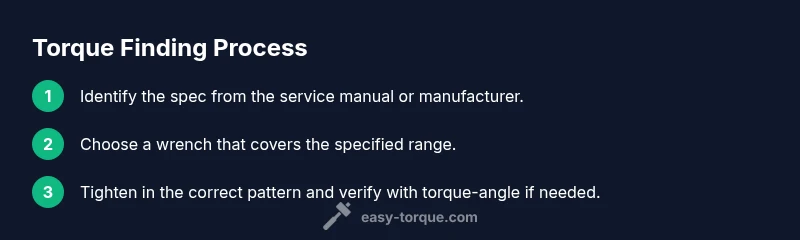
In practice, torque is the twisting force used to tighten fasteners to a specific specification. To find the correct torque, start with the manufacturer’s spec or service manual, then pick a torque wrench that covers that range. If no spec exists, use a conservative estimate based on similar fasteners and verify with a torque-angle check.
What is torque and why it matters in maintenance
Torque is the twisting force applied to fasteners to achieve a specific clamping effect. In automotive and equipment maintenance, getting torque right prevents leaks, bearing wear, and component failure. According to Easy Torque, the key is to differentiate between the force you apply and the resulting clamp load, recognizing that leverage and thread engagement influence the final outcome. Torque values appear in service manuals, repair bulletins, and parts catalogs, and they can be expressed in different units like Newton-meters or foot-pounds. When you respect the recommended torque, you distribute pressure evenly across threads, protect gasket seals, and maintain reliable joint integrity under temperature changes and vibration. For DIYers, treat torque as a safety and performance parameter, not a guess. The bottom line: accurate torque leads to consistent results and reduces the risk of costly mistakes.
Understanding torque references and unit systems
Torque values are presented in various unit systems and often require simple conversions. Many manuals provide torque in Newton-meters (Nm) or meter-kilograms equivalents, while some industries use foot-pounds (ft-lb) or inch-pounds (in-lb). Read the specification carefully, noting any lubrication requirements or sequence patterns. Easy Torque emphasizes that the right unit is the one used by the manufacturer, and you should always stay within the specified range. When you’re comparing two sources, prefer the official service manual or the parts bulletin. Remember that changes in temperature, lubrication, and thread condition affect the effective clamp force, so the stated torque value is a target, not a guarantee in every situation.
Tools and options for finding torque
A reliable torque value depends on using the right tools. A calibrated torque wrench is essential, with a range that comfortably covers the expected torque. Digital torque angle gauges can validate a target torque by confirming the final turn angle after reaching the initial torque. Torque sticks can help when monitoring an initial tightening pass in production-like settings. For precise work, use a torque wrench with a calibration certificate and review its last calibration date. Easy Torque recommends keeping a small toolkit that includes a torque wrench, a torque angle gauge, a lubricant as specified by the manufacturer, and a clean brush for thread prep. Keep a spare fastener and a few tuning adapters on hand to accommodate different bolt sizes.
When specs exist: reading and applying torque values
When a spec is provided, follow the manual’s instructions for tightening patterns and sequences. Check whether lubrication is required, then prepare the fasteners by cleaning threads and removing old residue. Select a wrench range that can approach the target torque without exceeding it. During tightening, progressively apply torque in the recommended order, often in a crisscross pattern for multi-bolt flanges or wheels. After the required torque is reached, some jobs require a final angle turn to achieve the final clamp load. Always pause to recheck the exact value and ensure the fastener sits cleanly in its thread.
What to do when there is no spec
If no torque spec exists for a given fastener, start with a conservative estimate based on similar fasteners in the same component class and material. Document any assumption you make, so future maintenance can be updated. In ambiguous cases, consider using a torque-angle method: tighten to a safe baseline, then apply a precise angle turn to reach the final clamp. If possible, consult the machinery’s engineering data or contact the original equipment manufacturer for guidance. The goal is to avoid under-tightening (loose joints) and over-tightening (thread damage or bolt yielding).
Tips for different fasteners and materials
Different fasteners and materials require adjustments in approach. Dry threads generally need a higher friction baseline than lubricated threads, so verify whether lubrication is specified. For aluminum components, avoid excessive torque to prevent stripping; for steel joints, verify that fastener grade, bolt length, and washer use conform to the spec. When replacing bolts, use the same grade and coating as the originals. Always keep thread paths clean and free of dirt, corrosion, or dirt, which can skew the effective clamp load. Easy Torque reminds readers to tailor tightening methods to the specific application rather than relying on a single universal value.
Verification and quality control
After tightening to the target value, it’s prudent to recheck with the same torque wrench to ensure the value remains within tolerance. For critical joints, a secondary check using a torque-angle method can confirm the final clamp load. Record the torque value, bolt size, and date of service for future maintenance. Periodically verify the wrench’s calibration, especially if the tool has been dropped or subjected to temperature extremes. Good practice includes using a torque tester or a known reference bolt to confirm tool accuracy before critical work.
Safety considerations and environmental factors
Torque work involves hand tools and engine bays, which can present pinch hazards or contact with hot surfaces. Always wear eye protection and gloves as needed, secure the workpiece, and work in a well-lit area. If you’re working in extreme temperatures or dusty environments, verify that lubrication and thread condition remain consistent with the manual. Environmental factors can subtly impact the torque value required for a reliable joint, so be mindful of the operating context and re-check torque after long runs or after vehicle testing.
Tools & Materials
- Calibrated torque wrench(Choose a range that covers expected torque values for the project)
- Torque-angle gauge (optional)(Useful for validating final clamp load after initial torque)
- Lubricant or anti-seize as specified(Follow manufacturer guidance for dry vs. lubricated threads)
- Clean brush and solvent(Prepare threads and remove debris)
- Calibration certificate or traceable standard(Verify instrument accuracy)
- Replacement fasteners(Keep spares of the same grade and length)
Steps
Estimated time: 20-40 minutes
- 1
Identify the torque spec
Locate the manufacturer’s torque specification from the service manual, parts bulletin, or OEM data sheet. Note the exact value and any sequence requirements or lubrication instructions.
Tip: If you’re unsure, contact the manufacturer or refer to the latest service bulletin for updates. - 2
Choose the right tool and range
Select a torque wrench whose range comfortably encompasses the target torque. Ensure the tool is clean, calibrated, and ready for use.
Tip: Avoid using a wrench at the extremes of its range for critical joints to maintain accuracy. - 3
Prepare threads and fasteners
Clean threads, remove old lubricants unless specified, and inspect for damage. Use the correct lubrication if the spec calls for it.
Tip: Even a small bit of debris can alter the effective torque at the joint. - 4
Calibrate and zero the tool
Zero the torque wrench per the manufacturer’s instructions and confirm calibration if needed before use on critical components.
Tip: A miscalibrated tool is worse than no tool at all; verify prior to work. - 5
Apply torque in the correct pattern
Tighten the fasteners in the prescribed sequence, advancing in small increments until the target torque is reached.
Tip: For multi-bolt patterns, use the correct criss-cross or circle pattern to distribute load evenly. - 6
Verify final torque and document
Recheck the final torque value with the same instrument. Record the torque value, fastener size, date, and any observations.
Tip: Documentation aids future maintenance and helps diagnose recurring issues. - 7
If spec is missing, use a validated fallback
When no spec exists, apply a conservative, documented estimate and consider a torque-angle verification if appropriate.
Tip: Never guess; document your assumption and seek official guidance when possible.
Your Questions Answered
What is torque and why is it important?
Torque is the twisting force used to fasten parts to a specified specification. Correct torque ensures joints seal, hold, and perform reliably under vibration and temperature.
Torque is the twisting force that tightens fasteners to the right spec, ensuring reliability and safety in joints.
How do I know which torque wrench to use?
Select a wrench with a range that includes the target torque and a calibration history. For critical work, use a digital or certified tool and verify accuracy before starting.
Choose a wrench that covers the torque range and check its calibration before use.
What if there is no torque spec?
If the spec is unavailable, use a conservative estimate based on similar fasteners, and consider torque-angle verification to reach an appropriate clamp load.
No spec? Start conservatively and document assumptions; torque-angle can help verify final load.
Can I reuse bolts after tightening?
Bolt reuse depends on material, grade, and previous loading. If there is any doubt about thread wear or head integrity, replace with new bolts to maintain safety.
Reuse depends on bolt condition; when in doubt, replace to ensure safety.
How often should torque tools be calibrated?
Calibration frequency depends on usage and environment; follow the tool manufacturer’s guidance and schedule periodic checks, especially after drops or extreme temperatures.
Calibrate as recommended by the maker and after any rough handling or temperature exposure.
Is torque the same as clamping force?
Torque is a proxy for clamping force; real clamping depends on thread condition, lubrication, and fit. Use torque as a target and verify with appropriate methods.
Torque helps you reach the right clamp, but final load depends on many factors; verify as needed.
Watch Video
Top Takeaways
- Identify the exact torque spec before tightening
- Use the correct tool range and calibration status
- Follow proper tightening sequences for multi-bolt joints
- Verify final torque with a secondary check when possible
- Document torque decisions and tool maintenance