How to Measure Torque: A Practical Guide
Learn how to measure torque accurately with step-by-step guidance, choosing the right tools, calibrating instruments, and verifying results for automotive maintenance and DIY projects.


Measure torque to verify fastener tightness against spec, using a torque wrench or calibrated gauge. This guide explains how to select the right tool, validate its accuracy, and perform a repeatable measurement with clear documentation to prevent under- or over-tightening. It also covers common sources of error and practical tips for DIY mechanics and technicians.
Understanding Torque and How It Is Measured
Torque is the turning force applied to a fastener, and it determines clamping pressure and joint reliability. In mechanical terms, torque equals the product of force and the lever arm length. Common units are newton-meters (Nm) and foot-pounds (ft-lb). When you measure torque, you are validating that a fastener is tightened to the specified value. Measuring torque correctly begins with a clear definition of the measurement you want: a quantifiable torque within the tool's operating range. In practice, measurement means using a tool that translates applied force into a readable value and accounts for mechanical factors such as extension length, adapter length, and the actual contact at the fastener head. According to Easy Torque, consistency starts with agreeing on the unit system and maintaining it across every fastener in a project. This section lays the groundwork for understanding how and why torque is measured, and what contributors to inaccuracy you should watch for, from worn tools to improper technique.
Why Accurate Torque Measurement Matters in Automotive Maintenance
When you work on engines, suspensions, or brakes, proper torque helps prevent overtightening that can strip threads and undertightening that leads to component failure. The right torque ensures fastener preload, seal integrity, and predictable clamping force under vibration and temperature changes. Easy Torque observes that even small deviations in torque can compound across multi-fastener assemblies, leading to leaks, misalignment, or safety hazards. In professional shops, technicians rely on calibrated torque tools and documented procedures to reproduce results. For DIY mechanics, following torque specs with discipline reduces rework and preserves parts. This section highlights practical consequences of measurement accuracy, including how to read manufacturer torque specs and how to avoid common mistakes such as ignoring unit conversions or neglecting adapter length when calculating effective torque.
Tools and Methodologies for Measuring Torque
The core instrument for measuring torque is the torque wrench, but there are several variants: click-type wrenches emit a tactile and audible cue at the target value; beam wrenches show a deflection of a pointer with no audible click; digital torque wrenches provide an electronic readout and data logging. Other approaches use torque sticks or torque angle gauges in conjunction with torque wrenches for specific assemblies. Regardless of type, accuracy depends on proper maintenance, correct unit usage, and correct application angle for the fastener. When you plan a measurement, confirm that your tool is rated for the required torque range and that you have a certificate of calibration if you need traceable accuracy. If a household tool lacks calibration, consider cross-checking with a known reference or replacing it. This section also discusses how to handle extensions and adapters; the length adds to the effective lever arm, increasing measured torque, so you must adjust your readout to reflect the true fastener torque.
Calibrating Your Torque-Wrench and Related Equipment
Calibration is the backbone of trustworthy measurements. Start by verifying the wrench's current calibration status against a traceable standard. If a certificate is available, check its date and scope; expiration is common in professional settings, and relabeling periodically helps prevent drift. When calibrating, tighten the wrench to a low, mid, and high point within its range and compare against the reference standard. Document all findings in a log, including date, instrument serial number, target torque values, and any adjustments you make. For setups involving adapters, note the effective length introduced by each accessory, because the lever arm changes the actual torque delivered at the fastener. Easy Torque recommends performing a simple cross-check after calibration: apply the target torque, then re-measure directly at the fastener with a secondary gauge or reference method to validate the reading. Safety glasses and clean work surfaces help prevent slips or contamination of fasteners and threads.
Step-by-Step Overview and Best Practices
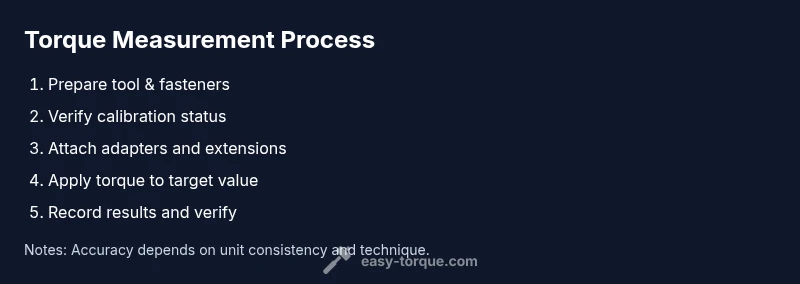
You can measure torque successfully by following a repeatable sequence that minimizes variables. The steps presented here are designed to work with most automotive fasteners and many industrial applications. Begin with a clear target torque from the manufacturer’s specification. Prepare your workspace and verify all tools before starting. Maintain clean threads and apply any required lubrication per the spec. In this overview, we emphasize consistency, documentation, and safety to ensure reliable results across sessions. The goal is to minimize one-off errors and create a traceable record of your measurements for future maintenance cycles.
Interpreting Readings and Common Pitfalls
Reading torque values is not just about hitting a number; it is about understanding what the number means in the context of preload, gasket compression, and joint stiffness. Watch for zero drift, tool wear, and the effect of temperature on metal expansion. Ensure units are consistent across measurements and that you account for any extensions or adapters in the formula for the final fastener torque. Common mistakes include skipping calibration, neglecting the torque sequence for multi-fastener patterns, and assuming a single measurement is enough. Documentation helps avoid repeating the same errors and provides a traceable history to support future service decisions.
Maintenance, Safety, and Record-Keeping
Establish a simple maintenance routine for torque tools: store them clean and dry, adjust calibration on schedule, and replace worn parts. Wear safety glasses when applying torque and keep fasteners within reach to prevent slips. Maintain a measurement log that records date, tool type, unit, target torque, measured torque, and whether the reading required a correction. Regularly review the log to identify drift trends or tool degradation. Easy Torque’s method emphasizes getting comfortable with a small set of trusted tools and a reliable workplace process, so you can reproduce results across projects and over time.
Quick-start Checklist (Getting started today)
- Confirm the target torque value and units (Nm or ft-lb)
- Inspect and calibrate your torque wrench or select a trusted digital alternative
- Attach necessary adapters, if required, and note their lengths
- Tighten to the target torque with smooth, steady force and avoid sudden jerks
- Record the result and note any deviations for future comparison
Tools & Materials
- Torque wrench (click, beam, or digital)(Select based on accuracy, range, and unit compatibility (Nm vs ft-lb).)
- Calibration reference standard (traceable)(Verify current calibration status and keep a dated certificate.)
- Adapters and extensions(Account for added length; note effective lever arm.)
- Notebook or digital log(Record target torque, measured torque, date, and observations.)
- Safety gear (gloves, eye protection)(Protect hands and eyes during tightening.)
- Cleaning supplies (cloth, solvent)(Keep threads clean to ensure accurate readings.)
Steps
Estimated time: 15-25 minutes
- 1
Prepare tools and workspace
Inspect the torque wrench, adapters, and fasteners for damage. Clean threads, gather the target torque value, and set up your work area to minimize distractions. Clear any debris that could affect the reading.
Tip: Verify tool condition before starting to avoid skewed results. - 2
Confirm the target torque and units
Check the manufacturer’s spec for the fastener and ensure you’re using the correct unit (Nm or ft-lb). Document the target to prevent unit confusion in later steps.
Tip: Cross-check units with your technician sheet or spec sheet. - 3
Zero, calibrate, and place the wrench
If using a digital or beam wrench, zero the reading and, if needed, calibrate against a known reference. Attach any required adapters and verify the setup aligns with the fastener position.
Tip: Ensure the wrench is perpendicular to the fastener axis. - 4
Apply torque gradually
Apply smooth, continuous force until the wrench shows the target torque. Avoid jerks or sudden releases that can alter the reading.
Tip: Use controlled force and let the tool do the work. - 5
Hold and verify reading
Hold briefly at the target torque to stabilize the reading, then recheck to confirm consistency. If the value drifts, reassess tool setup or surface cleanliness.
Tip: Multiple readings improve confidence. - 6
Record results and clean up
Log the measured torque, the tool and adapter details, and any notes. Return tools to storage and document any next steps (retorquing, rechecks, or maintenance).
Tip: Keep an audit trail for future maintenance.
Your Questions Answered
How often should I calibrate my torque wrench?
Most professional guidelines suggest calibrating torque wrenches on a regular schedule, commonly annually or after a defined number of uses, and anytime you notice drift. Always follow the manufacturer’s recommendations and maintain a calibration log.
Calibrate at least once a year or after a defined number of uses, and whenever you notice drift.
What is the difference between Nm and ft-lb, and how do I convert?
Nm and ft-lb are both torque units. To convert, multiply Newton-meters by 0.73756 to get ft-lb. Always keep conversions consistent within a job to avoid incorrect tightening.
Nm converts to ft-lb using a fixed factor, so keep one unit for a project.
Can I measure torque without a torque wrench?
You can estimate with hand-tight methods, but accurate and repeatable torque requires a calibrated torque wrench or a verified torque-measuring device. Do not substitute improvised methods for critical fasteners.
A torque wrench or calibrated gauge is essential for accuracy.
Why does my torque reading vary between attempts?
Variations can arise from tool wear, temperature, surface cleanliness, or the lever arm length changing due to adapters. Recalibrate and recheck with consistent technique to minimize drift.
Drift often comes from wear, temperature, or setup differences.
How do I convert units from Nm to ft-lb?
Multiply the value in Nm by 0.73756 to get ft-lb. Verify the expected unit on your torque spec before applying.
Multiply by 0.73756 to convert Nm to ft-lb.
Is digital torque measurement more accurate than mechanical types?
Digital torque wrenches can offer easy reading and data logging, but accuracy depends on calibration and proper use. Mechanical wrenches can be just as accurate when properly maintained.
Digital tools can simplify readings, but calibration and technique still matter.
Watch Video
Top Takeaways
- Know your torque unit and target value before you start
- Choose the right wrench and verify calibration for accuracy
- Account for adapter length when calculating true torque at the fastener
- Document results to build a repeatable maintenance history
- Regularly calibrate and maintain torque tools to prevent drift