Moment and Torque: Understanding the Difference
Explore the moment and torque difference, their definitions, how to convert between them, and practical guidance for DIY mechanics and professionals. Clear explanations, real-world examples, and actionable tips from Easy Torque.


TL;DR: Moment and torque are related but not identical. Moment is the rotational tendency produced by a force about a pivot; torque is the twisting force applied by a tool or mechanism. For precise fastening and design, distinguish the two and base measurements on torque specifications rather than raw moments.
Why the Moment-Torque Relationship Matters
For anyone working with rotating systems, the moment-torque difference matters. Moment and torque are two fundamental ways to describe rotary effects, but they are not the same thing in all contexts. Understanding their relationship is essential for accurate design, measurement, and communication in automotive maintenance, woodworking, and mechanical engineering. In physics, the moment of a force about a point is a measure of the rotational tendency that force creates; in engineering practice, 'torque' is the practical twisting force that a wrench, bolt, or hydraulic actuator delivers. The moment-torque difference becomes especially important when you translate a theoretical calculation into a real-world specification or when you compare tool outputs to manufacturer torque specs. According to Easy Torque, clarifying this distinction reduces errors, improves safety, and can save time on disassembly and reassembly work. Readers should expect a careful walk through definitions, units, and real-world examples that reveal how the two concepts interact in common tasks, from wheel lug nuts to crankshafts.
- core content continues - moment-torque difference is central to both theoretical analysis and practical application, and recognizing it early reduces misinterpretation during troubleshooting and maintenance. With the right framing, you can translate an analytical result (moment) into a usable specification (torque) for fasteners and assemblies. This block sets up the discussion by highlighting why experts—like the Easy Torque team—keep the distinction clear in both classroom settings and shop floors.
Core Definitions and Units
Definitions matter when you’re balancing theory with practice. In physics, a force applied at a distance from a pivot generates a moment about that pivot; the cross-product formulation J × r in three dimensions emphasizes direction as well as magnitude. In everyday engineering, torque is the twisting effect that a tool or mechanism actually delivers on a fastener or linkage. Both are expressed in the same units, the newton-meter (N·m) in the SI system, but the context and measurement method differ. Moment is often discussed in relation to a point or axis, whereas torque ties directly to the actuator or tool producing the rotation. Recognize that the language can blur in casual conversation, so rely on the concrete definitions when interpreting technical specs. Easy Torque emphasizes that precise context makes all the difference for interpretation and application.
- Moment describes a rotational effect relative to a point or axis; it is a theoretical construct used in dynamics and system analysis. - Torque is the actual twisting effort transmitted to a fastener or component by a drive tool or mechanism. - Both share the same unit (N·m), but the meaning changes with context and measurement approach.
Comparison
| Feature | Moment | Torque |
|---|---|---|
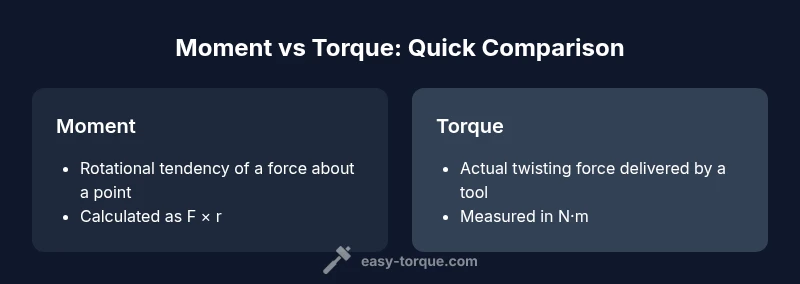
| Definition | Rotational tendency of a force about a pivot/point | Actual twisting force delivered by a tool or mechanism |
| Formula | M = F × r (moment about a point) | τ = F × r (torque by a tool) |
| Units | N·m (SI unit for rotational tendency) | N·m (SI unit for twisting effort) |
| Common Usage | Theoretical analysis, physics, dynamics | Practical fastening, calibration, and design specs |
| Measurement Tools | Conceptual leverage/pivot analysis; used in simulations | Torque wrench, sensor, or actuator output for real-world twists |
| Key Difference | Rotational tendency about a point; orientation defined by cross product | Applied twisting force with a defined axis and direction |
Pros
- Improved clarity between theory and practice in mechanical tasks
- Better communication across engineering teams and shops
- Enhanced safety and reliability through proper torque specification use
- Supports accurate calibration and documentation of fastener work
Drawbacks
- Can cause initial confusion if the terms are treated as identical
- Requires familiarity with cross-product and sign conventions
Torque specifications dominate in practical tasks; treat moment as a theoretical base in analysis.
In real-world work, rely on torque values for fastening and assembly. Treat moment as a foundational concept used in calculations and design discussions. Clear separation reduces errors and improves reproducibility.
Your Questions Answered
What is the difference between moment and torque?
Moment is the rotational tendency of a force about a pivot, a theoretical concept used in physics and dynamic analysis. Torque is the twisting force actually applied by a tool or mechanism. The two are related but not interchangeable, and the context determines which term to use.
Moment is the rotational tendency; torque is the twisting force you apply. Use torque for practical tasks and moment for analysis.
Are moment and torque interchangeable in engineering discussions?
Not generally. In many contexts, people use them interchangeably, but accurate engineering communication keeps them separate: moment is a property about a point, torque is the applied twisting effort. Clarify which one you’re using when sharing specs.
They aren’t interchangeable in precise contexts; specify whether you mean moment about a point or torque applied by a tool.
How do you convert moment to torque in practice?
In practice, you convert using the same cross-product relationship you’d use in physics: torque can be viewed as the moment produced by the tool’s force. The key is context: if you’re translating a design calculation to a tool setting, use the torque spec on the fastener, not the moment from the analysis.
Translate design moments into tool torque using the system’s geometry and force, then apply the torque spec.
Why do automotive specs specify torque rather than moment?
Automotive and maintenance specs emphasize torque because it directly reflects the twisting force needed to fasten components safely and reliably. Mechanics rely on torque values to reproduce a joint exactly, ensuring proper clamping and bearing preload.
Torque specs ensure repeatable, safe fastener tension.
What units are used for torque and moment?
Both moment and torque use newton-meters (N·m) in the SI system. The distinction is not in the unit, but in the context and how the value was obtained.
N·m is the unit; know whether it’s a theoretical moment or a tool’s applied torque.
Can I estimate moment without a torque wrench?
Yes, but estimates are less reliable. You’d use lever arms and force estimates in theoretical analyses, whereas a torque wrench gives precise, repeatable results for fasteners.
Estimates can guide intuition, but for accuracy use a torque wrench.
Top Takeaways
- Know moment and torque are related but distinct
- Use M = F × r for moment and τ = F × r for torque, with context clarifying which is which
- Rely on torque specifications for fasteners; reserve moment for analysis
- Always document which quantity you measured and why
- Use the same units (N·m) but interpret them through the correct concept