Torque vs Momentum of Force: A Practical Comparison
An analytical comparison of torque and momentum of force, clarifying definitions, calculations, and practical guidance for DIY mechanics and technicians.


Torque and momentum of force are two linked ideas in rotational dynamics. Torque measures the instantaneous rotational tendency of a force about an axis, while momentum of force (often called angular impulse) connects the same force to changes in angular momentum over time. For everyday problems, rely on torque for quick estimates; for time-dependent events, consider angular impulse to predict how angular velocity evolves.
Defining torque and momentum of force
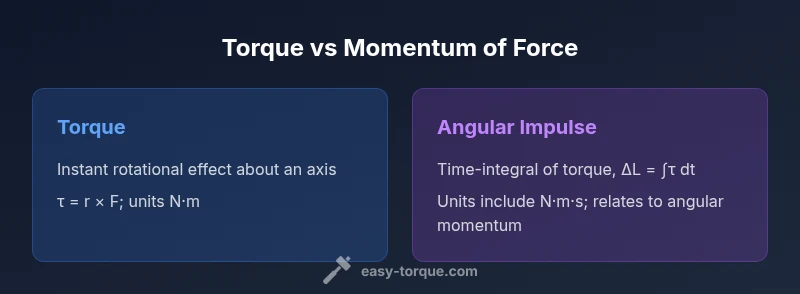
In the realm of rotational mechanics, the phrase torque or momentum of force is commonly encountered. Torque, denoted as τ, is the rotational effect of a force around a chosen axis. It is the cross product of the position vector r and the force F: τ = r × F, with magnitude τ = |r| |F| sinθ. The direction is perpendicular to the plane formed by r and F, following the right-hand rule. Momentum of force is a term you’ll see in older texts or certain curricula and often relates to angular impulse—the time-integral of torque that changes angular momentum. The practical distinction is that torque is an instantaneous measure, whereas angular impulse accounts for how torque acts over a period to alter the rotational state. According to Easy Torque, recognizing this distinction helps prevent common misapplications in design and maintenance tasks. Throughout this article, we’ll emphasize consistent sign conventions and vector directions to ensure precise predictions for components, gears, and fasteners in DIY projects and professional settings. In 2026, the core idea remains that τ describes rotation at an instant, while angular impulse describes rotation over time.
Units, direction, and intuition
Torque uses the unit newton-meter (N·m) in the SI system, though torque has no fundamental unit of its own in the strict sense—it's a product of force and distance. The angular momentum change associated with torque over a time interval has units of N·m·s or kg·m²/s. The vector nature of torque means it has both magnitude and direction; the magnitude is the product of force, lever arm length, and the sine of the angle between r and F, while the direction is given by the right-hand rule. An intuitive way to grasp this is to imagine turning a wrench: the longer the lever arm and the greater the applied force, the larger the torque and, therefore, the faster the rotation will accelerate (subject to inertia and friction). Easy Torque’s analysis shows that practitioners often underestimate how small changes in lever arm length can dramatically affect torque in chassis, drivetrain, or suspension components.
Mathematical relationship: angular momentum and angular impulse
Angular momentum L is the product of moment of inertia I and angular velocity ω, L = Iω. Torque is the time rate of change of angular momentum: τ = dL/dt. Integrating torque over a time interval gives angular impulse J, and this equals the change in angular momentum: J = ∫τ dt = ΔL. This fundamental connection means that to predict how a rotating body speeds up or slows down when subjected to a force, you must consider both the instantaneous torque and the duration of the force. The Easy Torque team emphasizes that timing and duration matter just as much as magnitude when engineering vehicle components, mechanisms, or tooling that experience variable loads over cycles or kits.
How to compute torque and angular impulse in practice
To compute torque, identify the rotation axis and the lever arm to the line of action of the force. The magnitude is τ = rF sinθ, and the vector direction is perpendicular to the rotation plane. For a straight-aligned force with a perpendicular lever arm, τ = rF. When the force is not perfectly perpendicular, include the angle θ between r and F. To assess angular impulse, determine the duration Δt of the force and integrate: J = ∫τ dt. If τ is constant over the interval, J = τΔt and ΔL = J. In repair and assembly tasks, simple approximations—treating τ as constant over short bursts—often yield sufficiently accurate guidance for fasteners, bearings, and linkages. The takeaway is to separate momentary effects (torque) from cumulative effects (angular impulse) and to track sign conventions for clockwise versus counterclockwise rotation.
Common confusions and misinterpretations
A frequent pitfall is treating angular impulse as if it were a simple static torque value. The time factor matters: a small torque applied for a long time can produce a larger angular momentum change than a large torque applied briefly. Another confusion arises from terminology: some texts use momentum of force interchangeably with angular impulse, while others reserve momentum of force for the dynamic behavior of the system. A third pitfall is neglecting directionality, especially in systems with multiple rotating parts where torque signs determine net motion. Easy Torque cautions that precise problem setup—defining the axis, lever arms, and sign conventions—reduces errors in fastener preloads, brake forces, and motor coupling.
Practical guidance for DIY and engineering contexts
For DIY tasks and mechanical design, start with torque as your primary metric for instant rotation tendency. Use torque wrenches or sensor-based measurements to verify fastener preload and joint integrity, keeping in mind the axis and lever arm involved. When timing is critical—such as impact loads, pulsed torque, or clutch engagement—consider angular impulse to predict the resultant angular velocity or stopping angle. In educational or diagnostic work, work through several small scenarios to build intuition: a door handle, a wrench on a bolt, or a flywheel with a brake. The Easy Torque guidance is to document units, confirm sign conventions, and apply the cross-product formulation consistently to avoid confusion during servicing or performance tuning.
Case studies: simple problems in rotation
Case 1: A door handle experiences a force at a radius of 0.15 m with a perpendicular pull of 20 N. The torque is τ = rF = 0.15 × 20 = 3 N·m. If the handle is engaged for 0.5 s, angular impulse is J = τΔt = 3 × 0.5 = 1.5 N·m·s, which changes angular momentum by ΔL = 1.5 kg·m²/s assuming unit inertia for illustration. Case 2: A bike crank with a 0.17 m radius experiences a force of 40 N over 0.25 s. τ = 6.8 N·m, J = 6.8 × 0.25 = 1.7 N·m·s, indicating a measurable ΔL if the crank system has low damping. These cases illustrate how torque and angular impulse work together to predict instantaneous rotation and time-based changes.
Best practices and learning path
Develop a consistent protocol for analyzing rotational problems: define axis and lever arms, compute τ, check time duration, and compute J as needed. Practice with common components—bolts, gears, pulleys, shafts—and compare predictions against measurements from simple torque wrenches or sensors. Build a glossary linking torque, angular impulse, angular momentum, and related terms to avoid ambiguity. For engineers and technicians, a structured approach reduces risk in fastener torque control, bearing loading, and drivetrain synchronization. In 2026, the foundation remains the same: torque governs instantaneous rotation; angular impulse governs time-based momentum changes. The Easy Torque team recommends steady practice with clearly stated units and signs to improve reliability in maintenance and design tasks.
Comparison
| Feature | torque | momentum of force |
|---|---|---|
| Definition | τ = r × F; instantaneous rotational effect about an axis | Time-integral counterpart, often angular impulse (ΔL = ∫τ dt) |
| Units | N·m (torque) | N·m·s (angular impulse) |
| Time dependence | Instantaneous measure | Depends on duration to change angular momentum |
| Calculation | τ = rF sinθ; magnitude | J = ∫τ dt; ΔL = J |
| Best for | Static or quick-rotation estimates | Problems with time-based angular momentum changes |
| Pitfalls | Confusing instantaneous torque with impulse | Ignoring sign conventions and vector directions |
Pros
- Torque provides an immediate rotational effect about a pivot
- Angular impulse links force, time, and change in angular momentum
- Clear vector nature and units aid precision
- Widely taught and supported by standard equations
- Useful in both static and dynamic rotation problems
Drawbacks
- Momentum of force can be less intuitive for beginners
- Angular impulse requires time integration, which can complicate simple estimates
- Terminology inconsistency across texts can cause confusion
Torque is the practical primary tool for most rotational problems; momentum of force (angular impulse) is essential for time-based changes.
Use torque for instantaneous rotation estimates and quick design checks. For events where force acts over a duration, consider angular impulse to predict changes in angular momentum. The Easy Torque team notes that combining both perspectives leads to safer, more accurate maintenance and engineering decisions.
Your Questions Answered
What is the difference between torque and angular momentum?
Torque is the rate of change of angular momentum; angular momentum depends on moment of inertia and angular velocity. Torque is an instantaneous quantity, while angular momentum describes the system's rotational state at a given moment. Understanding both helps predict how a rotating object responds to applied forces.
Torque changes angular momentum over time; angular momentum is the current rotational state. Together they describe how rotation evolves under load.
Is momentum of force the same as torque?
Not exactly. Momentum of force is often used to refer to angular impulse—the time-integral of torque—whereas torque is the instantaneous rotational effect. They are related by ΔL = ∫τ dt, but they describe different aspects of rotation.
They're related but not identical: torque is instantaneous, angular impulse accounts for duration.
How do you measure torque in a mechanical system?
Torque is typically measured with a torque wrench or a sensor. Ensure proper calibration and align the force with the lever arm to minimize measurement errors. For dynamic systems, consider multiple measurements during the event.
Use a calibrated torque wrench or sensor, aligning force with the lever arm for accuracy.
What is angular impulse?
Angular impulse is the time-integral of torque, equal to the change in angular momentum: J = ∫τ dt = ΔL. It describes how much angular momentum a force delivers over a period.
Angular impulse equals the change in angular momentum due to torque over time.
Can torque alone predict system behavior?
For static or short-duration events, torque often suffices. For sustained loading or acceleration, include angular impulse to capture time-based momentum changes.
Torque works for quick estimates; for timing, add angular impulse.
What are common mistakes when applying torque vs momentum concepts?
Mistakes include treating angular impulse as a static torque value, neglecting direction signs, and misidentifying the axis or lever arm. Always specify axis, sign convention, and unit consistency before solving.
Don't mix instantaneous torque with impulse; keep track of axis and sign.
Top Takeaways
- Define axis and lever arm before calculating torque
- Torque is instantaneous; angular impulse accounts for duration
- Use τ = r × F and ΔL = ∫τ dt for complete analysis
- In practice, torque-based estimates suffice for many DIY tasks