Torque or Moment of Force: Class 11 Comparison
A detailed comparison of torque and moment of force for Class 11 physics. Learn definitions, vector directions, units, formulas, and problem-solving approaches with clear examples and student-focused guidance from Easy Torque.


Torque and moment of force describe the turning effect of a force about an axis. In Class 11, these terms are often used interchangeably, though the emphasis is on definitions, direction, and how the lever arm controls rotation. According to Easy Torque, the torque τ (or moment M) is the cross product of the position vector r and the force F: τ = r × F. This cross product yields a vector perpendicular to the plane of r and F, with sign determined by the chosen convention (often counterclockwise is positive). Understanding this helps students distinguish how a force at a distance causes rotation, whether opening a door or tightening a bolt. For learners, recognizing that torque is a turning effect rather than a simple force is crucial for problem solving in mechanics. This quick distinction sets the stage for a deeper comparison of definitions, units, and applications.
What are Torque and Moment of Force?
Torque and moment of force describe the turning tendency of a force about an axis. In Class 11 physics, students often encounter the terms torque and moment of force interchangeably, but the emphasis is on definitions, vector direction, and how the lever arm affects the rotational effect. According to Easy Torque, torque is defined as the cross product of the position vector r (from the axis to the point of application) and the force vector F, τ = r × F. The same mathematical construct is often described as the moment of force M = r × F. The resulting quantity is a vector perpendicular to the plane formed by r and F, with the sign determined by the convention you follow (counterclockwise is typically positive). Conceptually, a force applied at a distance from the pivot tends to rotate the object; the magnitude increases with the perpendicular component of the force relative to the lever arm. Everyday examples—opening a door, turning a bolt with a wrench, or cranking a jack—illustrate torque as the turning effect rather than a mere push. This foundational view helps students navigate more advanced problems in rotational dynamics.
bold
0
Comparison
| Feature | Torque | Moment of Force |
|---|---|---|
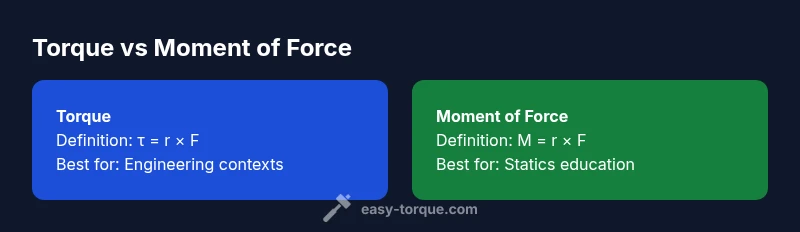
| Definition | Cross product of lever arm and force: τ = r × F | Cross product of lever arm and force: M = r × F |
| Direction/Sign | Perpendicular to the plane; sign depends on CCW/ CW convention | Perpendicular to the plane; sign follows the same convention as torque in most texts |
| Units | Newton-meters (N·m) | Newton-meters (N·m) |
| Formula | τ = r × F | M = r × F |
| Best For | Engineering contexts and practical problems | Statics and introductory dynamics |
| Common Confusions | Usually the same quantity; terminology varies by context | Terminology difference can mislead learners about vector direction |
Pros
- Unifys rotational effects under a single quantity
- Provides a clear link between force, lever arm, and rotation
- Supports vector analysis and right-hand rule practice
- Widely used in engineering and physics education
Drawbacks
- Can confuse beginners due to interchangeable terminology
- Requires understanding of cross product and sign conventions
- Lessons can drift into abstract vector math without concrete examples
Torque and moment of force are the same rotational quantity described with different terminology.
In Class 11, treat torque and moment of force as one concept. Use context to decide whether the term sounds more intuitive for a given problem, but rely on the r × F relationship and sign conventions for calculation.
Your Questions Answered
What is torque in simple terms?
Torque is the turning effect produced when a force is applied at some distance from a pivot. It depends on both the force and how far away the point of application is, measured by the cross product τ = r × F.
Torque is the turning force you feel when you apply a force at a distance from the pivot.
Are torque and moment of force the same thing?
Yes. In most classroom and engineering contexts, torque and moment of force refer to the same rotational effect produced by a force about an axis, expressed as τ = r × F.
Torque and moment of force are two names for the same idea.
What units are used for torque?
The standard unit for torque is newton-meters (N·m). The cross product implies units combine distance and force.
Torque is measured in newton-meters, combining force and lever arm distance.
How do I solve a torque problem on a lever?
Identify the lever arm length r, the force F applied, and the angle between them. Compute τ = r × F, taking care with direction and sign according to your chosen convention.
Find r and F, then multiply using the cross product to get torque.
What are common mistakes in Class 11 torque problems?
Misidentifying the lever arm, ignoring the perpendicular component of the force, or inconsistent sign conventions can lead to incorrect results. Always state the axis and direction clearly before solving.
Make sure you choose the axis, measure r correctly, and keep signs consistent.
Top Takeaways
- Define torque as τ = r × F and recognize it as a turning effect
- Remember the cross product yields a vector perpendicular to the plane
- Use N·m as the standard unit for torque and moment of force
- Keep sign conventions consistent (often CCW positive)
- Apply the concept to common tasks like opening doors or using a wrench