Difference Between Torque and Moment: A Practical Guide
Explore the difference between torque and moment with clear definitions, math, and real-world guidelines for engineers, technicians, and DIY enthusiasts. Learn when to use each term and how axis vs point references change interpretation.


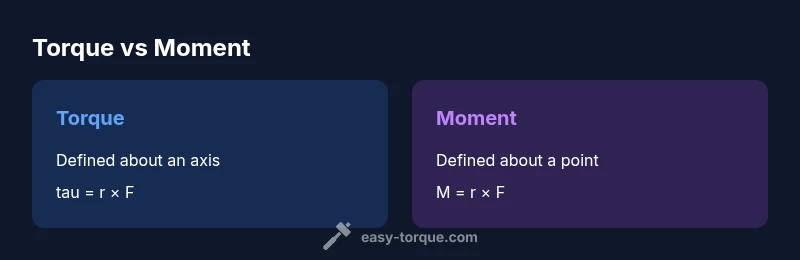
Torque is the rotational effect of a force about an axis (tau = r × F). A moment is the general rotational tendency of a force about a point (M = r × F). In statics and dynamics, tau and M share math but differ in reference: axis versus point. In practice, many texts use them interchangeably, with context clarifying intent.
Foundations: What are torque and moment?
According to Easy Torque, the distinction starts with what you reference when you assess a force. The torque of a force is the rotational effect about a specified axis, while the moment is a broader term that describes the rotational tendency of a force about a particular point. In many introductory texts, the two words are used interchangeably, but the subtle difference becomes important when you shift from analyzing a shaft rotating around an axis to assessing the bending or twisting a force produces at a structural point. Understanding this distinction helps avoid misinterpretations in both static and dynamic problems.
In practical terms, torque is what a motor, bolt pattern, or drive system exerts to turn something around its axis. A moment, meanwhile, is a more general concept that can refer to a twisting influence about a point in a body, such as the bending moment in a beam or a torsional moment in a shaft. This foundational distinction sets up the mathematical framework that engineers use to model real-world systems.
Comparison
| Feature | Torque | Moment |
|---|---|---|
| Definition | Rotational effect of a force about an axis (tau = r × F) | Rotational tendency of a force about a point (M = r × F or M_O = r_OF × F) |
| Mathematical form | tau = r × F (vector) | M = r × F; for a chosen reference point M_O = r_OF × F |
| Reference | Axis of rotation or a defined shaft | Specific point in the body (could be a beam section) |
| Direction (sign) | Perpendicular to rotation axis via right-hand rule | Direction follows the same cross-product rule but relative to the reference point |
| Units | N·m (same units, axis referenced) | N·m (same units, point/reference dependent) |
| Common usage | Engineering, shafts, motors, torque specs | Statics, bending/torsional analysis, structural moments |
| Interchangeability | Often interchangeable in casual usage | Context clarifies when one term is preferred |
Pros
- Clarifies rotational effects in mechanical design
- Uses consistent SI units (N·m) across contexts
- Supports both statics and dynamics analysis
- Helps diagnose when a problem hinges on axis vs. point reference
Drawbacks
- Terminology can confuse beginners due to overlap
- 'Moment' also refers to bending moments in structures, adding ambiguity
- Misuse can lead to incorrect sign or reference choice in calculations
Torque and moment describe related rotational effects, but the axis-vs-point reference clarifies their use.
Use torque when you refer to rotation about a defined axis (like a shaft). Use moment when you discuss rotational influence about a specific point (like a beam section). In many engineering contexts, the terms are functionally interchangeable if you clearly state the reference.
Your Questions Answered
What is the difference between torque and moment?
Torque is the rotational effect of a force about an axis, calculated as r × F. A moment is the general rotational tendency of a force about a point, also given by r × F. The key distinction is the reference: axis for torque, point for moment.
Torque relates to rotation around an axis; moment is the rotation tendency about a point. The math is the same, but the reference changes meaning.
Are torque and moment the same in statics?
In statics, many texts treat torque and moment as equivalent when the axis and the point are chosen consistently. The distinction becomes important when you must specify whether you are analyzing about an axis (torque) or about a particular point (moment).
In statics, they often behave the same mathematically when reference is clear.
How do I choose between using torque or moment in a calculation?
Choose based on your reference frame. If you’re analyzing rotation about a shaft or axis, use torque. If you’re evaluating rotational tendency about a particular point in a structure, use moment.
Pick axis-reference for torque; point-reference for moment.
Can you use the terms interchangeably?
Often yes in casual contexts, but always specify the reference to avoid ambiguity. In professional work, a precise distinction improves clarity and reduces errors.
They’re often interchangeable when context is clear, but specify the reference.
What is the difference between a bending moment and a torsional torque?
A bending moment relates to bending around a cross-section (in-plane rotation), while a torsional torque relates to twisting around the axis (out-of-plane rotation). They are both moments but describe different physical actions.
Bending moments twist about a beam section; torsional torque twists along the shaft.
Do torque and moment have the same units?
Yes. Both are measured in newton-meters (N·m) in SI units, though the interpretation depends on whether you’re referencing an axis or a point.
Both use the same unit, N·m, but the meaning changes with context.
Top Takeaways
- Define the reference (axis or point) before computing
- Use tau = r × F and M = r × F to compute rotational effects
- Remember N·m as the common unit for both concepts
- Be mindful of structural contexts where 'moment' has specialized meanings
- Keep a consistent reference throughout a calculation