Most Torque in a Car: Understanding Engine Torque Today
Learn what 'most torque in a car' really means, how torque is delivered across RPM, and how to compare torque across gas, diesel, and electric powertrains. Practical guidance from Easy Torque.


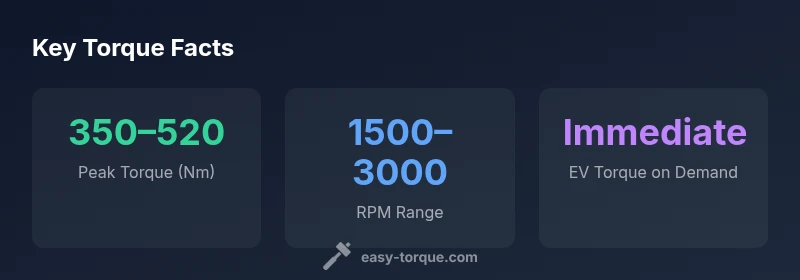
According to Easy Torque, there isn't a universal 'most torque' number for cars. In practice, peak torque for typical modern passenger cars sits roughly in the 350–520 Nm range. Turbocharged petrols and diesels push toward the upper end, while electric motors offer high, immediate torque from zero RPM. The real story is how torque is delivered across RPM and drivetrain pairing.
What torque is and why it matters in cars
Torque is the twisting force the engine produces at the crankshaft, and it is this force that propels your car forward when combined with gearing. In everyday driving, torque matters most for acceleration, hill climbing, and towing. When people ask about the 'most torque in a car', they’re usually looking for a single peak number. In reality, torque is a dynamic curve: engines produce different torque levels across RPM, and the drivetrain (transmission, differential, and tires) determines how much of that engine force actually reaches the wheels. A high peak torque is useful, but a broad torque band at low to mid RPM typically delivers stronger real-world pull. This is especially true in urban driving, where you often operate in a narrow RPM window. To compare cars meaningfully, you should examine the entire torque curve and how it aligns with your typical driving range, not just the peak value.
How torque is measured in engines and transmissions
Engine torque is measured with dynamometers, which apply a load to the crankshaft while sensors capture torque, speed, and efficiency. In practice, manufacturers publish torque curves showing torque against engine speed (RPM). Important to note: torque at the crank differs from wheel torque; the transmission, differential gearing, driveshaft losses, and tire slip all reduce available wheel torque. Tests can be conducted at the engine (crank torque) or at the wheels during chassis dyno runs. Modern testing and certification bodies standardize measurement methods to allow fair comparisons, but variation in test conditions, gearing, and traction can still affect published numbers. When evaluating torque data, examine the torque curve shape, the RPM range where it peaks, and the stability of torque as RPM changes. These details reveal how a car behaves under real driving, rather than just its nominal peak torque.
Torque curves explained: peak torque vs horsepower across RPM
Engines produce torque differently as RPM rises. Gasoline engines often showcase a broad peak in mid-range, while turbocharged engines push higher torque within a narrower band near boost onset. Diesels typically deliver strong low-end torque, with peak torque occurring at relatively low RPM and staying strong into mid-range. Electric motors are different: they deliver maximum torque almost instantly at zero RPM and can maintain a substantial portion of peak torque over a wide speed range, though the torque can taper at very high speeds due to electrical limits. The takeaway is not just the peak torque number, but the shape of the torque curve: how quickly torque builds, where it peaks, and how quickly it falls as RPM climbs. A smooth, broad torque curve generally offers better real-world acceleration and driver confidence than a sharp, tall peak that vanishes quickly.
Real-world implications: performance, towing, and reliability
Torque affects how quickly a vehicle can accelerate, how well it climbs grades, and how it pulls heavy loads. A car with a strong low-end torque provides quicker response at city speeds without downshifting, while higher mid-range torque helps at highway speeds when passing. For towing, sustained torque at lower RPMs reduces gear hunting and engine strain. However, more torque at any one RPM isn’t a guarantee of reliability; driveline design, cooling, lubrication, and belt/chain tension all influence longevity. The driveline choice—whether a torque-converter automatic, a dual-clutch, or a CVT—also shapes how torque is felt in everyday driving. In short, torque is a critical performance lever, but it lives within the broader system: engine, transmission, axles, and tires all shape final performance.
How manufacturers optimize torque: turbocharging, gearing, electrification
Manufacturers manipulate torque with several tools. Turbocharging raises the air charge, moving peak torque to higher RPM and increasing maximum torque in boosted regions; intercooling, variable geometry, and turbo sizing all influence where and how torque comes on boost. Gearing determines how engine torque translates to wheel torque; taller gears can reduce torque at the wheels, while shorter gears improve acceleration by keeping the engine in its torque band. Electrification flips the script: electric motors provide near-instant torque at standstill and can maintain strong torque across a broad range, only constrained by inverter limits and motor design. Hybrid systems blend these approaches to blend torque availability with efficiency. As a result, a modern car can feel very different even with similar raw torque numbers, depending on how torque is managed across the RPM spectrum and through the drivetrain.
How to compare torque specs when shopping for a car
To compare torque like-for-like, look beyond the peak torque figure. Examine the torque curve (if available), the RPM range over which peak torque occurs, and the vehicle’s gearing. Check wheel torque figures in the context of overall weight and drivetrain losses; heavy cars with tall gearing may deliver similar wheel torque as lighter cars with shorter gearing but feel very different. Consider your typical use case: city driving benefits from strong low-end torque; highway driving benefits from broad mid-range torque. If you’re shopping for an EV, note that instant torque can’t always deliver the same top-end acceleration as a petrol car at high speeds, and you may experience torque flattening due to speed limitations. When possible, test-drive, review third‑party dyno data, and compare multiple models within the same class to get a realistic sense of what torque feels like in real-world conditions.
Practical steps to estimate your car's torque needs
Start by listing daily use cases: commuting in traffic, hill starts, and occasional towing. Then translate those needs into a torque profile: do you value instant response at low speeds, or sustained pull at highway speeds? Use torque curves published by manufacturers and independent testing to rough out the RPM range you’ll operate in most. For a DIY estimate, calculate wheel torque by multiplying engine torque by total drivetrain reduction (gear ratios and final drive). Factor in weight and drag to understand acceleration potential. Finally, test-drive with the same load or trailer you expect to carry, and observe how the torque delivery feels at the speeds you actually drive. This practical approach will help you select a vehicle whose torque aligns with your real-world needs rather than chasing the largest number.
Approximate torque characteristics by engine type
| Engine Type | Peak Torque Range (Nm) | Typical RPM Range for Peak Torque | Notes |
|---|---|---|---|
| Naturally Aspirated Gasoline | 250–420 | 1800–3200 | Moderate torque at mid-range |
| Turbocharged Gasoline | 400–700 | 1800–3500 | Higher peak torque with boost |
| Diesel | 450–850 | 1500–2600 | Strong low-end torque |
| Electric Motor | 300–1000 | 0–6000 | Immediate torque from standstill |
Your Questions Answered
What does 'most torque in a car' really mean?
Torque refers to the twisting force produced by the engine. The 'most torque' depends on design and RPM; the curve, not a single number, determines real-world pull. Look at peak torque plus where it occurs in the rev range.
Torque is the engine's twisting force, and where it peaks matters as much as how big the peak is.
How is torque measured in cars?
Torque is measured on a dynamometer at the crank or wheels, producing a torque vs. RPM curve. Real wheel torque also depends on gearing and losses in the drivetrain.
Dynos measure torque at the crank, and the drivetrain changes what you feel at the wheels.
Does more torque always mean faster acceleration?
Not always. Acceleration depends on the entire torque curve, gearing, vehicle weight, and aero drag. A high peak with poor mid-range torque may feel less responsive than a broad, usable torque band.
More torque helps, but gearing and weight decide how fast you actually go.
How do turbochargers affect torque?
Turbochargers raise air pressure to boost torque, often shifting the peak torque to higher RPM and widening the usable range. Boost pressure, intercooling, and turbo sizing determine the exact curve.
Boost from a turbo gives more torque where you drive most—when you need it.
Do electric vehicles have torque curves?
Yes. Electric motors provide near-instant torque from standstill and maintain strong torque across a broad speed range, though some models taper torque at very high speeds due to electrical limits.
EVs can feel instantly powerful from a stop, with torque staying strong as you speed up.
What should I look for when comparing torque numbers?
Look at the complete torque curve, the RPM band of peak torque, and how the numbers translate to wheel torque given weight and gearing. Test drives and third‑party dyno data help validate claimed figures.
Check the curve and real-world feel, not just the peak number.
“Torque is the heartbeat of performance; understanding how and when torque is delivered helps you pick the right car for your tasks.”
Top Takeaways
- Prioritize torque delivery, not just peak value
- Check the RPM range of peak torque for real-world use
- Diesel and turbo engines excel at low-end torque
- Electric motors offer instant, broad torque access
- Match torque profile to your driving needs