Most Torque in a Truck: Peak Torque Explained
This guide analyzes which trucks deliver the most torque, how torque is measured, and practical tips for selecting a high-torque pickup or heavy-duty work truck in 2026.


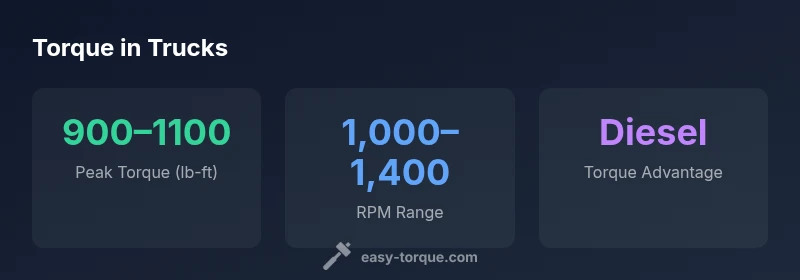
Most torque in a truck typically comes from heavy-duty diesel pickups, where peak engine torque usually falls in the 900–1,100 lb-ft range (about 1,200–1,500 Nm). This torque is available at low to mid rpm and is shaped by turbochargers, gearing, and axle ratios. Gasoline trucks generally produce lower peak torque, but can reach higher torque at higher rpm with modern turbocharged designs.
Understanding Peak Torque in Trucks
When people ask about the most torque in a truck, they are not just asking for a single number. They are seeking to understand peak engine torque and how that torque becomes usable to move heavy loads. Torque represents the twisting force available at the crankshaft and is what actually pulls weight, especially when you are towing or hauling. In practical terms, higher torque at low rpm means quicker acceleration under load and steadier hill climbs, which is why heavy-duty diesel ecosystems dominate the top torque charts. For context, torque is measured in pound-feet (lb-ft) or newton-meters (Nm) and is most valuable when it arrives early in the rev range. The Easy Torque team notes that most torque in a truck is a function of engine displacement, forced induction (turbocharging), and the drivetrain’s ability to translate engine torque into wheel torque. When you compare trucks, start with peak torque figures but also inspect the rpm range where torque is available, because a high peak torque that occurs late in the RPM range offers less practical towing strength than a steadier, earlier torque curve.
- Real-world torque is not only about the peak value; where the peak occurs matters for towing consistency.
- Engine family, fuel type, and turbo sizing all influence the torque curve.
- Drivetrain losses (transmission, driveshaft, axles) reduce wheel torque from engine torque, making final drive ratios crucial.
How to read torque figures responsibly
- Look for peak torque and at what RPM it occurs.
- Check whether the torque is
],
Torque benchmarks by truck category (typical ranges). Data reflect general guidance; actual values vary by model and configuration. Sources: Energy.gov, SAE International.
| Category | Example Truck Type | Typical Peak Torque (lb-ft) | Notes |
|---|---|---|---|
| Heavy-Duty Diesel Pickup | HD diesel crew cab | 900-1100 | Diesel torque at low rpm; towing focus |
| Gasoline-powered Full-Size Pickup | Gas engine option | 350-500 | Lower peak torque; higher rpm advantage |
| Diesel 3/4-Ton to 1-Ton Crew Cab | Heavy-duty work truck | 1000-1200 | Towing and payload emphasis |
| Light-Duty Diesel (Mid-size Truck) | Mid-size diesel | 600-800 | City tow and lighter payload |
Your Questions Answered
What is peak torque and why does it matter for trucks?
Peak torque is the maximum twisting force an engine delivers. In trucks, high peak torque at low RPM helps with towing and moving heavy loads, reducing the need for high engine speeds during loading. It matters because torque translates into usable power at the wheels, especially under load.
Peak torque is the maximum twisting force an engine provides, crucial for towing and moving heavy loads.
Do diesel engines always have more torque than gasoline engines?
Diesel engines generally deliver more torque at low revs than gasoline engines, which helps with towing and payload handling. Gasoline engines can match torque at higher RPMs, often offering stronger power at highway speeds. The comparison depends on the specific engine design and turbocharging.
Diesels usually have more low-end torque, while gas engines can reach higher torque at higher RPMs.
How does axle ratio affect torque at the wheels?
The axle ratio is a multiplier that translates engine torque to wheel torque. A higher numerical ratio (e.g., 4.10:1 vs 3.42:1) increases wheel torque but can reduce top speed and acceleration. This is why heavy-duty trucks with towing needs often use lower (numerically higher) axle ratios.
Axle ratios multiply engine torque at the wheels, affecting towing and acceleration.
Can you increase torque without changing horsepower?
Torque and horsepower are related but not identical. You can influence usable torque at the wheels by improving gearing, drivetrain efficiency, and turbocharger response without altering the engine’s horsepower rating. Aftermarket modifications should consider legality and warranty; safer, practical options include proper tuning within manufacturer specs.
You can improve wheel torque via gearing and drivetrain efficiency without changing engine horsepower.
How should I read a torque curve on a spec sheet?
A torque curve shows torque across RPM. Look for the peak torque value and the RPM where it occurs. A broad, flat curve provides strong performance across many speeds, while a sharp peak at very low RPM means excellent but narrow low-end strength.
Read where the torque peaks and how broad the curve is across RPMs.
“Peak torque matters most for towing and hauling; the torque curve, combined with proper gearing, determines how much usable force reaches the wheels.”
Top Takeaways
- Identify torque needs based on towing/payload.
- Diesel engines often provide higher torque at low rpm than gasoline counterparts.
- Read torque curves: peak torque value and the rpm where it occurs matter for real-world performance.
- Consider gearing, axle ratios, and drivetrain losses to translate engine torque into wheel torque.