Torque Check: A Practical Guide to Accurate Tightening
Learn how to perform accurate torque checks with a torque wrench. This educational guide covers specs, tools, step-by-step methods, safety considerations, and documentation for automotive and equipment maintenance.


By the end of this guide, you will perform a precise torque check using a torque wrench, verify fastener tightness to specification, and interpret readings for automotive or equipment maintenance. You will need a calibrated torque wrench, the correct torque values for the fasteners, and a clean, safe workspace. This method helps prevent under- or over-tightening and protects critical joints.
What is a torque check and why it matters
A torque check is the process of validating that a fastener is tightened to the specified torque. Using a torque wrench, you measure the clamping force applied to a bolt or nut, ensuring it achieves the designed preload. In automotive and machinery work, a proper torque check helps prevent bolt loosening, thread stripping, or joint failure under load. The Easy Torque approach emphasizes consistent technique, clean threads, and using manufacturer torque specs as the baseline. In practice, a torque check covers both seated torque (tightening to seat the joint) and running torque (the steady force after seating). A precise torque check is essential for reliability, safety, and longevity of assemblies across vehicles, machinery, and DIY projects.
Understanding torque specifications and units
Torque specifications tell you how tight a fastener should be to achieve the right preload without risking damage. Common units include Newton meters (Nm), pound-feet (lb-ft), and inch-pounds (in-lb). When performing a torque check, match the wrench’s unit to the specification, or convert carefully using the correct conversion factors. Always confirm whether the spec accounts for lubrication, thread condition, and seating method. Misinterpreting units or skipping the spec can lead to under-tightening, which loosens joints, or over-tightening, which strips threads or damages components.
Tools and equipment for accurate torque checks
A reliable, calibrated torque wrench is the cornerstone of any torque check. Pair it with the correct sockets or adapters for your fasteners, and have the manufacturer’s torque chart readily accessible. A clean work surface, good lighting, and a logbook or digital note app help you document readings. If the spec requires lubrication, use the approved lubricant; otherwise avoid lubricants that alter friction. For advanced setups, consider a torque-angle gauge to capture both torque and angular displacement perception.
Step-by-step overview (high-level)
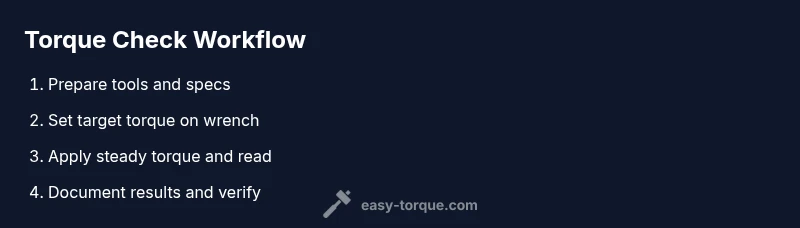
A torque check follows a simple, repeatable workflow: prepare materials and inspect the fasteners, set the target torque on the wrench, apply steady torque while monitoring the reading, verify the result against the spec, and record the data for future reference. This approach applies to automotive torque checks, engine assembly, and equipment maintenance alike, ensuring consistent preload and extending component life.
Interpreting readings and adjusting your approach
When you perform a torque check, readings slightly below spec may indicate lubrication, thread condition, or seating issues. Readings above spec can signal cross-threading, damaged fasteners, or incorrect torque values. If readings are inconsistent across similar fasteners, reassess the setup: confirm the right fastener size, verify the torque chart for accuracy, and check that threads are clean and free of debris. Document any anomalies and re-check after reseating the joint.
Common mistakes and how to avoid them
Common errors include skipping calibration, using the wrong units, or applying torque while the fastener is turning. A common oversight is relying on “feel” rather than a verified reading. Always zero the wrench before use, choose the correct torque range, and avoid forcing the wrench past its limit. For stubborn fasteners, stop and re-evaluate rather than forcing a higher torque value which can cause breakage or injury.
Calibration and maintenance of torque tools
Torque tools require regular calibration to maintain accuracy. Check the manufacturer’s recommended schedule, typically once per year or after a specific number of uses. Store the tool in a protective case, avoid dropping it, and recalibrate if it’s dropped or exposed to extreme temperatures. Keeping a calibration log helps you stay compliant and ensures measurements remain trustworthy.
Real-world scenarios: automotive and machinery torque checks
In automotive work, torque checks ensure wheel lug nuts, cylinder head bolts, and suspension fasteners meet spec. In machinery maintenance, you’ll torque intake manifolds, valve covers, or drive shafts according to service manuals. Across all scenarios, consistency matters: use the same tool, same procedure, and same seating method for every fastener of a given type to achieve uniform results.
Documentation and record-keeping for compliance
Record each torque check with the fastener type, location, target torque, measured torque, tool used, lubrication status, and operator. Keeping logs supports warranty needs, maintenance scheduling, and safety audits. Digital logs improve searchability and trend analysis over time, helping you spot drift in tool accuracy or recurring issues.
Tools & Materials
- Calibrated torque wrench(Ensure the torque range covers the fasteners in your project.)
- Torque specification chart or manual(Have exact values for each fastener in the assembly.)
- Appropriate sockets or torque adapters(Match drive size and socket type to fastener head.)
- Calibrated torque-angle gauge (optional)(Use if angle-torque verification is required.)
- Lubricant or anti-seize (as specified)(Only use when the manufacturer requires lubrication.)
- Clean workspace and safety gear (gloves, eye protection)(Reduce risk of slips and eye injuries.)
- Notebook or data logging app(Record readings for traceability and audits.)
Steps
Estimated time: 25-40 minutes
- 1
Prepare workspace and verify specs
Clear the area, inspect fasteners for damage, and confirm the exact torque specification from the manual. This ensures you have a reliable baseline before applying any torque.
Tip: Double-check that you are using the correct fastener size and thread pitch. - 2
Set up tools and adapters
Select the appropriate socket and attach it to the torque wrench. Ensure there is no play or wobble in the connection to avoid skewed readings.
Tip: Always torque in a clean, dry environment to prevent slippage. - 3
Zero and calibrate the wrench
Zero the wrench at the start and, if required, perform a quick calibration check using a known reference torque. This prevents drift during measurement.
Tip: If the wrench shows any drift, recalibrate or replace before proceeding. - 4
Position and set the target torque
Place the tool on the fastener head and set the wrench to the prescribed torque value. Confirm the setting on the display before tightening.
Tip: Avoid setting the torque while the fastener is loaded or under strain. - 5
Apply torque with steady force
Turn the wrench smoothly until it clicks or reaches the target reading. Do not jerk or overshoot; steady application yields accurate results.
Tip: Maintain a consistent angle and avoid side loading. - 6
Read and confirm the torque
Read the final value on the wrench and compare with the specification. If the reading matches within tolerance, the fastener is acceptable.
Tip: If the reading is off, stop and reassess the setup before re-tightening. - 7
Document the result
Record the measured torque, the fastener, location, tool, and operator in your log. This creates an auditable trail for maintenance.
Tip: Include any lubrication or seating notes for future reference. - 8
Re-check after seating
If required by spec, re-check the fastener after initial seating to account for any relaxation or thread seating effects.
Tip: Allow a brief settling period if specified by the manual.
Your Questions Answered
What is a torque check and when should I perform one?
A torque check verifies that a fastener is tightened to the specified torque to ensure proper preload and joint integrity. You should perform one whenever a critical assembly relies on proper clamping force, including engine components, suspension, and wheel installations.
A torque check confirms fasteners are tightened to the specified torque to ensure joint integrity. Do this for critical assemblies like engines, suspensions, and wheels.
Do I need to calibrate my torque wrench regularly?
Yes. Regular calibration ensures accuracy. Follow the manufacturer’s schedule, typically annually or after a defined number of uses, and recalibrate if the tool is dropped or exposed to extreme conditions.
Regular calibration keeps your torque wrench accurate. Check the manual for the recommended schedule and recalibrate after any impacts or extreme conditions.
What if readings are consistently high or low?
Consistent deviations can indicate incorrect specifications, lubrication effects, poor seating, or a damaged fastener. Re-check the setup, verify specs, and inspect threads before re-testing.
If readings are off every time, double-check the spec, seating, lubrication, and fastener condition before re-testing.
Can I use the same torque wrench for all fasteners?
Use the torque wrench within its calibrated range for each fastener type. If a fastener requires higher or lower torque than the wrench’s range, use the appropriate tool or a different range.
Use the right range for each fastener; don’t push a tool past its limits or use it outside its calibrated range.
What should I log in torque checks?
Record fastener type, location, target torque, measured torque, tool used, lubrication status, and operator. This creates a traceable history for maintenance and safety audits.
Log the fastener, location, target and measured torque, tool, lubrication, and who performed the check.
Watch Video
Top Takeaways
- Verify torque specs before tightening.
- Use a calibrated torque wrench and correct adapters.
- Document every reading for traceability.
- Avoid lubrication unless specified.
- Re-check after seating when required by spec.