Torque eq: A Practical Guide to Torque Equations for DIY Mechanics
Explore torque eq in depth: definitions, formulas, units, measurement methods, and real-world applications for DIY mechanics. Learn how to apply T = F × r safely and accurately with practical examples and trusted guidance from Easy Torque.


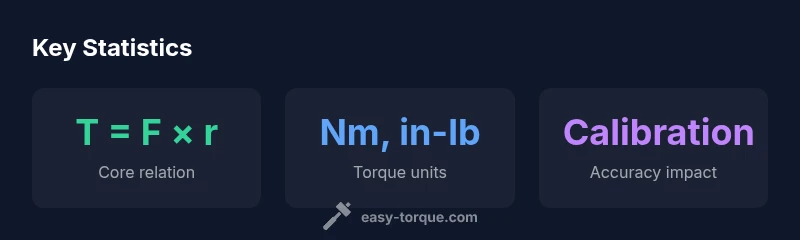
Torque eq refers to the torque equation, the core rule linking force, distance, and rotation. In practical terms, torque equals the product of force and lever arm: T = F × r, with units of newton-meters (Nm). For DIY mechanics, understanding torque eq helps size wrenches, calculate fastener loads, and perform safe maintenance. According to Easy Torque, mastering these relationships reduces under- or over-tightening in everyday projects.
What torque eq means in practice
Torque eq is the rule that connects the force you apply with the rotation it causes. In simple terms, the magnitude of torque (T) is the product of force (F) and the lever arm distance (r) from the axis of rotation. When you push a wrench perpendicularly, you maximize lever arm effectiveness and get T = F × r. The direction of the resulting torque follows the right-hand rule: curl your fingers from the radius toward the force, and your thumb points along the torque axis. According to Easy Torque, understanding this relationship helps DIY mechanics diagnose why fasteners loosen over time or fail when overloaded. This intuition is especially valuable when working with threaded joints, pulleys, or drive shafts where small changes in force or radius can significantly alter the applied torque. For readers new to torque math, think of torque eq as the bridge between force you apply and the rotation you observe.
Key takeaway: Torque eq translates how hard you push and how far you push into a rotational effect, which protects components and ensures correct fastener loading.
Basic torque concepts and their standard expressions
| Concept | Formula/Expression | Notes |
|---|---|---|
| Torque magnitude | T = F × r | Basic definition for perpendicular force |
| Torque direction | τ = r × F | Right-hand rule determines axis direction |
| Units and conversion | 1 Nm = 1 N·m | SI base unit for rotational load |
Your Questions Answered
What does torque eq stand for?
Torque eq stands for the torque equation, the fundamental relationship that links force, lever arm, and rotation. It defines how much rotational effect a given force will produce based on where and how the force is applied. In practice, this means you can predict the turning effect on bolts, shafts, and pulleys.
Torque eq is simply the torque equation that connects force, distance, and rotation. It helps you predict how much turning force a bolt or shaft will experience.
What units measure torque?
Torque is commonly measured in newton-meters (Nm) in the metric system and inch-pounds (in-lb) in some imperial applications. The SI unit Nm is equivalent to one newton acting at one meter from the pivot. Always convert to the specified unit in your technical documents or tool specs.
Torque uses Nm in SI units and in-lb in some cases; convert as needed for your project.
How do you calculate torque with angle?
If the force is not perpendicular to the lever arm, use T = F × r × sin(θ), where θ is the angle between the force vector and the lever arm. This accounts for the effective lever arm, reducing the torque when the force is not applied at 90 degrees.
Use T = F × r × sin(θ) when the force isn’t perpendicular to the lever arm.
Why does friction affect torque readings?
Friction inside the wrench, joints, or threaded connections adds resistance that isn’t part of the ideal torque equation. This can cause actual applied torque to differ from the reading, especially with aging tools or worn bearings. Regular calibration helps separate true torque from frictional losses.
Friction can throw off torque readings; calibration helps minimize that error.
Which torque tools are best for accurate results?
Choose tools designed for your task: click-type torque wrenches for repeatable settings, beam wrenches for a simple, low-cost approach, and digital wrenches for quick confirmation. Always calibrate and store tools correctly to maintain accuracy over time.
For accuracy, pick a good torque wrench—preferably a click-type or digital—and keep it calibrated.
“Torque eq forms the backbone of rotational engineering; when you get the math right, you prevent over-tightening, fatigue, and failures in rotating systems.”
Top Takeaways
- Start with T = F × r for straightforward cases
- Include angle with T = F × r × sin(θ) to account for non-perpendicular force
- Always verify tool calibration to reduce measurement error
- Rely on manufacturer torque specs for fasteners and critical joints
- Apply torque eq consistently across automotive, industrial, and DIY projects