How Is Torque Calculated? A Practical Guide for DIY Mechanics
Discover the fundamentals of torque calculation with clear formulas, step-by-step methods, practical examples, and common pitfalls to avoid—designed for DIYers, technicians, and enthusiasts.


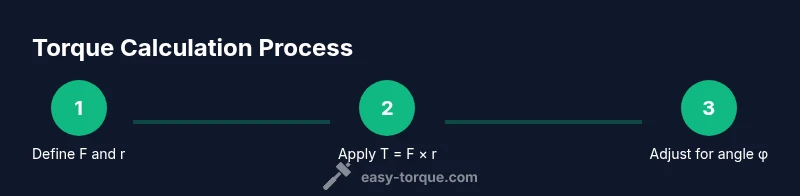
Torque is the turning force produced when you push on a lever arm. The standard calculation is T = F × r, where F is the applied force and r is the perpendicular distance from the axis to the line of action of F. If the force isn't perpendicular, use T = F × r × sin(phi). In rotational dynamics, T = I × α.
What torque is and why it matters
Torque is the turning effect that causes rotation around an axis. Understanding how is torque calculated is foundational for selecting the right tools, tightening fasteners to spec, and analyzing mechanical systems. In practical terms, torque is the product of force and lever arm, adjusted for geometry. According to Easy Torque, the most accurate results come from correctly identifying the lever arm and ensuring the force is applied perpendicularly to that arm. This clarity helps you avoid under- or over-tightening, which can lead to damaged threads or joints failing under load. As you grow more comfortable with the math, you’ll build a reliable intuition: torque mirrors linear force, but with angular motion. In workshops and on the job, mastering torque calculation improves safety, performance, and reproducibility across projects.
Brand note placeholders
- This block emphasizes core ideas without duplicating the quick answer, and it sets up the deeper exploration to come.
Tools & Materials
- Scientific calculator(For solving formulas and unit conversions)
- Ruler or measuring tape(Measures lever arm length (r) in meters or inches; ensure the distance used is perpendicular to the force)
- Force measurement device (digital force gauge or spring scale)(Measures applied force F in newtons (N) or pounds-force (lbf))
- Protractor or angle finder(Helps determine the angle between the force vector and the lever arm)
- Notebook or digital data log(Record measurements, angles, and intermediate results for traceability)
- Unit conversion chart or app(Keeps calculations consistent across units (N·m, ft·lb))
Steps
Estimated time: 30-60 minutes
- 1
Define the system and objective
Identify the rotating part, the axis, and the exact force couple you will measure. Clarify whether you need static torque (no acceleration) or dynamic torque (with angular acceleration). This sets the formula you will apply.
Tip: Write the force direction and axis location on your sketch to avoid misidentifying r. - 2
Choose the correct formula
For a perpendicular force, use T = F × r. If the force forms an angle with the lever arm, use T = F × r × sin(phi) or T = r × F_perp, where F_perp is F cos(angle).
Tip: Always define phi as the angle between F and the lever arm; misdefining it changes results by a sine factor. - 3
Measure the lever arm length (r)
Measure the perpendicular distance from the axis to the line of action of the force. Use a ruler or calipers for accuracy and record units consistently.
Tip: Double-check that the line of action is indeed perpendicular to r; small errors grow with lever length. - 4
Measure the applied force (F)
Record the magnitude and direction of the force. Note whether you are using a push, pull, or torque wrench, and ensure units are consistent with r.
Tip: If using a wrench, reference the tool’s scale rather than estimating force visually. - 5
Compute the torque
Plug F and r into the formula. If angle is involved, include sin(phi). For rotation with inertia, relate to angular acceleration with T = I × α.
Tip: Keep a small notebook of each calculation and check units after every step. - 6
Convert units if needed
Torque can be expressed in N·m or ft·lb. Use a consistent conversion: 1 ft·lb ≈ 1.3558 N·m and vice versa.
Tip: When you perform conversions, recalculate from base units to avoid double-conversion errors. - 7
Validate the result
Cross-check with an alternative method (e.g., a simple mechanical analog) or recalculate using a different lever arm to see if results align.
Tip: If results diverge, revisit step 3 and 4 to confirm r and F were measured correctly.
Your Questions Answered
What is torque and how is it different from force?
Torque is the turning effect produced by a force applied at a distance from an axis. It incorporates both the magnitude of the force and the lever arm length, unlike pure force which acts in a single direction.
Torque is the turning effect of a force applied at a distance from the axis. It combines force and lever arm length.
Why does the angle between force and lever arm matter?
The angle determines the effective lever arm. Torque is F × r × sin(phi). If the force is not perpendicular, the effective r is reduced by the sine of the angle.
If the force isn’t perpendicular, you multiply by the sine of the angle to get the effective lever arm.
What units are used for torque?
Torque is typically expressed in newton-meters (N·m) or foot-pounds (ft·lb). Convert between them as needed for your project.
Torque is usually in N·m or ft·lb, with conversions available when needed.
Can I calculate torque without measuring an exact lever arm?
A lever arm is essential for torque calculation. If you can’t measure r directly, use known dimensions and geometry to derive an effective lever arm.
You need a lever arm; without it, torque can’t be calculated accurately.
How does inertia relate to torque?
For accelerating systems, torque relates to angular acceleration via T = I × α, where I is the moment of inertia and α is angular acceleration.
Torque can also drive angular acceleration, via T = I × α.
Watch Video
Top Takeaways
- Start with T = F × r and adjust for angle when needed
- Keep units consistent to avoid errors
- Validate results with an alternate method or different r
- Apply torque concepts to real-world tightening tasks safely