How to Find Torque Without Force: A Practical Guide for DIY Mechanics
Learn proven methods to calculate torque without direct force measurement. Explore formulas, energy-based estimates, and step-by-step instructions for DIY mechanics and professionals.


Torque can be found without directly measuring force by using rotational dynamics relationships. When you know angular acceleration and moment of inertia, torque equals τ = Iα. If you can relate force to motion or energy through lever arms, you can estimate τ as F·r or from work done per angle. This quick guide outlines practical methods.
Why torque matters when you can't measure force
In many practical scenarios, you need torque data but can't or won't measure the actual force with a load cell or spring scale. This is common in field diagnostics, hidden failures, or historical datasets. The key is to leverage physics relationships that tie torque to other measurable quantities. According to Easy Torque, understanding the underlying relationships lets you estimate torque with accuracy that’s fit for maintenance decisions and safety checks. By shifting the problem from direct force measurement to kinematics, energy, or dynamics of rotation, you can infer torque from readily observed variables like angular velocity, acceleration, and geometry of the lever arm. This approach does not replace direct measurement in all cases, but it provides robust alternatives when direct force measurement is impractical. In this block we’ll outline foundational concepts and map out when each method is appropriate, so you can pick a path that matches your equipment and data availability.
The foundational formulas: torque definitions
Torque is the rotational counterpart to linear force. The most commonly used equations are:
- τ = r × F, with magnitude |τ| = F r sin(θ)
- For planar, τ = F r when the force is perpendicular to the lever arm
- The rotational form of Newton’s second law: Στ = I α, where I is the moment of inertia and α is angular acceleration
These relationships hold for rigid bodies about a fixed axis. In practice, you’ll often simplify to τ ≈ F r when the force is orthogonal to the lever arm and you know r. Remember that friction, bearing losses, and compliance can reduce the effective torque, so accounting for losses is part of a robust estimate.
Method A: torque from moment of inertia and angular acceleration
If you can measure the angular acceleration α and you know the rotation axis moment of inertia I, torque follows directly: τ = I α. This method is powerful for systems with well-defined geometry, such as disks, shafts, or flywheels. Steps include deriving I from geometry and mass distribution, capturing α with a high-resolution encoder or IMU, and applying the simple product to obtain τ. Practically, you’ll want to ensure your axis is aligned, your sensor sampling is fast enough to capture transient changes, and you filter noise to prevent large errors in α. The sign convention is important: positive α with a resisting torque will produce a negative net τ in many setups. The strength of this approach is that once I and α are known, τ is deterministic and independent of exact force measurement, which is ideal for field testing where force sensors aren’t available.
Method B: torque from energy and angular displacement
Torque can also be inferred from energy and motion. Work done by torque over an angular displacement Δθ is W = ∫ τ dθ. If you can estimate the work input or extract energy changes from a system (for example, from motor electrical input and efficiency, or from a known energy store such as a spring), you can determine an average torque over a rotation interval: τ_avg ≈ ΔW / Δθ. If you measure angular velocity ω during the rotation, you can relate power to torque via P = τ ω, giving τ = P / ω. This method is particularly useful when you have access to timing and energy data but cannot directly measure the force at the contact point. For accurate results, segment the rotation into small intervals where ω is roughly constant, compute ΔW, and average the resulting τ over each interval. It’s common to compare the τ from this method with the τ from the Iα method to validate your estimates.
Method C: lever arms and motion-based force inference
When you know the geometry of the lever arm and can observe the motion of a point at radius r, you can infer the force using F ≈ m a for the corresponding point mass and then compute τ ≈ F r. In rotating systems, linear acceleration a translates to angular acceleration α via a ≈ r α for points near the lever arm. By tracking the angular position and velocity of a marker on the rim with an encoder or video analysis, you can derive α and, with known mass distribution, estimate the force that would be required to produce the observed motion. This approach is especially helpful for non-contact measurements where direct force contact is impractical. As a cross-check, compare τ from Method C with τ from Method A or B to ensure consistency.
Practical measurement setup (no direct force measurement)
A practical setup uses an encoder or IMU to capture angular data, a scale or spring reference to infer inertia where feasible, and careful attention to alignment. Mount the sensor close to the rotation axis to minimize translational noise, and ensure the lever arm length is measured accurately. If you can access any energy data (electrical input, motor torque constant when available, or losses), you can triangulate torque with multiple methods to improve confidence. Keep records of operating conditions like bearing temperature and lubrication state because these affect friction losses and effective torque.
Calibration, validation, and real-world checks
Robust torque estimation without direct force depends on calibration and cross-checking. Start with a known reference: a test rig where you can apply a calibrated torque (for example, a calibrated brake drum or a fixture with a known inertia). Compare τ from Iα, τ from energy-based estimates, and τ inferred from lever-arm motion. Discrepancies reveal biases due to friction, misalignment, or sensor noise. Use zero-load and full-load tests to characterize error bands and then apply corrections to future measurements. The common practice is to present a torque estimate with a stated uncertainty, and to document the method used for traceability. Easy Torque analysis suggests keeping a simple uncertainty budget showing contributions from I, α, ω, Δθ, and any assumed masses or friction terms.
Safety, tips, and common pitfalls
When estimating torque without force, be aware of several pitfalls: assume no friction at your peril—friction can dominate at low torques; misalignment between the lever arm and rotation axis will skew results; sensor noise can inflate α or ω estimates; and data gaps can cause large errors if not interpolated carefully. Always validate with an independent method when possible and maintain clear labeling of units and sign conventions. Stabilize the test setup to avoid vibration, and use proper PPE when handling rotating equipment. Finally, document every assumption transparently so others can reproduce or audit your estimate.
Tools & Materials
- Encoder or tachometer (high-resolution preferred)(Place near the rotation axis for best signal; sample rate ≥ 10x expected α frequency)
- Inertial Measurement Unit (IMU) or angular velocity sensor(Useful for cross-checking ω and α; optional if an encoder suffices)
- Known geometry data (lever arm length r, axis location)(Precise measurement to reduce systematic error)
- Mass distribution data or a simple inertial surrogate(Needed if you’ll compute I for complex shapes)
- Data logger or computer with analysis software(To store high-rate measurements and perform calculations)
- Energy data source (motor current, voltage, efficiency) or torque constant(Helpful for the P = τ ω method; not required if you only use Iα)
- Calipers or precision ruler(For accurate lever-arm measurements)
- Safety gear (gloves, eye protection, lockout-tagout as needed)(Always follow safety protocols when testing rotating equipment)
Steps
Estimated time: 30-60 minutes
- 1
Identify the torque estimation goal
Define whether you want a quick estimate, an jä more precise value, or a comparative study across components. Clarify the axis, the load path, and the time window for measurement.
Tip: Write the objective and expected accuracy before you begin. - 2
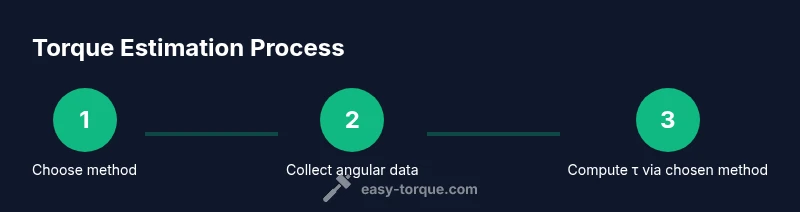
Choose your estimation method
Decide whether you’ll use Iα, energy-and-displacement, or lever-arm inference. Each method has different data needs and uncertainty sources.
Tip: Plan to use at least two methods for cross-checking results. - 3
Set up the measurement geometry
Mount sensors at stable positions with minimal backlash. Record lever-arm lengths and axis locations precisely.
Tip: Keep a fixed reference frame to reduce drift in angular measurements. - 4
Capture angular data with high resolution
Record angular position (θ) and velocity (ω) continuously during the test. Ensure sampling rate captures dynamic events.
Tip: Filter high-frequency noise to avoid inflated α estimates. - 5
Compute torque from Iα
If you have a known I, calculate τ = I α using the measured α. Keep track of units and sign conventions.
Tip: Verify I with multiple shapes or use published formulas for standard geometries. - 6
Estimate torque from energy/angle
If you have energy data, compute torque via τ_avg ≈ ΔW / Δθ over short intervals and compare with the Iα result.
Tip: Break the rotation into small segments to reduce error from varying ω. - 7
Cross-check with lever-arm motion
Use motion data to infer F ≈ m a and compute τ ≈ F r, then compare with τ from methods A and B.
Tip: Consistency across methods increases confidence in the estimate. - 8
Document and report findings
Record all assumptions, geometry, sensor specs, and computed τ values with uncertainties. Create a transparent report.
Tip: Include a chart of τ estimates and their uncertainties over time.
Your Questions Answered
What does torque measure if I can't measure force directly?
Torque measures the rotational effect of a force. Even without direct force data, you can estimate torque using angular acceleration with inertia or energy-based calculations from observed motion.
Torque measures the rotational effect of a force. You can estimate it using angular acceleration with inertia or energy-based calculations from observed motion.
Which method is best for field testing?
For field tests, using τ = Iα is often preferred when you can measure α and know I. If I isn't well defined, energy-based estimates offer a useful cross-check.
For field tests, use τ equals I times α if you can, and cross-check with energy-based estimates when possible.
Do I need specialized equipment?
A high-resolution encoder or IMU, plus basic geometry data, is usually enough. A torque sensor is helpful but not mandatory if you can robustly estimate torque from motion data.
A good encoder or IMU and geometry data are often enough; a torque sensor helps but isn’t required.
How accurate are these estimates?
Accuracy depends on sensor quality, alignment, and how well you account for losses. Expect some uncertainty, but cross-validation generally keeps errors within acceptable ranges for maintenance decisions.
Accuracy depends on sensors and setup; cross-validation helps keep errors within acceptable ranges.
When should I avoid these methods?
If you cannot control or measure key variables (α, ω, r, mass distribution) or if friction and backlash dominate, direct torque measurement may be more reliable.
If key variables can’t be measured accurately, direct torque measurement is better.
Can I use these methods for non-rotational systems?
These methods are specific to rotational dynamics. For translational systems, different relationships apply (e.g., torque equivalents translate into linear force via lever arms).
These methods apply to rotation; translational systems use different equations.
Do I need to document uncertainties?
Yes. Always present a simple uncertainty budget that identifies contributions from inertia, angle, velocity, and any assumed masses or friction terms.
Yes. Always show your uncertainties so others can trust the results.
Watch Video
Top Takeaways
- Leverage Iα to compute torque when inertia is known.
- Energy and displacement provide an independent torque estimate.
- Cross-check results from multiple methods for reliability.
- Document all assumptions and uncertainties for traceability.