How to Torque Angle Without Gauge: A Practical DIY Guide
Learn how to estimate torque angle without a dedicated gauge, using baseline torque, careful rotation, and verification. This step-by-step guide covers tools, safety, and common pitfalls for DIY mechanics.


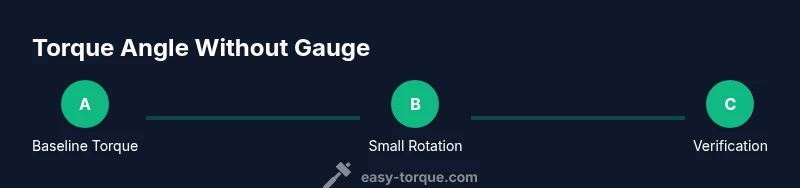
You can estimate angle torque without a dedicated angle gauge by combining a known baseline torque with a careful, repeatable rotation and rapid verification checks. Start by cleaning the threads and tightening to the manufacturer’s baseline torque using a standard torque wrench if available. Then apply a small, steady rotation, watching for consistent resistance and listening for changes in tension. This approach relies on disciplined technique, repeatability, and post-application checks.
Why angle torque matters when high-stress bolts are involved
In many automotive and machine assemblies, simply reaching a peak torque is not enough. The bolt must stretch to a precise length to maintain clamping force, seal, and safety. When a dedicated angle torque gauge isn’t available, technicians rely on a practical blend of baseline torque, controlled rotation, and verification. This approach emphasizes repeatability, clean threads, and consistent friction conditions. According to Easy Torque, understanding the interaction between torque, angle, and bolt stretch helps you avoid over-tightening or under-tightening a fastener, especially when lubrication or thread condition varies. In short, angle-torque without a gauge is about applying a repeatable process rather than chasing an exact degree measurement.
bodyBlocks
Tools & Materials
- Torque wrench(Calibrated within the last 6 months; choose a model with a broad range to cover baseline torque.)
- Marker or fine-tip pen(For marking starting orientation and reference lines on the bolt head or mounting surface.)
- Clean rags and thread cleaner(Remove debris and old lubricant to get a consistent friction surface.)
- Lubricant or anti-seize compound (optional)(Use only if the manufacturer specifies lubricant; otherwise dry threads are acceptable for feel-based methods.)
- Torque spec sheet or manual(Baseline torque and general guidelines for the fastener family.)
- Calibrated reference edge or mark (optional)(A stable reference on the mounting surface to help measure rotation by sight.)
- Safety glasses and gloves(Personal protective equipment for handling tools and parts.)
Steps
Estimated time: 60-90 minutes
- 1
Identify the fastener and baseline
Locate the exact fastener, its mating surface, and the manufacturer’s baseline torque. If an angle spec exists, note it. This establishes the starting point before you apply any turning or additional load. In the absence of an angle spec, you will rely on repeatable tightening and careful observation.
Tip: Have the service manual or torque spec sheet open so you can reference terms like baseline torque and recommended lubrication. - 2
Prepare the threads and mounting surface
Clean the threads and locking surface to remove dirt, rust, and old lubricant. A clean surface reduces irregular friction, which helps your baseline torque and subsequent angle feel be more consistent.
Tip: Use a dry rag or thread cleaner; ensure the mating surface is free of debris before tightening. - 3
Establish a repeatable baseline
Using the torque wrench, tighten to the specified baseline torque as accurately as possible. If you don’t have a gauge for angle, this baseline serves as the zero point for the subsequent rotation. Ensure the fastener is snug but not yet fully seated.
Tip: If the baseline torque isn’t known, tighten carefully to a conservative, intermediate value and prepare to re-check after rotation. - 4
Mark and orient for rotation
Mark the bolt head and a reference point on the mounting surface. This gives you a visual cue to monitor how much the fastener rotates during the angle application, even without a dedicated gauge.
Tip: Choose a stable, fixed reference so you can detect even small changes in orientation. - 5
Apply a small, steady rotation
Rotate the fastener a consistent, small amount while monitoring for smooth, even resistance. You are not relying on a digital angle readout; instead you look for a steady increase in tension and a uniform feel as you progress.
Tip: Keep the motion slow and controlled; avoid rapid twists which can jump friction and cause over-tension. - 6
Pause and verify resistance
Stop briefly after the initial rotation to re-check the feel of the threads and the mounting surface. If the resistance has become inconsistent or if the bolt loosens, do not push further without re-evaluating.
Tip: Use your marker to compare the starting and current orientation; any drift may indicate over-tightening or poor thread condition. - 7
Recheck the baseline torque
If you can, re-check the baseline torque with the torque wrench to ensure you didn’t overshoot during the rotation. This verification step helps catch mistakes before final assembly.
Tip: A short, final pass to baseline torque aligns the procedure with best practices. - 8
Document the result and finish
Record the method used, the baseline torque, the amount of rotation, and any observations about friction or surface condition. Proper documentation helps future maintenance and consistency across similar jobs.
Tip: Include the part number, batch, or service date to aid future service decisions.
Your Questions Answered
Is it safe to torque angle without a gauge on all fasteners?
No. This approach is primarily for non-critical applications or when OEM guidance supports a gauge-free method. For structural or safety-critical bolts, always use the manufacturer’s recommended angle gauge or seek professional approval. The risk of under- or over-tightening can compromise joint integrity.
Not always safe. Use only where allowed by the manufacturer and prioritize safety-critical guidance.
What factors affect accuracy when not using a gauge?
Friction variability from lubrication, thread cleanliness, bolt wear, and mounting surface condition all affect accuracy. Even temperature and material differences can shift the effective tension. Consistency in technique helps mitigate these effects.
Friction, cleanliness, and technique all influence accuracy; keep conditions as consistent as possible.
How can I verify that I’ve achieved proper tension without a gauge?
Use a post-tightening check: re-torque to the baseline specification, inspect for uniform resistance, and verify there is no loosening after a simulated load. When in doubt, replace with an angle gauge or consult OEM data.
Recheck baseline torque and ensure the joint remains stable under small loads.
Can I apply this method to every engine or vehicle?
Not every engine or vehicle is suited for gauge-free torque-angle work. Some engines require precise angle measurements to maintain seal integrity or avoid bolt necking. Always consult the service manual for the specific component.
Check the manual first; gauge-free methods aren’t universal.
What if I don’t have a baseline torque available?
If no baseline is available, start with a conservative, moderate torque that won’t risk bolt necking, then verify with careful rotation and inspection. Document the choice and seek OEM specs as soon as possible.
Without baseline, proceed cautiously and document your limits.
What signs indicate over-tightening when using this method?
Signs include sudden resistance spike, thread damage, or deformation of the mounting surface. Stop immediately and re-evaluate setup. If damage is suspected, replace the fastener and re-check alignment.
If you feel a sudden hard stop or see damage, pause and reassess.
Watch Video
Top Takeaways
- Follow a repeatable baseline torque as the zero point.
- Use careful, small rotations with steady feel—avoid rushing.
- Maintain clean threads and consistent friction for reliability.
- Document steps and observations for future maintenance.
- Avoid this method on safety-critical fasteners unless OEM guidance exists.