How to Measure Torque Without a Wrench
Discover practical methods to estimate torque without a torque wrench, including torque-angle strategies, hand-feel cues, and safety tips for DIY mechanics.


You can estimate torque without a wrench by using torque-angle methods, careful hand-feel estimation, and manufacturer torque tables. This quick answer outlines practical alternatives, how to minimize error, and when to rely on a proper torque wrench for precision-critical fasteners. These approaches are best for quick checks or non-critical fasteners where exact torque is not essential.
Why measuring torque without a wrench is tricky
Torque is the turning force applied to a fastener. Without a torque wrench, you can't directly measure that force; you rely on indirect methods that estimate torque based on rotation, friction, lubrication, and the size of the fastener. According to Easy Torque, accuracy hinges on repeatable conditions: consistent lubrication, clean threads, correct fastener path, and the right starter tension. In practice, this means results will vary by material, surface finish, and how firmly you initially snug the joint. For DIYers, the challenge is balancing practicality with safety, especially on critical components like wheel fasteners or engine hardware. When you must estimate, set expectations: your estimate is a best-effort approximation rather than a precise reading, and any uncertainty should prompt verification with a proper torque wrench if possible.
The limits of hand feel and what accuracy you can expect
Human touch can detect some resistance changes, but fingers and palms can't quantify torque the way a calibrated wrench does. Hand feel is highly subjective and influenced by fatigue, tool handling, and environmental conditions. Easy Torque's experience shows that even seasoned technicians vary in their estimates across sessions. Expect large variance between two attempts on the same fastener, especially if surfaces are dry, lubricated, or slightly dirty. Use hand-feel as a quick check for non-critical assemblies and as a prompt to look up the official torque spec when possible. Document your personal calibration: practice on spare bolts with a wrench to build a mental map of what “snug,” “tight,” and “over-tight” feel like on your hardware.
When a torque-angle method is your best alternative
Torque-angle tightening uses a known rotation after reaching a snug point to achieve a target preload. This relies on consistent lubrication, clean threads, and predictable friction. If you can't access a torque wrench, a torque-angle gauge or a marked rotation over a reference point can help you repeat a similar pre-load. Start by snugging the bolt, then record the angle you apply, and compare to manufacturer guidelines or a validated chart for similar fasteners. Translate that angle into an approximate torque using your reference data, recognizing the approximation depends on thread condition, lubrication, and diameter. This method works best when you are performing repeated, identical fasteners in serviceable conditions.
High-level workflow for torque estimation (without a wrench)
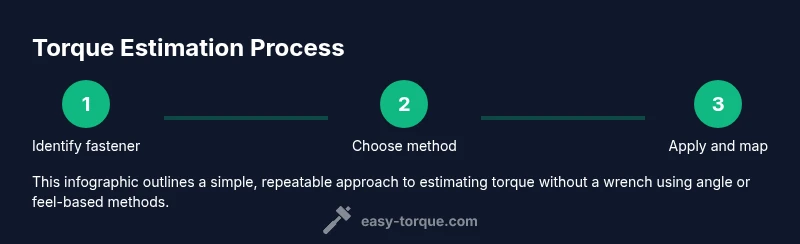
Plan your approach before touching the bolt: identify the spec, choose a method, and gather the right tools. Mark the fastener to track movement, and prepare a clean surface to avoid debris. Apply a careful sequence: snug, then apply rotation according to your chosen method (angle or feel), pause to evaluate resistance, and recheck for any movement after settlement. Record your readings and map them to an estimated torque range using reference data. Finally, compare results across similar fasteners and, if possible, verify with a wrench on a spare fastener to calibrate expectations for future work.
Calibrating your gut sense: building a personal reference
Developing a personal calibration involves repeating the same procedure on a few test bolts with known specs. Use identical thread size, lubrication, and surface condition to build a consistent baseline. Track your 'snug' and 'slightly tight' thresholds across sessions and note how lubrication changes affect feel. Keep a simple log: fastener size, lubrication state, measured angle or perceived force, and the approximate torque you mapped from reference material. Over time you will reduce guesswork and improve your confidence, while still recognizing that a wrench is the gold standard for precision.
Safety considerations when estimating torque
Estimating torque without a wrench carries safety risks: under-tightening can lead to loosening and failure; over-tightening can strip threads, break bolts, or damage components. Always wear PPE when applying force and avoid forcing a bolt beyond its normal range. If you encounter any stiffness, cross-threading, or unusual resistance, stop and re-evaluate with the proper tool. For critical systems (brakes, suspension, engine assembly), default to the manufacturer torque spec and torque wrench whenever possible.
Tools, references, and best practices
Keep a small toolkit with a torque-angle gauge, a sharp marker, and the official torque specs for your vehicles or equipment. Rely on manufacturer data rather than arbitrary values; if you don't have the exact spec, use the closest published alternative within the same fastener family and lubrication state. Create a short, repeatable process for each job: verify lubrication, ensure clean threads, snug before angle or feel-based tightening, and document results to reduce future error. Also, consult reputable sources (manuals, service bulletins) to validate your approach.
How to verify results and minimize error
Whenever possible, verify your estimates by cross-checking with a torque wrench on non-critical joints first and then apply to the critical fasteners with caution. Compare results across methods: angle-based estimates vs. feel-based estimates, and look for consistency. Record the outcomes and refine your method with revised charts or notes. Finally, if the job matters for safety or performance, perform the final tightening with a calibrated torque wrench to confirm the proper preload.
Tools & Materials
- Torque-angle gauge (or digital angle gauge)(Prefer a model that can read degrees and minutes)
- Manufacturer torque spec sheet or service manual(Include the fastener size, lubrication state, and environment)
- Marker or tape to mark bolt position(Use on accessible bolt heads and reference points)
- Lubricant-consistency reference (optional)(Use the same lubricant as specified for accurate results)
- Personal protective equipment (gloves, eye protection)
- Notebook or digital device for recording readings(Document the angle, feel, and mapped torque)
Steps
Estimated time: 45-60 minutes
- 1
Identify target fastener and locate specs
Find the exact fastener size, lubrication state, and the official torque spec from the manual or label. Confirm whether the joint is critical and whether lubrication matches spec. This establishes the basis for any non-wrench approach.
Tip: Double-check the exact part and environment to avoid using an incorrect spec. - 2
Choose a measurement method
Decide between the torque-angle method or hand-feel estimation. Consider the fastener type, lubrication state, and the availability of angle gauges. Choose one method and commit to it for repeatability.
Tip: Consistency is more important than the chosen method itself. - 3
Prepare workspace and fastener
Clean the threads and surrounding area. Mark the fastener position with your marker to observe any movement. Ensure the surface is free of debris and that you have stable footing and lighting.
Tip: Lubrication state should match what the spec requires; otherwise adjust and note the difference. - 4
Apply controlled tightening
If using angle method, rotate to the measured angle after snugging. If using feel, tighten in small, repeatable increments until you reach a defined threshold. Avoid forcing beyond resistance that feels abnormal.
Tip: Proceed slowly and stop if you sense unusual stiffness or end resistance. - 5
Record and map to torque
Record the angle or felt resistance and map it to an estimated torque using your reference data. Note lubrication, thread condition, and diameter to explain variance.
Tip: Keep the log precise; even small details affect the estimate accuracy. - 6
Validate and plan follow-up check
If possible, verify the result with a torque wrench on a spare fastener or non-critical joint. Use the outcome to adjust future estimates and build confidence in your method.
Tip: Schedule a wrench-based check for critical joints whenever feasible.
Your Questions Answered
Is it safe to estimate torque without a wrench?
Only for non-critical fasteners; never rely on estimation for safety-critical joints. Use a torque wrench for high-stakes connections.
It's risky to estimate for safety-critical parts; use a torque wrench when precision matters.
How accurate can non-wrench torque estimates be?
Estimates can be approximate and vary with method, lubrication, and repeatability. Always cross-check with a torque wrench if precision is required.
Estimates are rough and vary a lot; verify with a wrench when precision is needed.
What is the torque-angle method?
Tighten a fastener to snug, then rotate by a specific angle to achieve target preload. It relies on consistent friction and lubrication.
You tighten to snug, then turn a set angle to reach preload.
Can torque sticks help as substitutes for a wrench?
Torque sticks provide rough limits but are not substitutes for a calibrated torque wrench for precision work.
They’re rough guides, not precise tools.
What are signs of over-tightening without a wrench?
Stiffness, thread damage, or hollow feel when tightening are warning signs; stop and re-check with a proper tool.
If it becomes too stiff or you feel damage risk, stop and test with a wrench.
When should I avoid measuring torque without a wrench?
Avoid estimating for critical components like engine head bolts, wheel lug nuts, or suspension parts. Use official specs and a torque wrench.
Best to avoid estimating for safety-critical parts; use a torque wrench.
Watch Video
Top Takeaways
- Estimate torque without a wrench using angle or feel methods.
- Verify critical fasteners with a proper torque wrench when possible.
- Maintain consistent lubrication and clean threads for reliability.
- Document methods and results to improve future accuracy.