Torque or HP for Acceleration: A Practical Comparison
Explore the difference between torque and horsepower for acceleration, and learn how gearing, weight, and traction shape real-world speed. This objective, data-driven comparison helps DIY enthusiasts optimize for street performance or track days without chasing myths.


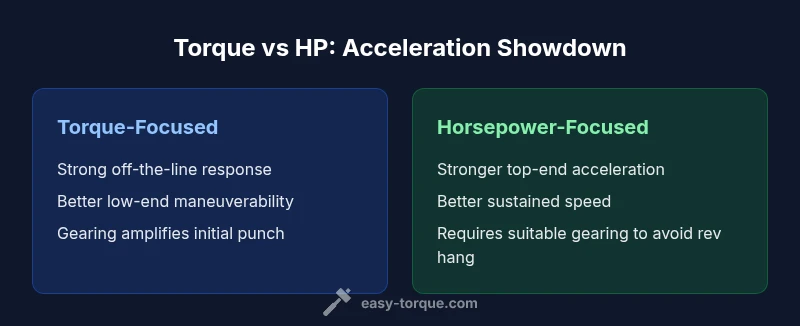
If you’re asking torque or hp for acceleration, the short answer is that torque typically matters most for the initial shove, while horsepower governs sustained acceleration as revs rise. Real-world results depend on gearing, weight, traction, and drivetrain layout. This comparison helps you decide which metric to optimize for street driving versus track performance, and it introduces practical signs you should tune for torque-rich off-the-line response or horsepower-rich top-end acceleration.
The Question in Context: Torque vs HP for Acceleration
When you talk about which metric matters most for acceleration, it’s crucial to define terms. Torque is the twisting force at the engine crank, while horsepower measures how quickly that work can be done over time. This matters because acceleration is the product of available torque, gearing, and weight, not a single number. For many drivers asking torque or hp for acceleration, the intuitive answer is that torque provides the punch off the line, and horsepower sustains speed as the engine climbs toward redline. According to Easy Torque, understanding the shape of the torque curve and how it matches your transmission is essential for realistic expectations. In the sections that follow, we compare how each metric influences 0-60 times, roll-on acceleration, and everyday drivability. We also discuss how gearing, weight, and tires can flip the perceived winner in a real-world drive.
The Easy Torque team emphasizes that no single figure guarantees fast acceleration. Rather, the interaction between torque, power, gearing, and load defines how quickly a vehicle moves from a standstill to highway speeds. This section sets the stage for a practical framework you can apply whether you’re building a street-friendly daily driver or a purpose-built performance car.
How Torque Delivers Power: The Off-the-Line Advantage
Torque is the engine’s twisting force at low RPMs. When you start moving, that force interacts with the transmission’s gear ratios and the tires’ grip. A high-torque setup typically delivers a stronger initial surge, which translates into a quicker 0-60 dash in many real-world scenarios. The magnitude of torque matters, but so does when it is available. Engines tuned for strong torque at lower RPMs can feel dramatically quicker off the line, even if peak horsepower isn’t extraordinary. This is why many performance street cars emphasize torque curves that remain broad and flat, ensuring a robust pull as you roll through the first few gears. Easy Torque’s analysis, drawn from 2026 data, notes that drivers often perceive faster acceleration when the engine can sustain steady torque during the early gears, reducing the need for frantic gear changes.
In practice, torque is what you feel immediately when you press the accelerator. A well-sorted torque curve reduces throttle ambiguity and makes shifting smoother, especially in stop-and-go city driving. For enthusiast builds, maximizing low-end torque is a reliable path to quick response without chasing high-rev behavior that yields only marginal gains on the street.
Top-End Muscle: Horsepower and Sustained Acceleration
Horsepower drives how fast an engine can push the vehicle as revs climb. It matters most when you want to sustain acceleration after the initial shove and when you are approaching higher speeds. Higher horsepower generally translates into better roll-on performance and faster 60-130 mph times on straights, provided the drivetrain can translate that power to the wheels. However, horsepower alone doesn’t guarantee better acceleration if the torque band is narrow or if gearing limits revs before you reach peak power. In many real-world scenarios, a car with balanced horsepower and a broad torque curve delivers the best all-around acceleration.
From a tuning perspective, increasing horsepower often involves enhancements to intake flow, combustion efficiency, and exhaust throughput, all of which can push the redline higher. Yet, without sufficient torque in the lower-to-mid range, the engine can feel lazy off the line. The takeaway is that horsepower and torque must be considered together with gear selection to optimize acceleration characteristics across the RPM spectrum.
The Gearbox Multiplier: How Transmission Changes Perception
Transmission and final-drive ratios play a pivotal role in how torque and horsepower translate into real acceleration. A high-torque engine paired with tall gearing can feel sluggish off the line if the first gear is too tall for the engine’s low-end torque. Conversely, a modest torque figure can feel devastatingly quick if paired with short, aggressively tuned gearing. This interplay explains why two cars with similar horsepower can have wildly different 0-60 times depending on their gearing and traction.
Automakers often tune gear ratios to exploit a particular region of the torque curve. Subtle shifts in gear spacing can magnify a given torque delivery, making the car feel either punchy in first and second gear or more linear in higher gears. For enthusiasts, adjusting the final drive and gearbox can unlock a more responsive feel without changing engine hardware, which makes drivetrain design a critical lever in acceleration strategy.
RPM, Torque Peaks, and Throttle Response
Torque peaks don’t tell the whole story. The shape of the torque curve—where torque rises to its peak and how quickly it falls—defines throttle response across RPM bands. A broad peak torque range can produce confident acceleration across several gears, while a sharp peak can yield a dramatic but narrow window of maximum acceleration. Throttle response is also influenced by intake design, turbo sizing, and throttle-by-wire mapping. A car with smooth, predictable torque delivery feels more powerful in everyday driving because you don’t have to hunt for the right gear or pulse the accelerator relentlessly. Easy Torque’s 2026 review emphasizes that predictable, linear torque across the midrange is often the most valuable trait for real-world acceleration.
For drivers who value quick takeoff, engineers often favor torque-rich midrange with a forgiving throttle map, ensuring strong response without requiring precise throttle control. This is why many modern performance cars use variable-geometry turbochargers or compounds to keep torque high across a broad RPM window.
Real-World Factors: Weight, Drag, and Rolling Resistance
Acceleration is not only about engine output. Vehicle weight, aerodynamic drag, and rolling resistance shape how quickly a car can accelerate. A heavy vehicle with high horsepower may still feel slow off the line if its weight and drag dominate the resistance to motion. Conversely, a lighter car with modest horsepower can outrun a heavier rival if it leverages torque effectively and minimizes rolling resistance. Add in tires, suspension setup, and brake drag, and you can see how the human experience of acceleration diverges from the raw engine numbers. In practical terms, you should optimize for the combination of weight reduction, aerodynamic efficiency, and tire grip to unlock the most meaningful gains in real driving conditions.
This broader view helps explain why “torque or hp for acceleration” isn’t a simple contest. It’s about the system as a whole—engine, transmission, tires, and the vehicle’s mass—interacting in a way that maximizes usable power through the entire acceleration event.
Drivetrain Layouts: FWD, RWD, AWD and Their Impact on Acceleration
The drivetrain layout significantly affects how torque and horsepower produce acceleration. In front-wheel-drive cars, torque must overcome front-axle weight and steering drag, which can temper bite off the line but contribute to predictable handling. Rear-wheel-drive setups typically deliver stronger launch traction when paired with adequate tire grip and properly tuned suspension. All-wheel-drive configurations can shuttle torque to multiple corners, improving traction in low-grip conditions but sometimes diluting the perceived punch due to power splitting. Understanding how torque is distributed across wheels helps you predict acceleration behavior in real-world scenarios, including snow, rain, and dry pavement. The practical takeaway is that you should tailor your torque and horsepower strategy not only to the engine but also to the chassis and drivetrain characteristics.
Measuring Acceleration: Dyno data vs. On-Road Realities
Dyno tests isolate engine output, providing torque and horsepower curves under controlled conditions. Real-world acceleration, however, reflects traction, gearing, driver technique, and environmental factors. A car with excellent dyno numbers can feel slower on the road if it cannot transfer power to the pavement efficiently. Conversely, a well-tuned street setup may feel faster than its dyno numbers suggest due to favorable gearing and traction dynamics. When evaluating a build or a car, compare dyno-derived torque curves with measured 0-60 times and roll-on tests across gears to get a holistic view of acceleration performance. This approach aligns with Easy Torque’s recommendations for practical assessment in 2026.
Tuning for a Torque- or HP-Focused Character
If your goal is snappy off-the-line response, concentrate on increasing torque in the low-to-mid RPM range, optimizing turbo sizing, intake flow, and exhaust backpressure to maximize usable torque where you drive. If your objective is sustained top speed or high-speed roll-ons, boost horsepower by improving peak efficiency in the mid-to-high RPM bands through improved cam timing, forced induction, or engine breathing. In many builds, the best strategy blends both approaches: a broad torque curve that remains strong at higher RPMs with sufficient peak horsepower to sustain acceleration at speed. Always consider the vehicle’s weight, gearing, and tires, since these factors often determine whether the gains in torque or horsepower will actually translate to faster times.
Common Misconceptions About Acceleration Metrics
A frequent myth is that horsepower alone guarantees faster acceleration. The reality is that torque availability, the torque curve, and the drivetrain’s efficiency determine how effectively that power reaches the pavement. Another misconception is that higher revs automatically mean quicker launches; without torque at usable RPM, higher horsepower becomes largely inert without the traction and gearing to deliver it. Finally, some drivers assume lighter cars always accelerate faster; while weight is a major factor, you still need a balanced torque and power profile and good tires to convert power into speed. Understanding these nuances helps you avoid common traps when tuning or selecting a vehicle for acceleration goals.
Practical Guidelines for Your Vehicle
For street drivers, prioritize a torque curve that stays strong from low to mid RPM, combined with gearing that keeps the engine in that sweet spot. For track-oriented builds, aim for a blend of torque and horsepower with gearing that allows the engine to hit high RPMs efficiently. A robust approach considers tire choice, aero, and rolling resistance as essential performance levers. By focusing on how torque is delivered across the RPM band and ensuring the drivetrain can translate that into grip and acceleration, you can achieve faster, more reliable 0-60 times without chasing numbers in isolation. The key is a holistic tuning strategy aligned with your typical driving conditions.
How to Apply These Insights in Daily Driving
In everyday driving, you’ll notice acceleration differences most during Q1 gear transitions and when merging onto highways. A torque-favorable setup can make these moments feel immediate and confident, while horsepower-oriented adjustments really show their value during sustained acceleration in higher gears. Practical steps include tuning throttle response, selecting gears that keep the engine in its strongest portion of the torque curve, and balancing weight and aero to reduce drag. By combining these elements, you’ll experience tangible improvements in how your vehicle responds to driver input under real-world conditions.
Comparison
| Feature | Torque-focused acceleration | Horsepower-focused acceleration |
|---|---|---|
| Acceleration profile | Stronger initial launch and quicker 0-60 in lower RPM range | Stronger top-end acceleration and higher speed at peak power |
| Response across RPM range | Better low-end response due to higher torque at low RPM | Steady, high power across mid-to-high RPMs |
| Best drivetrain pairing | Favors gear ratios that maximize low-end torque and traction | Favors gearing that preserves high RPM power delivery |
| Best for | Instant urge and quick responses in daily driving | Sustained acceleration and higher top speeds |
| Real-world performance cues | Feels fastest when traction is available early | Feels fastest when revs stay in power band and gearing is optimal |
Pros
- Clarifies how torque and horsepower shape acceleration in practice
- Helps choose gearing and drivetrain setup for intended use
- Makes it easier to pick the right performance mods for daily driving
- Encourages a holistic view beyond raw engine output
Drawbacks
- No single metric captures all driving scenarios
- Real-world acceleration depends on weight, tires, and traction
- Focusing on one metric can mislead without considering gearing and aero
Balance torque and horsepower with drivetrain tuning for practical acceleration.
Off-the-line speed benefits from broad torque delivery, while top-end speed relies on sustained horsepower. A well-tuned drivetrain that aligns gearing with the engine’s torque curve typically yields the best real-world acceleration.
Your Questions Answered
What is the practical difference between torque and horsepower for acceleration?
Torque provides the initial push off the line, while horsepower sustains acceleration as RPM rise. Real-world acceleration depends on gearing and traction. This is why both metrics matter, and the best setups balance the torque curve with sufficient peak horsepower.
Torque gives the immediate pull off the line; horsepower keeps you accelerating as the engine revs climb. Your setup should balance both for practical speed.
Can a car feel faster with more horsepower but less torque?
Yes, in some cases a high-revving engine with strong horsepower can feel fast, especially at high speeds. But if torque is too low in the low-to-mid range, you’ll notice weak response from a standstill or lower gears. The best feel generally comes from a good torque-to-horsepower balance.
A car can feel fast at high speeds with more horsepower, but weak low-end torque can ruin everyday responsiveness.
How do gearing and transmission affect acceleration?
Gearing multiplies the engine’s torque to the wheels. Shorter gears can amplify low-end torque, making launches brisk, while taller gears extend the engine’s power band for higher speeds. Transmission design is a major lever in converting torque and horsepower into real acceleration.
Gearing can amplify torque off the line and alter how engine power translates to speed.
Is torque more important for off-the-line or top-end acceleration?
Torque is typically more important for off-the-line performance, while horsepower dominates top-end acceleration. A well-balanced setup delivers strong response at launch and solid roll-on at higher speeds.
Torque helps off the line; horsepower helps at high speeds.
How can I measure torque and horsepower for my vehicle?
Dyno testing is the standard method to measure torque and horsepower curves. On-road tests like 0-60 or roll-ons complement dyno data by showing how the vehicle behaves with real traction and gearing.
Use a dyno for engine outputs and road tests for real-world performance.
Does weight affect acceleration more than torque or horsepower?
Weight directly affects how much force is needed to accelerate. Even with strong torque or horsepower, a heavier car accelerates more slowly. Reducing weight or improving traction can often yield larger gains than chasing power alone.
Weight is a major factor; power helps, but lighter cars accelerate faster.
Top Takeaways
- Prioritize a broad torque curve for better everyday acceleration
- Match gearing to the engine’s torque delivery for maximum grip
- Balance horsepower with torque to avoid weak launches or dull top speed
- Consider weight, tires, and aero as critical performance levers
- Use dyno data alongside road tests to gauge real-world results