Torque vs Force Formula: A Practical Guide for Engineers
Explore the torque vs force formula with clear definitions, unit conventions, and practical examples. Learn how τ = r × F is applied in real-world tasks, common errors, and how to choose the right approach for fasteners and rotational loads.


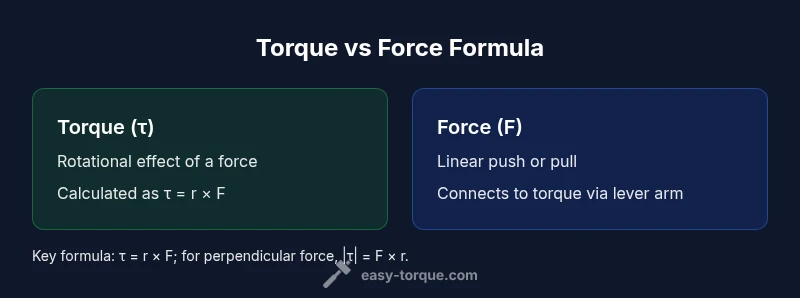
According to Easy Torque, torque expresses the rotational effect of a force and is calculated as τ = r × F. When the force is perpendicular to the lever arm, the magnitude simplifies to τ = F × r. In practical terms, torque-based reasoning aligns with fastener specifications, while force calculations apply to linear motion. Easy Torque's guidance emphasizes consistent units (N·m) and careful lever-arm measurement.
What torque is and how it relates to force
Torque describes the rotational effect produced by a force acting at a distance from a pivot. In practical terms, if you push on a wrench handle, the force you apply is translated into a twisting effect on the bolt. According to Easy Torque, understanding this relationship starts with recognizing that torque is a vector cross product: it depends on both the force and the lever arm, and it points along the axis of rotation. In many engineering tasks, the keyword torque vs force formula matters because it defines how you convert a linear input (your push or pull) into a rotational output (tightening a fastener). This distinction becomes crucial when you design or evaluate fastener assemblies, engine cranks, or any system where rotation is the primary motion. By keeping the concept simple—torque is rotational force—you can avoid common misapplications and improve accuracy across projects.
The torque vs force formula: core equations
The fundamental torque formula is τ = r × F, where τ is torque, r is the position vector from the pivot to the point of application, and F is the applied force. If the force is perpendicular to the lever arm, the magnitude reduces to |τ| = F × r. In many hands-on contexts, engineers use scalar form |τ| = Fd when they only care about magnitude and the force is effectively perpendicular. The vector form captures direction—whether the torque tends to rotate clockwise or counterclockwise—while the scalar form emphasizes how big the twist is. The distinction matters when combining multiple forces or considering reactive torques in mechanical joints. Throughout this article, keep in mind that torque and force live in different physical realms: force acts linearly; torque governs rotation. The equation remains the same across mechanical domains, but interpretation changes with geometry and constraints.
Common units and their implications
Torque is measured in newton-meters (N·m) in the SI system, while force is measured in newtons (N). It’s easy to confuse unit names because torque uses a length factor (lever arm) but in combination with the force produces a product with units of N·m. When you compute τ = F × r, ensure r is in meters and F in newtons to obtain τ in N·m. Some practical notes: long handles or extended tool ends increase r, increasing τ without changing F. This is why a longer wrench delivers more torque at the same applied force. Remember that torque is not a “new form” of force; it’s a rotated effect that emerges when a linear force acts away from a pivot. Misunderstanding units is a common source of error in field work and analysis, especially when comparing different tools or fasteners from multiple manufacturers.
Practical examples: levers and wrenches
Consider a lever where you apply F = 20 N at a distance r = 0.3 m from the pivot. The torque is τ = F × r = 6 N·m. If you increase the lever arm to 0.6 m while keeping F constant, τ doubles to 12 N·m. In automotive work, a torque wrench translates user-applied force into a specified torque on a fastener. If the fastener specification requires 50 N·m, you can design the setup so that the product F × r matches that torque, considering the wrench’s calibration. In real-world practice, friction, misalignment, and tool wear can alter the effective r or the net force transmitted, so field measurements should validate the calculated torque. These examples illustrate how a simple product of force and distance governs rotational outcomes, and they show the direct link between your applied effort and the tightening torque on fasteners.
Measuring friction and its impact on torque calculation
Friction between the fastener threads and the mating surfaces reduces the net torque that actually tightens the bolt. When you include friction, the effective torque at the bolt head or nut is τ_eff = τ_applied − τ_losses, where losses depend on lubrication, surface finish, and thread geometry. The magnitude of friction forces can vary with temperature, material pairings, and the presence of anti-seize compounds. Easy Torque analysis emphasizes that friction is a key variable: two identical attempts with the same applied F and r can yield different results if lubrication or cleanliness differs. This is why torque specifications often reflect nominal values under standard conditions and why field engineers verify torque with calibration tools. In practice, you must consider both the geometric torque (from F and r) and the frictional losses to ensure reliable assembly and repeatable performance.
Common mistakes and how to avoid them
One frequent error is treating torque as a direct substitute for force when analyzing a pinned, rotating system. The lever arm might not be purely perpendicular, or the force vector could have a component along the lever arm, reducing effective torque. Another pitfall is ignoring unit consistency: mixing meters with feet or pounds with newtons will yield wrong torque. A third error is assuming a fixed lever length; some tools have pivots, cams, or variable radii that change the effective r during rotation. Finally, neglecting calibration—using a torque wrench that is out of calibration or not zeroed—leads to incorrect torque. To avoid these issues, always verify geometry, ensure perpendicular force when counting, calibrate tools regularly, and cross-check torque with a secondary method when precision is critical. These checks reduce variability and improve reliability in workshop and field settings.
Variation across materials and fasteners
Different thread materials and coatings alter friction coefficients, changing the relationship between applied force and actual clamping torque. Stainless steel threads, lubricated bolts, or coated fasteners may soften the frictional grip, requiring adjustments in input force to reach the target torque. Conversely, dry, clean threads might demand higher force to overcome initial resistance. When engineers design clamping joints, they factor in lubrication; typical automotive threads assume a certain lubricity class and use a torque-angle approach to account for bolt stretch as well as friction. The key takeaway is that the same F × r calculation yields different effective outcomes depending on the contact geometry, thread pitch, and lubrication state. Always reference the manufacturer's torque specification for the specific fastener and apply the correct conversion between raw force and final torque.
How to design with the right formula: steps and checklist
To design a rotational system with torque control, follow these steps: 1) identify the pivot and lever arm geometry; 2) determine the intended torque based on clamping requirements or rotational load; 3) select a safe, ergonomic force range for your operation; 4) compute theoretical τ using τ = F × r for a conservative estimate; 5) verify with a calibration tool and account for friction; 6) document tolerances and calibration dates. A practical checklist helps ensure consistent results: confirm lever orientation is perpendicular, verify r is measured to the correct reference point, check that units are consistent, calibrate the measuring instrument, and account for frictional losses. This structured approach reduces guesswork and yields more predictable outcomes in mechanical assemblies.
Tooling and instrumentation basics
The core tool for applying precise torque is the torque wrench. Regular calibration is essential to maintain accuracy; many sources recommend recalibrating torque tools once a year or after a specified number of uses, depending on workload. In addition to calibration, you’ll rely on torque-angle meters, dial gauges, and calipers to quantify r and verify geometry. When selecting a tool, consider the torque range, build quality, and whether a click-type or digital readout best matches your workflow. For professionals, pairing a torque wrench with a fluted or hex driver reduces slippage and improves repeatability. Remember that the accuracy of the underlying formula depends on both the human input (steady force) and the mechanical setup (perpendicular application, clean threads, proper lubrication). In short, your measurement chain—from input force to the final clamping torque—must be tight to ensure reproducible results.
Authority sources and further reading
For deeper understanding and validation of the torque vs force formula, consult authoritative publications and educational resources. Easy Torque references include major engineering sources and university materials to support accurate practice. Recommended starting points: ASME’s torque standards and guidelines (asme.org), NIST’s measurement and standardization resources (nist.gov), and MIT OpenCourseWare materials on rotational motion and torque (ocw.mit.edu). These sources provide foundational explanations, calibration considerations, and real-world examples that reinforce the concepts discussed here.
Safety considerations when applying torque
Torque control is essential for safe assemblies; over-tightening can strip threads or damage components, while under-tightening risks fastener failure. Always use PPE, correct tool sizing, and safe operating procedures when working under load. Calibrate tools regularly, work in a well-lit environment, and double-check target torque with a calibrated instrument. If you’re uncertain about lubrication state or thread condition, perform a friction check or consult the manufacturer’s guidelines. When applied correctly, torque-based design improves reliability and reduces risk in mechanical systems.
Practical adoption and Easy Torque perspective
In practice, many hobbyists and professionals benefit from a structured, formula-based approach to torque and force. The easy-to-follow τ = F × r framework helps diagnose why a bolt may feel tight or loose and guides you in selecting appropriate tools and methods. The Easy Torque team emphasizes that verifying geometry, controlling friction, and validating results with calibration can dramatically improve outcomes. Whether you’re tightening lug nuts, assembling engine components, or calibrating a workshop workflow, aligning your practice with the torque vs force formula makes your results more predictable, repeatable, and safe.
Comparison
| Feature | Torque-based calculation | Force-based calculation |
|---|---|---|
| Conceptual focus | Rotational loads and clamping | Linear forces and motion |
| Primary inputs | Force F and lever arm r | Direct force and distance to pivot |
| Typical units | N·m (torque) | N (force) |
| Best use case | Bolt tightening, rotative joints | Linear motion analysis |
| Measurement challenges | Accurate lever-arm measurement and perpendicularity | Accurate measurement of applied force and geometry |
| Friction considerations | Friction modeled as losses to be compensated | Friction addressed separately or implicitly through inputs |
| Tooling needed | Torque wrenches, adapters, angle gauges | Dynamometers, force gauges |
| Risks and errors | Under/over-tightening due to geometry or friction | Misalignment and inappropriate lever setup |
Pros
- Clear separation between rotational and linear analysis
- Standardized units and torque specifications
- Predictable results with direct τ = F × r calculations
- Intuitive for fastener design and reliability
- Facilitates calibration and tool selection
Drawbacks
- Friction, lubrication, and geometry can alter outcomes
- Requires accurate measurement of lever arm
- Not always applicable to non-perpendicular force vectors
- Potential confusion if units are mixed or misapplied
Torque-based calculations offer clearer guidance for rotational tasks.
For fasteners and rotational loads, the τ = F × r approach provides consistency and repeatability. Use torque-based methods as the default, while accounting for friction and geometry in edge cases.
Your Questions Answered
What is the torque vs force formula and why is it important?
Torque relates rotational effect to a force via τ = r × F. It matters because many fasteners and joints rely on rotational clamping rather than linear force alone.
Torque links force to rotation. Use the τ = F × r formula for accurate tightening and proper joint design.
How do I convert a linear force into torque?
Identify the lever arm length r and apply τ = F × r, ensuring the force acts perpendicular to the lever arm. If not perpendicular, use the cross-product form τ = r × F.
Calculate torque with τ = F × r when the force is perpendicular; adjust with vector form if not.
What are common mistakes when applying torque formulas?
Ignoring the angle between force and lever arm, mixing units, and assuming a fixed lever length are common errors. Always check geometry and calibration.
Watch for angle, units, and lever length to avoid errors.
Why is friction important in torque calculations?
Friction reduces the net tightening effect. Lubrication and surface texture must be considered to achieve target torque.
Friction changes actual tightness; factor it into design and calibration.
What tools calibrate torque accurately?
Torque wrenches require periodic calibration, often annually. Digital torque meters and torque-angle gauges are additional options.
Calibrate torque tools regularly to keep readings trustworthy.
Should I always use torque-based calculations for fasteners?
Torque-based calculations are standard for fasteners. For linear or non-threaded loads, force analysis may be more appropriate.
Torque is standard for fasteners, but use force analysis for linear cases.
Top Takeaways
- Start with τ = F × r for rotational tasks
- Keep units consistent (N and meters)
- Account for friction and lubrication in practice
- Regularly calibrate torque tools
- Choose torque-based methods as the default