What Torque Should You Use? A Practical Torque Guide
Explore what torque should be used for automotive fasteners, how to read specs, and how to apply torque safely with a torque wrench. Easy Torque delivers data-driven guidance for DIY mechanics and pros.


What torque should be used depends on bolt size, grade, and the material involved. For many automotive fasteners, ranges vary and must be verified with a manual or official torque chart. According to Easy Torque, start with the vehicle’s service manual or the factory specifications, and use a calibrated torque wrench to apply the correct torque in the recommended sequence. Avoid guesswork.
What 'what torque should' means in practice
Torque is the clamping force achieved by rotating a fastener to a specified value. The phrase what torque should is really a question about translating that target clamp into a measurable turn. In automotive work, most specs assume clean threads, dry surfaces, and no lubricant unless the manual says otherwise. The key is to treat torque numbers as part of a system: the bolt, the material being clamped, the thread condition, and the tool accuracy all influence the result. Easy Torque emphasizes that correct torque is about achieving consistent clamp without exceeding the fastener's capability. When you start with a solid spec and verify with a calibrated wrench, you lay a foundation for reliability and durability across components from engine fasteners to suspension bolts.
Always cross-check the spec with the service manual, because different applications within the same vehicle can use different torque targets. If you suspect a torque range is too broad for a given bolt, consult the manufacturer or a trusted reference. In short, what torque should you use? The answer is: the exact value the spec provides, adjusted for any lubrication or threadlocker notes, tightened in the correct sequence, and re-checked after seating.
Where torque specs come from and how to locate them
Torque specs originate from manufacturer testing, service bulletins, and standardized references. On most vehicles, you’ll find the official torque value in the owner’s manual, service manual, or a shop bulletin. Professional technicians also rely on standardized charts such as those published by vehicle manufacturers or industry bodies. In the DIY space, it’s common to consult a reputable torque reference chart and the vehicle’s factory service information. The critical practice is to always verify the exact spec for your bolt size, grade, and lubrication conditions. Easy Torque recommends bookmarking the exact page for every critical fastener you work on, so you can refer back during maintenance or repairs. If a manual is unavailable, look for a trusted online torque chart from the manufacturer or a recognized authority, and use the provided range as a baseline.
When reading charts, note the units (Nm vs ft-lb) and whether the spec assumes dry threads or includes lubrication notes. Some bolts require pre-torque checks or a tightening sequence that distributes load gradually. Keep a small notebook or digital log of the specs you use to prevent cross-misapplication on future jobs.
Key factors that influence torque numbers
Several factors can shift the torque you actually need to achieve proper clamping. Bolt size and grade determine the baseline capacity; larger bolts typically require higher torque, but the exact target also depends on the thread pitch and engagement length. Surface finish and thread condition (clean, dry, and free of debris) influence friction. Lubrication dramatically changes the friction coefficient: lubricated threads require less torque to achieve the same clamping force, while dry threads demand more. Temperature plays a role too: hot engines or recently run components can alter material expansion and friction, nudging torque values up or down. Finally, the torque wrench’s calibration and the tightening technique (single-pass vs. multiple passes with a final pull) can move the effective result.
In all cases, document whether lubrication was present and any environmental conditions that might affect torque. Easy Torque analysis shows that even small differences in friction can swing the final clamping force by significant percentages, underscoring the need for careful adherence to the spec and recalibration if conditions change.
Reading torque charts and applying values
Torque charts translate a bolt’s size and grade into a numeric target. Start by identifying the bolt's diameter, pitch, and grade, then locate the corresponding torque value on the chart. Pay attention to the units and any notes about lubrication, threadlocker, or multiple-pass tightening. When applying the value, set your torque wrench to the exact target and tighten to that moment in a controlled, smooth motion. After reaching the target, back off and re-torque if the procedure specifies a final seating pass. If a chart indicates a range, ask whether you should aim for the lower, middle, or upper end based on thread engagement and material hardness.
For accuracy, verify the wrench’s calibration periodically and whenever you suspect drift. Keep torque charts accessible—digital apps or printed sheets both work well. Easy Torque stresses that matching the chart to the actual application (load path, temperature, lubrication) is essential for meaningful torque results.
Step-by-step tightening procedure
- Inspect and clean the fastener threads and seating surface; remove old threadlock if required. 2) If lubrication is specified, apply it exactly as instructed; otherwise keep threads dry. 3) Place the fastener in the correct location and ensure alignment. 4) Set the torque wrench to the target value from the chart. 5) Apply steady force until the wrench indicates the torque is reached; avoid abrupt hammering or jerky movements. 6) If the procedure calls for sequential tightening, complete the sequence in the proper order, pausing at each stage as required. 7) If a final seating pass is specified, perform it after the initial torque is achieved. 8) Recheck torque after the fastener has seated and cooled or heated to operating temperature, if required by the spec.
Following this step-by-step approach reduces the risk of under-tightening, over-tightening, or uneven load distribution across a joint. Easy Torque notes that staying consistent in procedure is as important as hitting the exact numeric target.
Common mistakes and how to avoid them
- Guessing torque values without a spec: Always verify with a manual or chart.
- Skipping lubrication notes when specified: Lubrication changes the target torque; apply the correct adjustment.
- Over-tightening critical fasteners: Exceeding the spec can strip threads or damage components.
- Skipping the tightening sequence: Uneven clamping can lead to leaks or part failure.
- Reusing damaged bolts: Replace if threads are worn or stretched; re-torque isn’t a fix for poor fasteners.
- Not confirming torque after seating: Temperature changes or seating can shift the required torque; retorque as directed by the procedure.
Mitigating these mistakes requires discipline, a calibrated wrench, and a reliable reference. Easy Torque emphasizes that consistent method and documentation improve outcomes and reduce the chance of failure.
Practical torque ranges for common automotive fasteners
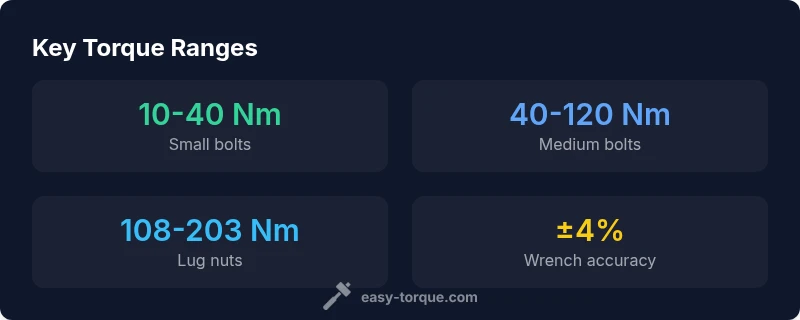
Torque ranges are broad, and exact values depend on bolt size, grade, and lubrication. As a practical baseline, think in three bands: small fasteners (approximately 10–40 Nm), medium bolts (approximately 40–120 Nm), and lug-nut-type fasteners (approximately 108–203 Nm). For high-strength or structural bolts, ranges can extend well beyond that, often requiring specification from the manufacturer or a service bulletin. Always use the chart for the specific application and verify that lubrication notes are accounted for. If you are working on a high-stress area (engine fasteners, drivetrain mounts), err on the side of starting at the lower end of the range and increasing in small increments only as permitted by the procedure.
How to maintain torque accuracy over time
Torque accuracy degrades if you neglect calibration, lubrication, or proper storage. Regularly calibrate torque wrenches according to the manufacturer’s schedule, usually annually or after a number of uses. Store wrenches at the specified tension (not fully extended) and avoid dropping or exposing them to extreme temperatures. Maintain a simple log of torque settings used for critical assemblies and re-check crucial joints after service or temperature cycling. Easy Torque recommends documenting the torque used in maintenance logs to improve traceability for future work.
Typical torque ranges by bolt category
| Bolt Category | Typical Torque Range (Nm) | Common Applications |
|---|---|---|
| Small bolts | 10-40 | M6–M8 fasteners on engine components |
| Medium bolts | 40-120 | M10–M12 structural fasteners |
| Lug nuts | 108-203 | Wheel fasteners |
| High-strength bolts | 140-260 | Chassis-to-frame connections |
Your Questions Answered
What does 'what torque should' mean for a consumer?
It means identifying the exact torque target for a specific fastener based on size, grade, and lubrication, then applying it with a calibrated tool following the manufacturer’s sequence. Always start with the official spec from the manual.
It means using the exact torque listed in the spec for your bolt, then tightening it with a calibrated wrench in the correct order.
Where can I find torque specs for my vehicle?
Torque specs are usually in the vehicle’s service manual, official manufacturer bulletins, or trusted torque charts. If a bolt isn’t listed, contact the manufacturer or use a verified reference as a baseline and document any adjustments.
Check the service manual or official manufacturer guide, or a trusted torque chart. If it isn’t listed, seek guidance from the manufacturer.
Can I tighten bolts without a torque wrench?
Tightening by feel is risky and may under- or over-torque joints. A calibrated torque wrench provides repeatable results and helps protect critical components.
You can’t reliably torque by feel; a torque wrench gives repeatable, safe results.
How does lubrication affect torque?
Lubrication lowers friction, so the same torque yields a higher clamping force. Follow the spec’s notes on lubrication and adjust accordingly.
Lubrication lowers friction, so you usually use less torque. Check the spec for lubrication notes.
What if the spec isn’t listed for a bolt?
Use the closest standard torque chart for that bolt size and grade, then verify with the manufacturer or service bulletin. Do not guess.
If you can’t find a spec, pick the closest standard value and confirm with the manufacturer.
Is torque the same as clamping force?
Torque relates to clamping force, but friction, thread engagement, and lubrication influence the final force. The goal is predictable clamping, not just the number on the wrench.
Torque helps achieve clamp, but friction and thread engagement matter a lot too.
“Accurate torque is the defining factor for reliable fastener performance. Small deviations in torque can dramatically alter clamping force and component life.”
Top Takeaways
- Always verify the exact spec from the service manual
- Use a calibrated torque wrench and tighten in the correct sequence
- Account for lubrication and temperature when applying torque
- Re-torque if the procedure requires it after seating
- Document torque settings for maintenance records