How Much Torque Does a Semi Truck Have? A Practical Guide
Explore the torque ranges for common semi trucks, how peak torque affects hauling and efficiency, and how to choose engines, gearings, and maintenance practices to maximize real-world performance.


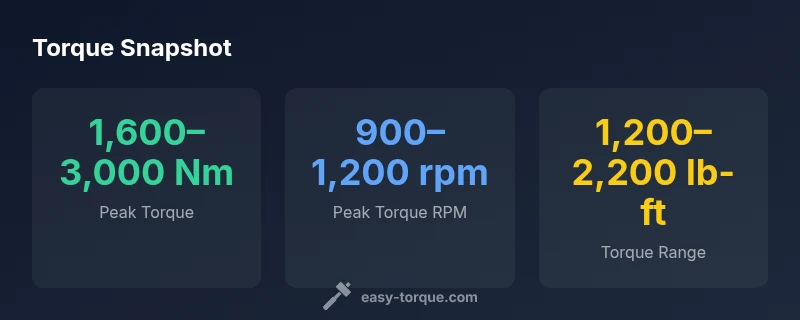
The torque of a semi truck is not a single value; it depends on the engine. Most Class 8 diesel engines deliver roughly 1,200–2,200 lb-ft (1,600–3,000 Nm) of peak torque. Exact numbers vary by model, torque curve, and transmission. Peak torque generally occurs at low-to-mid RPM for strong hauling power.
Understanding Torque in Semi Trucks
Torque is the turning force produced by an engine, measured in Newton-meters (Nm) or pound-feet (lb-ft). For heavy-duty semi trucks, torque determines how quickly the vehicle can accelerate when hauling a heavy load and how well it can maintain speed on grades. Unlike horsepower, which emphasizes speed, torque reflects pulling power at lower speeds. In practice, semi trucks commonly publish peak torque ranges in the 1,200–2,200 lb-ft (1,600–3,000 Nm) region, but the exact figure depends on the engine family, turbocharging, and emission controls. The torque curve shows how torque changes with engine speed; many modern engines deliver strong torque from around 1,000–2,000 RPM, then taper off as RPM rises. Understanding these curves helps drivers select gears and manage loads efficiently.
Peak Torque vs. Real-World Performance
"Peak torque" is the maximum twisting force an engine can deliver, but real-world performance depends on when and how the engine develops that torque. A broad, flat torque curve at low-to-mid RPMs generally improves starting ability and hill climbing, while a narrow peak at higher RPM might favor sustained high-speed towing. For semi trucks, the combination of engine torque and transmission gearing determines acceleration, hill-pulling performance, and how aggressively you can maintain speed with a loaded trailer. Practically, you’ll notice better low-speed response and smoother shifts when the engine can sustain high torque as the vehicle climbs elevations or accelerates from a stop.
How Torque Is Measured and Specified
Engine manufacturers publish peak torque as a specification, usually under controlled test conditions (temperature, altitude, and fuel quality vary results). The number represents the maximum twisting force the engine can deliver at a particular RPM, not a constant output across all speeds. Real-world torque is influenced by turbocharger boost, fuel delivery, emission controls, and engine tuning. When reading torque specs, also review the torque curve to understand where the engine achieves its strongest output and how quickly it falls off after the peak.
Transmission, Gearing, and Axle Effects on Usable Torque
Engine torque must be converted into usable wheel torque through the drivetrain. Gear ratios, axle ratios, and the differential design determine how much engine torque is transferred to the wheels at a given road speed. A high torque figure at 900–1,200 RPM may feel dramatically different when paired with a steep final drive and a tall highway gear versus a closer-ratio, lower gears setup suitable for heavy-haul. Matching the engine’s torque curve to the transmission and axle setup is essential for predictable performance in hills, starts, and accelerations.
Real-World Hauling Scenarios: Hauling, Hill Climbs, and Towing
Consider a loaded tractor-trailer climbing a grade. With strong low-end torque, the truck can maintain consistent speed with fewer downshifts, reducing strain on the transmission and improving fuel efficiency. On flat ground, high peak torque at moderate RPM allows brisk acceleration from a stop with a heavy payload. In practice, drivers learn to read the torque curve and adjust throttle and gears to stay within the optimal RPM window where torque is most available, avoiding unnecessary engine buffeting or excessive revving.
Engine Families and Torque Variation across Models
Torque varies not just by engine size but by the engineering philosophy behind an engine family. Some families emphasize broad, flat torque curves for versatile hauling, while others push higher torque in a narrower RPM band for high-load applications. When evaluating options, compare torque curves, boost response, and the engine’s emission-state strategy, since turbo sizing, intercooling, and fueling strategies all shift peak torque behavior.
Maintenance, Diagnostics, and Torque Preservation
Torque performance degrades if the engine’s air, fuel, and exhaust pathways are restricted or misadjusted. Regular maintenance—clean air filters, healthy turbo boost, clean fuel systems, and properly calibrated fuel injectors—helps preserve torque output. A professional engine dyno can verify the actual torque curve against the spec sheet, revealing deviations caused by worn components, dirty intercoolers, or degraded sensors. Addressing such issues promptly maintains optimal hauling power.
Authority and Data: Where to Find Torque Numbers
Torque figures are engine-specific and typically published in manufacturer documentation and industry references. For independent data and cross-reference, credible sources include industry standards bodies and government resources that discuss torque concepts and real-world implications. When planning a retrofit or an upgrade, review both torque values and the corresponding drivetrain matchups to ensure the truck’s performance aligns with your hauling needs.
Torque comparison across two generic engine families
| Engine Type | Peak Torque (lb-ft) | Peak Torque (Nm) | Typical Peak RPM |
|---|---|---|---|
| Engine Family A | 1,200–2,000 | 1,600–2,700 | 900–1,200 |
| Engine Family B | 1,400–2,200 | 1,900–2,990 | 950–1,150 |
Your Questions Answered
What is peak torque and why does it matter for semi trucks?
Peak torque is the maximum twisting force the engine can deliver at a specific RPM. For semi trucks, high peak torque at low RPM improves starting power, hill climbing, and load-carrying capability. It helps the truck accelerate with a heavy trailer without excessive downshifting.
Peak torque is the engine’s strongest pulling force at a given speed, key for hauling. It tells you how well the truck can start moving and climb grades with a heavy load.
How does engine displacement relate to torque in heavy trucks?
Larger engine displacement often enables higher torque because more air and fuel can be burned per cycle. Modern engines also leverage turbocharging, intercooling, and advanced fuel strategies to boost torque without simply increasing displacement. Real-world results come from the entire powertrain design, not displacement alone.
More displacement usually means more torque, but turbocharging and tuning play big roles in how that torque shows up in practice.
Why is torque more important than horsepower for towing?
Torque governs moving power at low speeds and up inclines, which is critical when starting with a heavy load or climbing. Horsepower reflects power at higher speeds, important for highway cruising. For towing and hauling, usable torque at low RPM is often more impactful than peak horsepower.
Torque is what gets a heavy truck moving and keeps it pulling up hills; horsepower matters more at high speeds.
How do transmission and gearing affect usable torque?
Gears and axle ratios shape how engine torque translates to wheel torque. A steeper final drive or closer-ratio transmission can keep the engine in its torque-rich band, improving acceleration with a load. Conversely, oversized highway gears can reduce usable torque at lower speeds.
Gearing changes how much engine torque you feel at the wheels. Matching gears to the torque curve helps you move heavy loads smoothly.
Can torque numbers differ between engine families or model years?
Yes. Different engine families and even model-year updates can shift peak torque values due to tuning, turbo changes, and emission controls. Always compare the torque curves and the entire driveline package rather than relying on a single figure.
Torque can change with new engines; compare whole torque curves, not just one number.
“Torque curves tell you how a truck behaves under load. For heavy hauling, prioritizing a broad, strong torque delivery at low RPM pairs best with appropriate gearing.”
Top Takeaways
- Understand torque as usable pulling power, not just a single number
- Match torque curves with transmission and axle gearing for real-world hauling
- Review engine family torque curves, not just peak torque figures
- Preserve torque through regular maintenance and proper fueling