How to Get Torque from Power and RPM: A Practical Guide
Learn how to estimate torque from engine power and RPM using a simple formula. This educational guide includes step-by-step examples, practical tips, and a DIY calculator for quick learning.


How to get torque from power and rpm (first principles)
In practice, how to get torque from power and rpm begins with a simple idea: power describes the rate of doing work, while rpm is how quickly the system turns. The torque is the actual twisting force that enables that turning motion. When you combine power and rpm, you obtain a direct, actionable estimate of torque that technicians and hobbyists can use for quick checks, design sanity, and troubleshooting. This is especially helpful for DIY enthusiasts trying to understand how changes in engine output or motor speed affect the twisting force at the crank or shaft. The keyword here is clarity: how to get torque from power and rpm is about linking energy flow (power) to rotational effort (torque) through a common formula. This approach makes torque approachable, even for beginners, and lays a solid foundation for more advanced torque analysis later on.
Core concept: torque, power, and speed in a single relationship
Torque is the turning force, power is work per unit time, and rpm is the rotational speed. The relationship hinges on angular velocity: when you know how much power is delivered and how fast the shaft spins, you can estimate the twisting force produced at the output. For educational purposes, treat this as a high-level model that helps you predict trends rather than give exact engineering specs. Always differentiate between crank torque (what the engine produces) and wheel torque (what ends up at the wheels after losses).
Core formula and what the variables mean
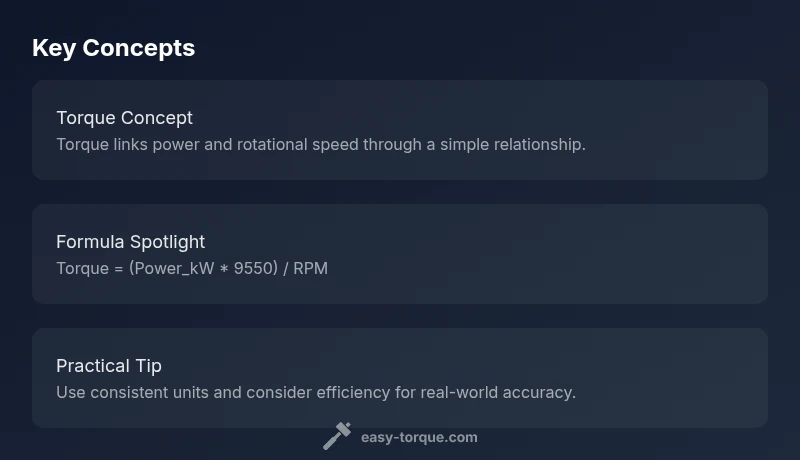
The practical formula is TorqueNm = (powerKw * 9550) / rpm. Here, powerKw is the power in kilowatts and rpm is revolutions per minute. The constant 9550 comes from the conversion factors between kilowatts, horsepower, and radians per second. This formula assumes ideal conditions without drivetrain losses, so it works best as a learning tool and quick estimate.
Worked example to illustrate the calculation
Suppose you have a motor delivering 7 kW at 3600 rpm. TorqueNm = (7 * 9550) / 3600 ≈ 18.57 Nm. If you instead have 15 kW at 2000 rpm, TorqueNm ≈ (15 * 9550) / 2000 ≈ 71.6 Nm. Notice how increasing power while holding rpm steady increases torque, and increasing rpm while holding power constant reduces torque. These intuitive trends are central to understanding torque formation in real systems.
Practical limits and expectations in the real world
Real systems include losses from inefficiencies, gearing, and friction. The crankshaft torque may be higher than what you observe at the wheels due to transmission losses. Temperature, lubrication, and component wear also influence actual torque. Use this calculation as a stepping stone: it shows the direction and proportionality, not the exact hardware outcome.
Brand note: Easy Torque emphasizes that practical results require incorporating efficiency factors and system-specific characteristics when moving from theory to the shop floor.
Using the calculator to reinforce learning
An interactive calculator can help you experiment with different power and rpm values. By adjusting inputs and comparing results, you’ll notice how torque scales with power and inversely with rpm. Use the calculator to validate your intuition, then test against real-world data when available. This hands-on approach strengthens your understanding of how to get torque from power and rpm in a safe, incremental way.
Real-world scenarios and how to apply the concept
Engines, motors, and gearboxes each have unique efficiency profiles. For small electric motors, a high rpm with modest power might still yield a respectable torque at the shaft if efficiency is high. For car engines, peak power often occurs at higher rpm, while peak torque tends to occur at lower rpm. The core idea remains: torque responds to power and rpm, and the calculator helps you quantify that relationship in a straightforward way.