Torque Calculation for Motor: A Practical Guide
Learn how to calculate motor torque from power, RPM, and efficiency. This educational guide covers core formulas, a practical example, an interactive calculator, data references, and tips for safer, efficient motor design.


What is torque calculation for motor and why it matters
Torque calculation for motor performance is fundamental to predicting how a drive will respond under load and how components interact in a system. According to Easy Torque, a clear understanding of the relationship between power, speed, and torque helps you choose compatible motors, controllers, and gears. In practical terms, torque tells you how much rotational force is available at the shaft, which influences everything from acceleration to peak loads. For DIY enthusiasts and professional technicians, starting with a solid grasp of the core concepts reduces guesswork and speeds up design iterations. When you know the target torque, you can select hardware with the right safety margins and plan for heat, insulation, and vibration considerations. This section sets the stage for the formulas and real-world checks you'll use throughout this guide.
Core formula: torque from power and speed
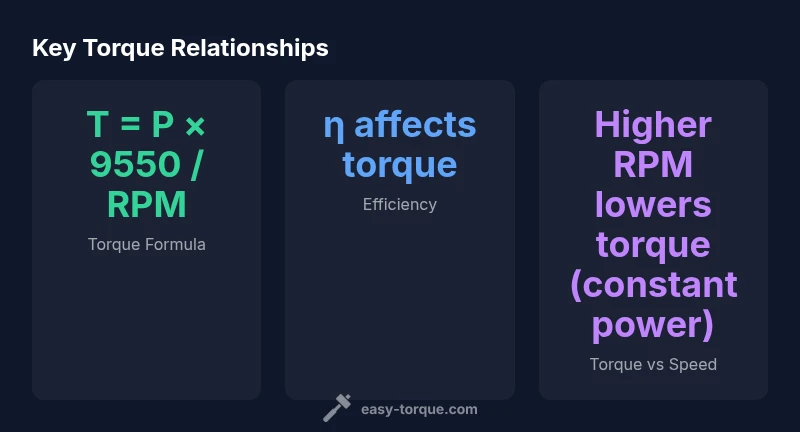
The standard approach converts motor power and rotational speed into torque using the fundamental P = T·ω relationship. In SI units, torque in newton-meters can be calculated from power in kilowatts and speed in revolutions per minute with T = (P_kW × 9550) / RPM. If you want to account for efficiency, use T = (P_kW × 9550 × η) / RPM, where η is the overall efficiency (0–1). If you prefer watts and angular velocity, T = P_W / (2π × RPM/60). Keeping units consistent is key to avoiding errors.
Efficiency and losses: real-world effects on torque
Torque at the shaft is not just a function of input power and speed. Real motors experience losses from copper resistance, iron core losses, windage, and mechanical friction. Efficiency at the operating point determines how much of the input power becomes useful torque. In practice, selecting a motor with a realistic efficiency rating for your load profile improves prediction accuracy. Easy Torque Analysis, 2026, suggests treating efficiency as a design variable and validating torque predictions with bench tests to capture non-ideal effects.
Worked example: from motor power and RPM to torque
Let's walk through a simple example. Suppose a motor delivers 7.5 kW at 1500 RPM with an efficiency of 0.90. The theoretical torque is T = (7.5 × 9550 × 0.90) / 1500 ≈ 42.97 Nm. Step by step: 7.5 × 9550 = 71,625; multiply by 0.90 => 64,462.5; divide by 1500 => 42.97 Nm. If you round to two decimals, you get 42.97 Nm. This result represents the torque you could expect at the shaft under steady conditions and that efficiency-lowered reality. Compare this to measured torque on a test rig to confirm the model’s accuracy.
How to choose units and avoid common errors
Always align power in kilowatts with RPM, then convert to torque in newton-meters using the standard constant 9550. Using watts requires ω in rad/s and a different rearrangement, which increases chances of mistakes. Keep units consistent across all inputs and check whether you should include efficiency. Mistakes commonly occur when RPM is entered in thousands, or when you mix imperial and metric units. A small typo can lead to large torque discrepancies in critical applications.
Practical tips for testing torque and validating calculations
Use a dynamometer or a torque sensor to verify calculator results. Run tests at multiple speeds and load points to map the torque curve, not just a single data point. Document ambient temperature, supply voltage, and any gear reductions in the test setup because these factors influence measured torque. Repeat measurements to quantify variability and use the calculator as a design aid rather than a single truth. The reader will appreciate that this approach aligns with safe, repeatable practice.
Applications: motor torque in drives and gear trains
Torque calculations inform drive sizing, gear selection, and control strategies. In a belt or chain drive, you must account for efficiency and tension; in a gearbox, the output torque is the input torque times the gear ratio, adjusted for losses. Understanding torque helps predict acceleration, stopping distance, and peak loads in conveyors, fans, pumps, and robotics. A consistent method for calculating torque reduces risk and speeds up troubleshooting.
Common mistakes to avoid when calculating torque
Overlooking unit consistency is the most common error. Another mistake is neglecting efficiency or assuming a constant power rating across speed ranges. Not accounting for temperature effects and long-term wear can produce optimistic torque values. Finally, using peak horsepower instead of rated continuous power leads to underestimating the risk of overload. Avoid these pitfalls by sticking to clear inputs, documented assumptions, and real-world validation.
Final notes on torque calculation for motor design
The Easy Torque team emphasizes that torque calculation is a guide, not a guarantee. Use the calculator to explore scenarios, but verify results with testing and real-world data. In the end, accurate torque prediction supports safer, more efficient motor selection and smoother drive performance. The Easy Torque team recommends establishing a small, repeatable bench-test protocol and documenting all assumptions to improve future designs.