Torque and Angular Acceleration: A Practical Guide
Explore the relationship between torque and angular acceleration, compare torque-centric and acceleration-centric analysis, and learn measurement, modeling, and application strategies for rotating systems.


Torque and angular acceleration are central to predicting how a rotating component responds to applied torque. In rotational dynamics, torque translates to angular acceleration via the inertia of the system (τ = Iα). This TL;DR comparison shows when to prioritize torque measurements versus angular-acceleration data in design, testing, and maintenance roles.
Core Concepts: Torque and Angular Acceleration
At the heart of rotating systems lies a simple but powerful idea: torque (τ) is the rotational equivalent of force, while angular acceleration (α) is how quickly the rotation speed changes. The link between them is governed by the moment of inertia (I): τ = Iα. In practical terms, a given torque will produce a larger α if the system is lighter in rotation or a smaller α if more mass is distributed farther from the axis. The Easy Torque approach emphasizes understanding both quantities together, because they determine how quickly a motor, gear, or shaft responds under load. This perspective helps diagnose stalls, overshoots, or slow ramp-up in real-world machinery.
Core Concepts: Torque and Angular Acceleration
At the heart of rotating systems lies a simple but powerful idea: torque (τ) is the rotational equivalent of force, while angular acceleration (α) is how quickly the rotation speed changes. The link between them is governed by the moment of inertia (I): τ = Iα. In practical terms, a given torque will produce a larger α if the system is lighter in rotation or a smaller α if more mass is distributed farther from the axis. The Easy Torque approach emphasizes understanding both quantities together, because they determine how quickly a motor, gear, or shaft responds under load. This perspective helps diagnose stalls, overshoots, or slow ramp-up in real-world machinery.
Comparison
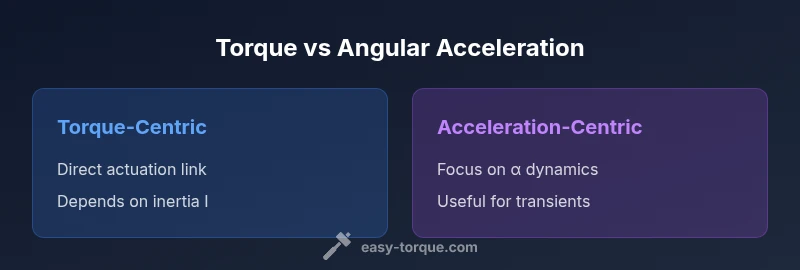
| Feature | Torque-centric analysis | Angular-acceleration-centric analysis |
|---|---|---|
| Fundamental equation | τ = Iα: direct link between actuation and motion | α = τ/I: requires accurate I to compute acceleration |
| Primary inputs | Measured torque, inertia estimate, and velocity/position data | Measured α, inertia estimate, and torque or velocity data |
| Best-use scenarios | Designing actuators, gear trains, and control loops | Analyzing transient events and high-dynamic maneuvers |
| Sensitivity to inertia | High sensitivity (α directly proportional to τ and inversely to I) | Depends on accurate I; sensitivity rises in non-uniform or changing I |
| Measurement complexity | Torque sensors and speed sensors are common | Requires precise ω measurements or high-fidelity α sensing |
| Common error sources | Backlash, torque sensor noise, misalignment | Inertia misestimation, drift in angular sensors |
| Typical units | Neater with τ (N·m), I (kg·m²), α (rad/s²) | α (rad/s²) is primary unit; τ or I used to compute it |
| Example | Motor torque driving a rotating disk and ramp | Disk angular acceleration during a rapid clutch engagement |
Pros
- Direct link between actuation and motion simplifies design decisions
- Clear criteria for control system tuning and safety margins
- Facilitates power/torque budgeting for dynamic loads
- Eases debugging by relating torque input to observed acceleration
Drawbacks
- Accurate inertia (I) data is essential and sometimes hard to obtain
- Nonlinearities (bearing friction, flexural effects) can distort simple τ–α relations
- Measurement noise and dynamic coupling can complicate interpretation
Hybrid approach is recommended: use torque-centric analyses for design and control, and incorporate angular acceleration to validate transient behavior.
Most practical work benefits from starting with τ = Iα and verifying with measured α during transients. This reduces errors from inertia misestimation and improves prediction accuracy.
Your Questions Answered
What is the relationship between torque and angular acceleration?
Torque and angular acceleration are linked by τ = Iα, where I is the moment of inertia. This equation means applying torque changes angular speed at a rate determined by inertia. Understanding both sides helps predict how fast a component will start or stop rotating under a given load.
Torque equals inertia times angular acceleration; inertia controls how quickly rotation responds to torque.
Why is inertia important in torque–acceleration analysis?
Inertia determines how much a given torque will accelerate a rotating body. A larger I means slower acceleration for the same torque, and vice versa. Accurate I estimation is essential for reliable predictions and safe operation.
Inertia dictates how quickly rotation speeds up for a specific torque.
When should you measure angular acceleration instead of torque?
Measure angular acceleration during transients, impacts, or when you need to confirm dynamic performance. Torque data alone can miss peak accelerations or overshoot behavior, especially in systems with changing inertia or nonlinear friction.
Use angular acceleration to verify transient behavior and peak dynamics.
How do you calculate angular acceleration from torque?
If you know torque and inertia, α = τ/I. Ensure I is appropriate for the rotating body and includes contributions from all moving parts. For nonuniform or flexible systems, consider a distributed I or modal analysis.
Use α = τ divided by the inertia I.
What are common testing errors in torque–acceleration analysis?
Errors include ignoring inertia variation, misaligning sensors, or neglecting frictional losses. Inaccurate torque readings and poor calibration can also skew results. Validate with multiple methods to catch mismatch.
Watch for inertia errors, sensor misalignment, and friction losses.
Can torque and angular acceleration be used for non-rigid bodies?
Yes, but the analysis becomes more complex. You may need distributed parameters, modal decomposition, or lumped-parameter models to capture how different parts contribute to overall α.
Non-rigid bodies require more advanced models to relate τ to α.
Top Takeaways
- Prioritize torque data to drive design decisions.
- Use angular acceleration to validate dynamic events.
- Accurately estimate inertia I for reliable α predictions.
- Account for damping, friction, and nonuniform mass distribution.
- Integrate both perspectives for robust modeling.