Torque vs Power Formula: Understanding the Relationship
A rigorous, data-backed comparison of the torque vs power formula, its units, and practical implications for engines, motors, and drivetrain design.


At a glance, torque and power are related but describe different things. The torque vs power formula shows that power equals torque multiplied by angular velocity (P = τ · ω). In practical terms, torque measures twisting force at a moment, while power accounts for how fast that twist does work over time. Understanding both is essential for analyzing engines, motors, and drivetrains.
Core concepts: torque vs power in context
In mechanical systems, torque and power are two sides of the same physical coin. Torque (τ) is the instantaneous twisting force that a shaft or tool can exert, typically measured in newton-meters (N·m) or foot-pounds (ft·lb). Power (P) is the rate at which work is performed or energy is transferred, measured in watts (W), kilowatts (kW), or horsepower (hp). The primary link between them is the torque–speed relationship: as rotational speed increases, the same torque delivers more power up to system limits. The primary keyword torque vs power formula appears here as the backbone of many calculations that engineers perform when sizing components or predicting performance. According to Easy Torque Team, embracing both concepts avoids misleading conclusions that rely on torque or power in isolation. Keeping the big picture in mind helps DIY mechanics and professionals diagnose drivetrains, engines, and motors more accurately and safely.
The torque equation and its units
Torque arises from force acting at a distance. The fundamental definition is τ = F × r, where F is force and r is the lever arm. In rotational systems, we commonly express angular quantities: torque in N·m and angular velocity ω in rad/s. Because power is the product of torque and angular velocity, P = τ × ω, the units align as follows: 1 W = 1 N·m × 1 rad/s ≈ 1 J/s. When using imperial units, torque is often expressed in ft·lb and power in horsepower. It is crucial to be consistent with units: mixing metric and imperial values without proper conversion leads to erroneous power estimates.
The power equation and angular velocity
The standard power relationship introduces angular velocity ω, the rate of rotation. In SI, ω is in rad/s, and P = τ × ω encapsulates how quickly a given torque does useful work. If torque remains constant while speed increases, power scales linearly with ω. Conversely, at a fixed speed, higher torque yields more power. For rotating machinery operating in revolutions per minute (rpm), you can convert: P (W) = τ (N·m) × (2π × N rpm / 60). This conversion is essential when engines are tested on dynamometers or when benchmarking motors against performance targets. The torque vs power formula thus ties mechanical twisting to energy transfer across the spectrum of operating speeds.
Converting between torque and power in practice
Suppose a drive shaft delivers a constant torque of 250 N·m while turning at 300 rad/s. Power output is P = 250 × 300 = 75,000 W, or 75 kW. If you instead know power and speed, you can infer torque: τ = P / ω. For example, a motor producing 20 kW at 400 rad/s yields τ = 20,000 / 400 = 50 N·m. In automotive design, engineers use these relations to size shafts, gears, clutches, and transmissions so that the system delivers the desired performance across the expected rpm range. When discussing torque vs power formula, the key message is that both quantities are inherently linked by ω, so measuring one at a given operating condition allows you to calculate the other.
The speed effect: how rpm shapes torque and power curves
In most practical systems, torque is not constant across the speed range. Engines, motors, and pumps exhibit torque curves where peak torque occurs at a certain rpm, followed by a decline as speed rises due to efficiency, friction, and aerodynamic losses. Power, however, often peaks at a higher rpm because it depends on the product of torque and ω. Understanding where the peak torque and peak power occur helps optimize gear ratios, throttle response, and overall efficiency. This nuance is a frequent source of confusion: more torque at low speeds does not always translate to higher power at high speeds, and vice versa. Easy Torque’s analyses emphasize evaluating both curves in tandem to predict real-world performance.
Measuring torque and power: tools and best practices
Historically, torque was measured with hand tools, but modern practice relies on sensors and dynamometers. Torque sensors, rotary transducers, and torque wrenches provide τ, while rotary encoders or hall-effect sensors track ω. A dynamometer records torque and speed to derive power, revealing the system’s true operating envelope. Calibration, temperature, and mounting accuracy all influence measurements, so repeatability is critical. When you’re evaluating a device or component, report both torque and speed data over the same operating range to enable a clear application of the torque vs power formula. The right measurement strategy reduces uncertainty and supports safer, more reliable designs.
Practical applications: from engines to robotics
In automotive engineering, torque curves guide gearing selection, differential design, and clutch sizing. In robotics and automation, motor torque and speed dictate actuator performance, acceleration, and precision. Industrial fans and pumps use torque and power relationships to control flow and energy use. Across these domains, the torque vs power formula provides a robust framework for predicting performance, sizing components, and optimizing control strategies. Engineers often plot both curves on the same graph to visualize trade-offs and identify operating points that maximize efficiency while meeting reliability targets.
Common pitfalls and how to avoid them
Misinterpretations arise when engineers compare raw torque or raw power without context. Torque alone can suggest strong starting capability, but without sufficient speed, it may underperform in real tasks requiring work over time. Conversely, high power at a high rpm might not translate to usable force at the wheels if gearing or inertia limits are present. Always verify units, ensure consistent measurements, and compare torque and power at identical operating conditions. When unsure, consult a torque belt curve or perform a controlled dyno test to reveal the true performance envelope.
Design insights: leveraging the formulas for better systems
A practical approach is to define target performance (e.g., acceleration or load-handling) and then work backward: select a target ω range, determine the required τ via τ = P / ω, and confirm the chosen gear ratios align with the torque curve. This process makes the torque vs power formula a practical tool rather than a theoretical concept. In maintenance, understanding these relationships helps diagnose underperforming components—low power at high RPM may indicate inefficiencies, while high torque at low RPM could signal drivetrain binding. Easy Torque emphasizes documenting operating envelopes and validating assumptions with empirical data.
Quick reference: common formulas you’ll use
- τ = F × r (definition of torque)
- P = τ × ω (power from torque and angular velocity)
- P (W) = τ (N·m) × ω (rad/s)
- P (hp) = (τ × ω) / 746 (for consistent units)
- ω (rad/s) = 2π × N rpm / 60
- τ (N·m) = P / ω
These relationships form the core toolkit for analyzing rotating systems across mechanical and electrical domains.
Comparison
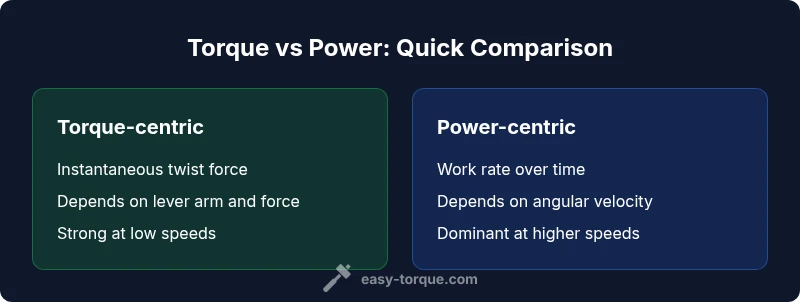
| Feature | Torque-centric analysis | Power-centric analysis |
|---|---|---|
| Definition | Twisting force at a specific instant (N·m) | Rate of doing work over time (W) |
| Key formula | τ = F × r | P = τ × ω |
| Primary variable | Torque and speed (ω) determine power | Power depends on torque and speed |
| Units | N·m, rad/s, rpm | W, hp, kW |
| Best used for | Assessing instantaneous drive capability and torque curves | Estimating propulsion and energy use over a speed range |
| Measurement focus | Torque sensors and dynos for τ, speed sensors for ω | Dynamometers track torque and speed to derive P |
Pros
- Clarifies how torque and speed combine to produce power
- Supports sizing components for peak performance across RPM
- Useful across automotive, industrial, and robotics domains
- Enables predictive maintenance by linking measurements to performance
Drawbacks
- Torques and speeds must be measured consistently to avoid errors
- Relying on a single metric can misrepresent real-world behavior
- RPM bands shift under load, so curves are essential for accuracy
Torque and power are intertwined; use both to predict real-world performance
The torque vs power formula is the bridge between instantaneous force and work rate. Analyzing both metrics across the operating range yields the most reliable design and diagnostic insights, particularly when selecting gears, shafts, or motors.
Your Questions Answered
What is torque in mechanical terms?
Torque is the instantaneous twisting force applied to an object around an axis, typically measured in N·m or ft·lb. It indicates how much rotational effort a component can exert at a given moment.
Torque is the twisting force you feel at the shaft, measured in newton-meters. It's about what happens at a specific moment.
What is power in rotating systems?
Power is the rate at which work is done, combining torque and rotational speed. In rotating systems, it is calculated as P = τ × ω and is measured in watts or horsepower.
Power tells you how fast energy is being transferred, calculated as torque times speed.
How are torque and power related?
They are linked by the torque–power formula P = τ × ω. At a fixed ω, more torque yields more power; at a fixed τ, higher ω yields more power.
Power grows with both torque and speed; you get more power when either torque or speed increases.
How do you convert rpm to angular velocity?
Convert rpm to rad/s with ω = 2π × (N rpm) / 60. This links rotational speed to the angular velocity used in P = τ × ω.
Multiply rpm by 2π and divide by 60 to get radians per second.
What units should I use for torque and power?
Torque is typically in N·m or ft·lb, while power is in watts or horsepower. Keep unit systems consistent to avoid errors in calculations.
Use N·m or ft·lb for torque and watts or horsepower for power, ensuring consistency everywhere.
Top Takeaways
- Understand the fundamental relation: P = τ × ω
- Always compare torque and power at the same operating point
- Use both units and curves for accurate performance predictions
- Harness dyno data to validate theoretical calculations
- Apply the formula to sizing, control, and maintenance tasks