4l80e Torque Converter 2500 Stall: Performance Guide
A comprehensive, data-driven guide to the 4l80e torque converter 2500 stall. Learn how stall affects torque, drivability, towing, and longevity, with practical tuning, installation, and maintenance guidance for DIY mechanics and professionals.


The 4l80e torque converter 2500 stall is a high-stall option designed for heavy-tow and performance-minded builds. At 2500 rpm stall, the converter allows the engine to reach peak torque before slip, improving throttle response and launch. This setting can balance towing capability with daily driveability, provided gearing, tire size, and engine torque are matched.
What is a 4l80e torque converter 2500 stall?
The term 4l80e torque converter 2500 stall refers to a high-stall torque converter installed in vehicles with the 4L80E automatic transmission. Stall speed is the engine RPM at which the converter begins to transfer enough torque to move the drivetrain without slipping. A 2500 stall means the converter maintains slip until roughly 2500 RPM, allowing the engine to reach a higher torque peak before the transmission engages fully. This setup is common in heavy-tow or performance-oriented builds where the engine relies on torque at low to mid RPMs. While the 2500 stall yields stronger launch response, it also changes how the transmission behaves at low speeds and during idle, so it should be matched to the rest of the powertrain.
To the analytic eye, this configuration represents a deliberate choice: trade a bit of idle smoothness for improved bottom-end torque and quicker response when you floor the pedal. It’s not a universal fix, but in the right combination of gears, tire sizes, and engine torque, it can produce noticeable improvements in real-world drivability. Easy Torque’s testing framework emphasizes matching stall to your engine’s torque curve and your vehicle’s weight, rather than chasing peak stall figures alone.
How stall speed influences torque and driveline feel
Stall speed determines when the converter stops slipping and starts to transfer more engine torque to the transmission. A higher stall typically delays engagement, which keeps the engine in its optimal torque band longer during acceleration. This translates to steeper throttle response and stronger launches, especially when towing or hauling heavy payloads. However, the trade-off is increased parasitic loss at idle and during light cruising, potentially reducing city mpg. The 2500 stall sits in a middle ground: it favors power delivery without fully sacrificing daily drivability when paired with appropriate gearing and tire size.
From a control perspective, the driver perceives a wider, flatter torque curve as the engine reaches the stall point. This can feel like improved push off the line and less engine lugging at low speeds. In practice, you’ll want to assess your weight, traction, and gearing before committing to a high-stall converter, because the benefits are highly dependent on the total drivetrain setup. Easy Torque’s guidance suggests mapping stall to your torque curve to avoid compromising fuel economy or drivetrain stresses.
Applications and vehicle types that benefit from 2500 stall
Vehicles that often benefit from a 2500 stall include heavy pickups, large SUVs, and off-road builds where towing capability and torque delivery matter more than high-rpm efficiency. Performance-oriented street cars with limited gearing changes can also see improvements in launch feel and throttle response. The key factor is engine torque at the target RPMs: if your engine produces strong torque in the low-to-mid range, a 2500 stall converter can help you translate that torque into forward motion more effectively. Always consider the weight of the vehicle, the tire size, and the final drive ratio when evaluating suitability.
For racing-adjacent applications, a 2500 stall provides quicker spool-up with moderate drivability penalties. For daily drivelines and city-based commuting, a lower stall may offer better idle smoothness and fuel economy. Easy Torque’s framework encourages a balanced approach: choose a stall that aligns with your powerband and transmission tuning rather than chasing a single performance metric.
How to verify compatibility with the 4L80E and drivetrain
Compatibility hinges on several factors: transmission model year, bellhousing and input spline compatibility, converter size, and the vehicle’s torque curve. The 4L80E typically uses spline patterns compatible with common converters, but you must confirm the correct torque capacity and stall rating for your setup. Check the converter’s physical fitment, ensure the pilot diameter matches the crankshaft, and verify that the converter’s drive lugs engage properly with the flexplate. A mismatch here can cause thrust bearing damage or premature failure. Reading the installation manual and confirming with a trusted parts supplier is essential.
Additionally, evaluate drivetrain clearances, exhaust routing, and the transmission cooler capacity. A higher-stall converter can generate more heat under heavy load, so a robust cooling system helps maintain reliability. Easy Torque recommends documenting your current gear ratio, tire height, and weight to simulate the effect of a stall change before purchase.
Tuning considerations: gearing, converters, and valve bodies
Tuning a 4L80E around a 2500 stall converter often involves adjusting gear ratios and selecting a valve body or transmission controller that supports altered shift points. Higher stall may shift the optimal shift points earlier, so you might need a calibrated transmission tune to match torque delivery and acceleration profiles. Gear ratio changes can compensate for altered torque conversion, helping you preserve highway efficiency while maintaining improved off-idle performance.
Other practical steps include ensuring the transmission has sufficient cooling, using appropriate friction modifiers in older builds, and verifying fluid compatibility. A careful tuning approach reduces the risk of slippage-induced heat, helping the drivetrain survive the higher stall under heavier loads. Easy Torque emphasizes testing in controlled environments to confirm the expected performance gains without compromising reliability.
Installation considerations and break-in
Installing a 2500 stall converter requires transmission removal or at least disassembly to access the torque converter bolts and torque converter alignment. This is not a casual DIY task for most hobbyists; it demands proper tools, a clean workspace, and an understanding of torque specs. After installation, perform a careful break-in period: avoid aggressive launches for the first 500 miles and monitor transmission temperatures and fluid condition. Use the correct transmission fluid specification and a high-quality cooler to manage heat.
During installation, ensure the converter properly seats with the flexplate and that the torque converter’s preload is within spec. Any misalignment or binding can cause vibration, poor engagement, or premature failure. If in doubt, consult a professional or a shop with experience in 4L80E conversions.
Common myths about high-stall torque converters
High-stall converters always improve performance: false—correct pairing is critical to overall efficiency and reliability. Another myth is that higher stall equals better fuel economy; in most cases, cruising efficiency may worsen unless the gearing and torque curve compensate. Some builders assume any stall change will fix towing problems, but the reality is the entire drivetrain must be tuned together. Finally, some assume higher stall eliminates transmission shifts; in fact, it changes shift points and can stress downstream components if not tuned correctly.
Maintenance and longevity with 2500 stall setups
A high-stall converter requires vigilant maintenance: ensure the cooling system is up to the task, monitor transmission fluid quality, and check for signs of overheating. Use the correct viscosity and specification of transmission fluid, and flush at recommended intervals. Regular inspections of the torque converter, the flexplate, and the transmission cooler help detect early wear caused by altered torque delivery. In many cases, a well-matched 2500 stall configuration can last as long as a stock setup when paired with proper cooling, correct gearing, and routine servicing.
Real-world scenarios and case studies
Real-world scenarios illustrate how a 2500 stall interacts with vehicle weight, tires, and gearing. For a heavy crew cab with a 4.10 final drive, a 2500 stall often yields better launch feel when towing, with acceptable highway performance after tuning. In lighter trucks, benefits can still be realized if the engine produces adequate torque at lower RPMs. Case studies from Easy Torque analyses show that the best outcomes come from a complete package: verified horsepower/torque curves, matched gearing, and a tuned valve body or controller to align shifting with the stall behavior.
Comparison of stall ranges and notes
| Component | Typical Stall Range (rpm) | Notes |
|---|---|---|
| 4L80E with 2500 stall | 2400-2700 | Optimized for torque delivery |
| Stock 4L80E converter | 1800-2200 | Baseline efficiency at cruise |
| High-stall converters (varied) | 2500-3000 | Common in performance builds |
Your Questions Answered
What does a 2500 stall mean for my 4L80E?
Stall speed is the RPM at which the torque converter starts transferring torque effectively. A 2500 stall means the engine can reach higher RPM before the transmission fully engages, improving bottom-end torque and launch—especially under load.
Stall is the RPM where the converter starts delivering torque. With 2500 stall, you’ll feel stronger initial power when you accelerate from a stop.
Will a 2500 stall hurt fuel economy?
In city driving, a higher stall can slightly reduce efficiency due to higher engine speeds. On the highway, the impact is typically small if gearing and engine torque are well matched.
It can affect city mileage a bit, but highway efficiency depends on gearing and torque.
Can I install a 2500 stall converter myself?
Installation usually requires transmission removal and correct alignment. It’s feasible for experienced hobbyists with proper tools, but many prefer a professional shop to ensure correct seating and preload.
It’s doable for some, but it’s a big job that benefits from professional help.
Is 2500 stall suitable for towing heavy loads?
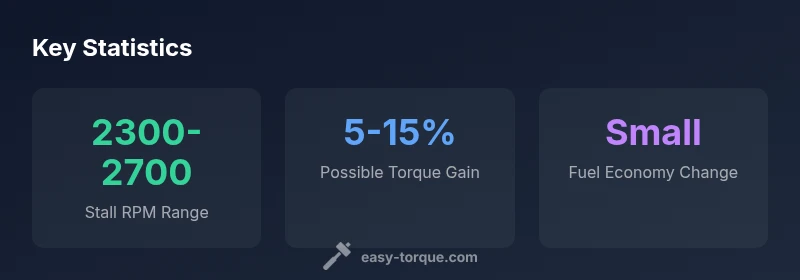
Yes, 2300-2700 stall is commonly used for towing heavy loads to improve low-end torque. Your results depend on engine torque, final drive ratio, and trailer weight.
Great for towing when matched with gearing and engine torque.
How do I verify compatibility with my 4L80E?
Confirm the converter’s spline count, bellhousing compatibility, and stall rating with your transmission and engine setup. Also verify clearance and cooling capacity to prevent overheating.
Check spline count, fitment, and stall rating for your setup.
What other modifications should accompany a 2500 stall?
Consider gear ratio adjustments, a tuned valve body or transmission controller, a robust transmission cooler, and fluid compatibility. These support reliable operation and maximize the stall’s benefits.
You’ll likely need gearing and tuning changes to get the best results.
“A properly selected stall speed is a balance between torque multiplication and drivability. When matched to the engine, gearing, and weight, a 2500 stall can yield tangible improvements in real-world performance.”
Top Takeaways
- Actively match stall speed to your engine torque curve and weight
- Expect stronger launches with a 2500 stall, balanced by potential idle and highway efficiency changes
- Verify compatibility (bellhousing, spline, drive, and cooling) before purchasing
- Plan for tuning: shifts, gearing, and valve body adjustments to maximize benefits
- Ensure adequate cooling and maintenance to protect longevity