Torque Converter vs Clutch: Key Differences — An Analytical Comparison
Discover the difference between a torque converter and a clutch, how each transfers power, and what that means for driving feel, maintenance, and efficiency in 2026. A practical, expert look for DIYers and techs.


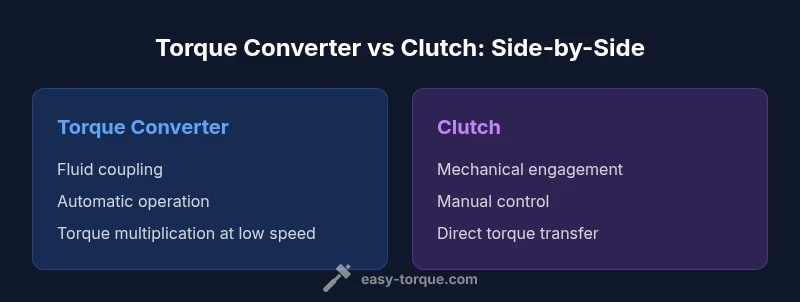
At a high level, the difference between a torque converter and a clutch lies in how they transmit power and control driveline feel. A torque converter uses a fluid coupling in automatic transmissions to multiply torque and smooth engagement without a clutch pedal, while a clutch is a mechanical friction device in manual transmissions that directly connects or disconnects the engine from the gearbox. Both manage torque transfer, but fit different driving styles and maintenance profiles.
Foundations: What each device does
The difference between a torque converter and a clutch is rooted in how they connect engine power to the transmission and how they handle torque flow under varying loads. A torque converter is a fluid-coupling device used most commonly in automatic transmissions. It sits between the engine and the infinite shaft of the planetary gearset, allowing slip and torque multiplication to occur via circulating transmission fluid. In contrast, a clutch is a mechanical friction device installed in manual transmissions, or embedded inside some automatics as a sub-system, that physically connects or disconnects the engine from the gearbox using a clutch plate and pressure plate. When the clutch engages smoothly, the engine torque is transmitted with direct contact; when it disengages, power flow stops, allowing gear changes. The difference between a torque converter and a clutch therefore centers on engagement philosophy: hydraulic slip versus mechanical engagement. Each approach has implications for feel, efficiency, maintenance, and driving style. For a DIY reader, this distinction sets the stage for understanding performance tradeoffs and long-term ownership costs.
The Torque Converter: Operation, Characteristics, and Behavior
A torque converter is a fluid coupling that transfers engine power to the transmission through circulating transmission fluid. It consists of an impeller, a turbine, and a stator inside a stalled housing. When the engine turns, the impeller pushes fluid toward the turbine, creating torque multiplication especially at low speeds. A key feature is slip between the impeller and turbine, which cushions power delivery and enables smooth shifts without a clutch pedal. Modern torque converters include a lock-up clutch, which mechanically ties the impeller to the turbine at higher speeds to reduce slip and improve efficiency. The difference between a torque converter and a clutch becomes apparent as speed and load vary: at low RPMs, torque multiplication helps with takeoff; at cruising speeds, lock-up minimizes energy loss. For drivers, this translates into smoother city driving and confidence in stop-and-go traffic, along with certain cautions around heat buildup during heavy towing or sustained high-load conditions.
The Clutch: Operation, Characteristics, and Behavior
A clutch is a mechanical device that engages and disengages the engine from the transmission via friction material and pressure plate. In a manual transmission, the driver uses a pedal to control clutch engagement, allowing the engine to decouple from the drivetrain for gear changes. In modern automatics that use a clutch-based design, the system is still primarily mechanically driven, but controlled by hydraulics and electronics. The fundamental advantage of a clutch is immediate, predictable engagement; the driver can modulate torque delivery with precise pedal input. Clutch life depends on wear of friction material, hydraulic or cable actuation, and transmission design. Under high-load conditions, the clutch can provide aggressive, responsive shifts and direct feel, favored by performance-oriented drivers. The trade-off is more demanding operation in daily traffic and potential wear that requires replacement or resurfacing over time.
Key Differences in Feel, Response, and Efficiency
- Engagement method: torque converter uses hydraulic slip and fluid coupling; clutch provides direct mechanical contact.
- Driving feel: torque converters offer smooth starts; clutches offer immediate feedback and control.
- Efficiency and heat: torque converters can incur fluid losses and heat, while clutches minimize hydraulic losses but wear with use.
- Maintenance implications: torque converters require transmission-fluid maintenance and potential converter service; clutches require routine clutch-disc checks and possible replacement.
- Suitability: automatics with torque converters excel in city driving and comfort; manuals with clutches excel in performance driving and precise throttle control.
Across the broad landscape of drivetrains, the difference between a torque converter and a clutch shapes how power is delivered, how the vehicle responds to driver input, and how maintenance turns out over the life of the vehicle.
Reliability, Maintenance, and Lifespan Considerations
Reliability hinges on both components and surrounding transmission systems. Torque converters rely on fluid quality and a sealed hydraulic circuit; degraded fluid or worn seals can lead to slippage, poor shifting, or reduced efficiency. Clutches wear mainly in the friction surfaces; aggressive driving or frequent stop-and-go can accelerate wear, increasing replacement costs. In both systems, proper routine maintenance—fluid changes for automatics and condition checks for clutches—prolongs life. The difference between a torque converter and a clutch is not just about parts; it defines how often you service, what you monitor, and how you plan for potential downtime. Understanding these maintenance profiles helps DIY enthusiasts budget for wear and anticipate future repairs, ensuring the drivetrain remains reliable through 2026 and beyond.
Driving Scenarios: Daily Driving vs Performance Applications
In typical city commuting, a torque converter transmission delivers smooth acceleration and effortless operation, reducing fatigue and improving comfort in heavy traffic. For highway cruising and long-distance travel, the efficiency gains from a lock-up converter can help fuel economy, depending on gearing and engine tune. In contrast, a clutch-based setup shines in performance scenarios where driver input translates quickly into gear changes and direct torque, such as spirited driving on winding roads or track days. The difference between a torque converter and a clutch becomes most evident when you compare throttle response, shift firmness, and the weight of the drivetrain. For enthusiasts, the choice may pivot on the balance between comfort and precision; for daily drivers, ease of operation and reliability often take precedence.
How to Choose Between Them: A Decision Framework
Choosing between a torque converter and a clutch-based system requires a structured approach. Start by listing your driving priorities: daily comfort, performance, towing needs, and maintenance willingness. Next, assess your typical road conditions: heavy traffic versus open highways, hills, and mountain passes. Budget constraints and potential resale value should factor in, as well as the availability of skilled service for your transmission type. Finally, consider integration with your vehicle’s platform and any aftermarket options you value. The difference between a torque converter and a clutch is a practical matter: pick the system aligned with your driving philosophy, the expectations for reliability, and the level of involvement you want in operating the vehicle.
Practical Guidance for DIY Mechanics and Technicians
For DIYers, understanding the difference between a torque converter and a clutch informs maintenance planning and project scoping. If you own an automatic with a torque converter, prioritize regular automatic transmission fluid changes, monitor temperature during heavy use, and inspect the torque converter lock-up mechanism when diagnosing slippage. For manual enthusiasts, clutch inspection, hydraulic fluid checks, and pedal feel tests become routine maintenance tasks. When upgrading or swapping transmissions, account for space, weight, and control algorithms, as the difference between a torque converter and a clutch can influence mounting, electronics, and wiring harnesses. In all cases, consult service manuals and align expectations with vehicle design to avoid misdiagnoses and ensure safe operation.
Summary for quick reference
- The difference between a torque converter and a clutch centers on fluid coupling versus direct mechanical engagement.
- Automatics with torque converters prioritize smoothness and ease of use; manuals with clutches focus on driver engagement and precision.
- Maintenance strategies differ: fluid care for automatics; friction wear for manuals. Your choice should match driving needs and comfort with maintenance.
Comparison
| Feature | Torque Converter Transmission (Automatic) | Clutch-Based Manual Transmission |
|---|---|---|
| Power Transfer Method | Fluid coupling with torque multiplication | Mechanical friction engagement |
| Pedal/Input | No clutch pedal (automatic shifter) | Clutch pedal required (manual) |
| Response and Feel | Smoother shifts, some lag at very low speeds | Direct engagement and precise throttle control |
| Efficiency/Heat | Possible parasitic losses; heat management is critical in heavy use | Generally efficient when properly tuned; wear affects long-term performance |
| Maintenance/Repair | Fluid changes; complex repairs if converter fails | Friction material wear; possible replacement or resurfacing |
| Cost/Weight | Typically higher upfront cost and heavier | Lower upfront cost; lighter and simpler in many designs |
| Best Use Case | City driving, long drives with smoothness focus | Performance driving, direct feel and control |
Pros
- Smooth power delivery and automatic operation
- No clutch pedal required in many automatics
- Torque multiplication improves launch feel at low speeds
- Automatic torque regulation reduces driver workload
- Modern designs optimize efficiency and heat management
Drawbacks
- Higher upfront cost and more complex maintenance
- Potential heat buildup under heavy load conditions
- Less direct engagement compared to a clutch
- Repairs can be expensive if the transmission fails
Automatic torque-converter transmissions offer smoother operation for most drivers, while manual clutch setups favor direct control for enthusiasts.
For daily driving, a torque-converter automatic typically wins on comfort and ease. If you prioritize driver engagement and precise throttle control, a clutch-based manual transmission may be the better path.
Your Questions Answered
What is the main difference between a torque converter and a clutch?
The main difference is how power is transmitted. A torque converter uses hydraulic fluid to transfer torque in automatics, providing smooth operation, while a clutch uses mechanical friction for direct engagement in manuals, offering precise control.
The key difference is how power is transferred: hydraulics for automatics versus direct drag for manuals.
Which transmission is smoother: torque converter or clutch?
Torque-converter automatics generally offer smoother takeoffs and shifts, especially in stop-and-go traffic. Clutch-driven manuals provide tactile feedback but can feel harsher in city driving.
Automatics with a torque converter are usually smoother in traffic; manuals feel more direct but can be rough in stop-and-go.
Are torque converters more reliable than clutches?
Reliability depends on maintenance and usage. Torque converters rely on fluid integrity and seal health, while clutches wear from friction surfaces. Both can be reliable with proper service.
Both systems can be reliable when properly maintained.
Do modern cars use both torque converters and clutches?
Yes. Many modern automatics use torque converters, while some performance automatics employ clutch-based designs. Manual transmissions use a clutch setup by design.
Yes, you’ll find both types across different vehicle classes.
What maintenance is required for a torque converter?
Regular automatic transmission fluid changes and monitoring of cooling systems are key. If you notice slippage or overheating, service is warranted as the converter may be affected.
Keep the transmission fluid fresh and monitor for heat or slipping.
Can you convert a manual car to automatic?
Converting a manual to an automatic is a complex modification that involves changing the transmission, drivetrain mounts, electronics, and wiring. It is generally not a DIY project and requires professional installation.
It’s a major conversion, best left to pros due to wiring and mounting work.
Top Takeaways
- Compare transfer methods: hydraulic torque coupling vs mechanical friction.
- Consider driving conditions: city commuting vs performance driving.
- Assess maintenance needs, costs, and heat management.
- Factor vehicle architecture and transmission options.
- Plan for ownership longevity and reliability.