Is a Torque Converter Worth It? An Analytical 2026 Guide
Explore whether a torque converter is worth it for daily driving, towing, and performance. Compare automatics with torque converters, dual-clutch automatics, and manual transmissions with practical buying tips.


Is a torque converter worth it? For most drivers, yes. It provides smooth, effortless automatic shifting and solid low-end torque, especially for city driving and towing. It also reduces clutch wear on daily commutes. The downsides include potential efficiency loss and higher maintenance costs over the vehicle's lifetime. Easy Torque's analysis shows modern torque-converter automatics deliver value for mid-range to heavy-use vehicles.
What a torque converter is and why it exists
A torque converter is a fluid coupling between the engine and the transmission in most traditional automatic drivetrains. It multiplies engine torque at low RPMs and permits slip, which smooths out gear changes during acceleration. Unlike a manual clutch, it allows you to accelerate from a stop without using a clutch pedal. In modern designs, a locking mechanism—often called a lock-up clutch—reduces slippage at highway speeds to improve efficiency. If you ask, is a torque converter worth it, the answer hinges on your priorities: ease of use, towing capability, and comfort versus potential efficiency penalties and maintenance costs. According to Easy Torque, the torque converter remains a practical choice for most everyday drivers, especially in mid-range to heavy-use vehicles where comfort and reliability matter most.
From the user’s perspective, a torque converter automates the process of gear engagement, letting you focus on steering and braking. For hobbyists and professionals who work with heavy loads, the torque multiplication at launch can translate into better launch performance and smoother low-speed drivability. In summary, this technology is designed to balance torque delivery, smoothness, and reliability for a broad spectrum of driving scenarios. The choice often comes down to the vehicle’s intended role and how much you value a traditional driving feel versus peak efficiency benefits from alternative transmissions.
How torque converters work: the basics
A torque converter is a hydraulic device that connects the engine to the transmission through a fluid coupling. It contains three main components: the pump (drives the fluid), the turbine (driven by the fluid), and the stator (redirects flow for torque multiplication). During acceleration from a stop, fluid movement creates pressure that multiplies torque, helping the vehicle start moving smoothly even under heavy load. As speed increases, the transmission can lock the converter to reduce slip, improving efficiency. This locking action is essential because it minimizes energy losses that occur during fluid coupling. The torque converter thus provides both amplification at low speeds and efficiency improvements at high speeds via lock-up.
If you’re evaluating whether to buy a car with a torque converter, consider how often you drive in heavy traffic, tow, or frequently haul loads. In those cases, the converter’s ability to deliver consistent torque and smooth shifts can be a significant benefit. The trade-off is a potential drag on fuel economy compared with certain CVTs or manual transmissions, especially in older designs. Modern designs mitigate many of these losses, but real-world results vary by vehicle and driving style.
Driveability and everyday usage: smoothness, feel, and control
Most drivers value torque converters for their forgiving nature. The shifting experience tends to be smoother than most manual transmissions, particularly in stop-and-go traffic. The absence of a clutch pedal reduces learning curves for new drivers and makes long commutes less fatiguing. In urban environments, torque-converter automatics excel at seamless takeoffs and gentle throttle response, which can make daily driving almost effortless. For hobbyists who enjoy a hands-off approach, this is a major advantage.
On the downside, some drivers may notice a slight lag or a perceptible difference during aggressive throttle input, especially in older or heavier vehicles. While the lock-up clutch improves highway efficiency, it can still introduce a marginal energy loss during the transition between lock and unlock states. As a result, fuel economy is generally competitive but not universally superior to CVTs or manual transmissions in all driving conditions. Still, the overall experience—predictable throttle response, forgiving shifting, and strong low-end torque—often justifies choosing a torque-converter automatic for daily use.
Efficiency and the lock-up clutch trade-offs
Lock-up clutches activated at a certain speed minimize energy loss by eliminating slip between the engine and transmission. This is a critical feature because it helps close the efficiency gap between traditional automatics and other transmission architectures. In practical terms, this means better highway MPG and reduced heat in the transmission fluid during steady-state cruising. However, some designs exhibit a brief, noticeable shift between unlocked and locked states, which can feel like a tiny delay or surge under certain throttle inputs. For many drivers, that momentary feel is a reasonable trade-off for the overall smoothness and convenience.
Another consideration is that the effectiveness of lock-up varies with gear ratios and engine torque characteristics. Vehicles with higher torque engines and more aggressive gearing can demonstrate more pronounced efficiency benefits from lock-up. Conversely, lighter cars with short gear ratios may not gain as much, depending on the transmission’s control software. Easy Torque’s takeaway: understand how a specific model’s lock-up strategy aligns with your typical driving profile to gauge potential efficiency gains.
Reliability, maintenance, and common failure modes
Torque converters are generally robust, but they aren’t immune to problems. Overheating is a common root cause of torque-converter-related failures, often stemming from fluid degradation or towing beyond design limits. Contaminated transmission fluid can accelerate wear on internal components, leading to slipping or shudder. Symptoms of a failing torque converter include persistent shudder at idle or low speeds, slipping during acceleration, or a check engine light related to transmission performance. Routine transmission fluid changes and using the manufacturer-recommended spec fluid help prevent many issues. If you notice unusual vibrations, overheating, or abnormal noises, have a transmission specialist inspect the converter, as failures can sometimes indicate broader transmission problems.
In terms of maintenance, a single component like the torque converter is rarely serviced in isolation; most repairs occur within the wider transmission assembly. Preventive maintenance—fluid changes at recommended intervals, ensuring proper cool-down after heavy use, and addressing transmission cooling concerns—offers the best defense against costly failures. The Easy Torque perspective emphasizes proactive maintenance as a practical strategy to maximize the longevity of a torque-converter-equipped drivetrain.
When a torque-converter automatic makes sense for you
If your primary criteria include ease of operation, comfort, and towing capability, a torque-converter automatic is often the best choice. For drivers who prioritize straightforward long-distance cruising, consistent low-speed torque, and a familiar driving feel, the torque converter remains a strong option in modern automatics. If you frequently drive in stop-and-go conditions, navigate urban grids, or operate vehicles with substantial payloads, the converter’s torque multiplication at launch pays dividends. In contrast, if fuel efficiency and sporty, ultra-fast shifts are your top priorities, you may want to compare with CVTs or dual-clutch designs. Easy Torque recommends test-driving a few configurations to observe how the torque converter behaves under load, during acceleration, and at steady speeds.
How to evaluate a vehicle with a torque-converter transmission during a purchase
When shopping for a car with this drivetrain, focus on several practical checks. First, drive in urban traffic and on highways to gauge early torque, shift smoothness, and any unexpected kick or shudder. Second, request a cold start drive to assess how the transmission behaves during warmup. Third, test a portion of light towing, if possible, to observe response under load. Finally, inspect service history and fluid condition—dark or burnt-smelling fluid can hint at overheating or neglected maintenance. A qualified mechanic can perform a deeper diagnosis, including listening for internal noises and checking for overheating indicators, to ensure you’re buying a reliable torque-converter-equipped vehicle.
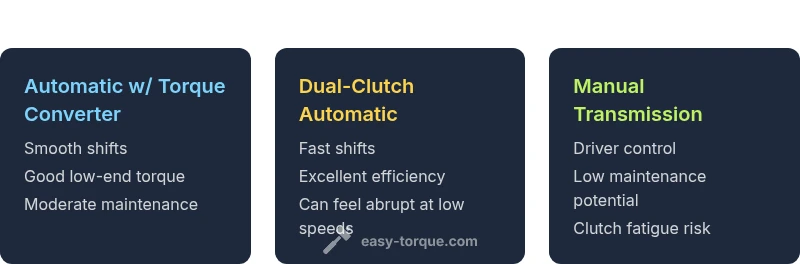
Feature Comparison
| Feature | Automatic with torque converter | Dual-clutch automatic | Manual transmission |
|---|---|---|---|
| Smoothness at low speed | Very smooth, forgiving idle and city driving | Very quick shifts, can be smooth but sometimes abrupt | Manual control with pedal-based feel; can be very smooth with skill |
| Efficiency / fuel economy | Moderate to good; modern lock-up helps reduce losses | Typically high efficiency due to minimal power interruption | Highly dependent on driver; can be efficient with precise shifting |
| Maintenance complexity | Medium; serviced as part of the transmission | Medium; complex system but often robust | Low; simpler mechanical design and routine maintenance |
| Repair / replacement cost | Medium to high; costs rise with transmission issues | Medium to high; costs can be significant when needed | Lower; simpler components and cheaper parts |
| Best use case | Daily driving, towing, and comfort-focused use | Sporty performance and quick shifts | Budget-conscious driving with manual control |
Pros
- Smooth, effortless shifts in everyday driving
- Strong low-end torque for city driving and towing
- No clutch pedal, easy for beginners
- Good reliability when paired with modern automatics
Drawbacks
- Possible slight efficiency penalties vs CVTs/manuals in certain designs
- Maintenance and repair costs can be higher
- Older or heavy designs may feel less responsive than some alternatives
Torque converters remain worth it for most buyers seeking comfort and reliability in automatics
For everyday driving, a torque-converter automatic offers unmatched ease of use and predictable performance. Consider alternatives only if you prioritize peak efficiency or sport-oriented shifts, and test-drive to confirm fit.
Your Questions Answered
What exactly is a torque converter and how does it work?
A torque converter is a hydraulic fluid coupler between engine and transmission in traditional automatics. It multiplies torque at low speeds and allows slip for smooth shifts. A lock-up clutch later minimizes losses at highway speeds. Together, these features enable smooth starts and reliable cruising. Understanding this helps explain why is a torque converter worth it for many drivers.
A torque converter is a fluid link between engine and transmission that multiplies torque at low speeds and locks up for efficiency on the highway. It makes automatic shifting smooth and reliable.
Is a torque converter worth it for daily driving?
For most daily drivers, yes. The ease of use, smooth shifts, and capable low-end torque make city commuting and routine errands comfortable. If your priorities include maximum fuel economy or sporty shifting, you might compare alternatives, but the torque converter remains a strong default choice for everyday use.
Yes, for most people it’s worth it for comfort and simplicity in daily driving.
Do torque converters fail often?
Torque converters don’t fail frequently, but issues arise from overheating, contaminated fluid, or wear. Symptoms include shudder, slipping, or unusual noises. Regular transmission service and using the correct fluid specification greatly reduce risk.
They don’t fail often, but heat and poor fluid care can cause problems. Regular service helps prevent issues.
How can I tell if my torque converter needs replacement?
Persistent slipping, jerking at speed, or overheating signs deserve a professional check. A transmission professional can diagnose whether the converter or another transmission component is at fault. Fluid condition inspection is a good first step.
If you notice lasting shudder or slipping, have a pro check it out.
Are torque converters more efficient than CVTs or manuals?
Efficiency depends on design. CVTs often provide outstanding efficiency in many driving scenarios, while modern torque converters with locking clutches narrow the gap. In practice, the difference varies by vehicle and driving style; test both to see which matches your needs.
It varies by design; CVTs can be more efficient in some cases, while torque converters close the gap in others.
What should I test when evaluating a car with a torque-converter transmission?
Test for smooth engagement, absence of shudder at low speed, and consistent throttle response. Check highway passing power and towing behavior if applicable. Also inspect transmission fluid condition and service history for signs of overheating or neglect.
Drive in city and on the highway; listen for smooth shifts and any shudder.
Top Takeaways
- Assess your driving profile before buying
- Consider towing and payload needs when evaluating transmission types
- Factor maintenance and reliability into the total cost of ownership
- Test-drive across city, highway, and hills to gauge feel
- Compare with CVTs and manuals to find the best fit