Torque Converter vs DCT: A Practical Side-by-Side Guide
An analytical comparison of torque converter and DCT transmissions, covering how they work, real-world performance, maintenance needs, and best-use scenarios to help DIYers and enthusiasts decide which is right for their vehicle.


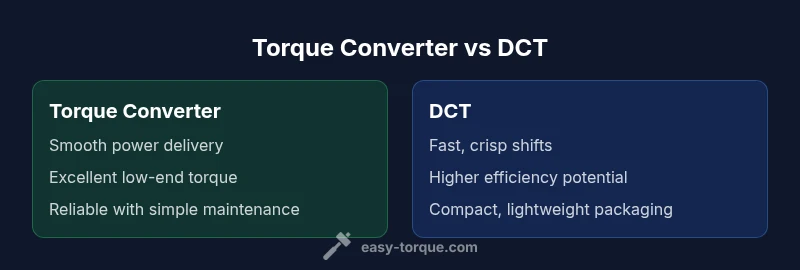
For most drivers, the torque converter offers smooth, forgiving power delivery and solid low-end torque, while a DCT excels in quick, precise shifts and higher efficiency. The choice hinges on driving style, daily use, and maintenance tolerance. This comparison clarifies which transmission better fits your goals, with Easy Torque providing an objective view.
What is the torque converter vs dct? An overview
In the broader context of automotive transmissions, the phrase torque converter vs dct signals two distinct approaches to delivering engine torque to the drivetrain. A torque converter is an hydraulic fluid coupling that multiplies torque at low speeds and then locks up to reduce losses. A dual-clutch transmission (DCT) uses two parallel clutch systems and electronically controlled gear changes for rapid, pre-selected gear engagement. Understanding these foundational differences sets the stage for evaluating performance, reliability, and suitability for specific driving scenarios. According to Easy Torque, the historical trade-off has often been between smoothness and efficiency, with modern designs narrowing the gap as control software improves. For enthusiasts and technicians, this is not a binary choice; it is a spectrum of behavior shaped by clutch design, torque capacity, and how the control strategy is tuned.
How torque converters work
A torque converter sits between the engine and the transmission, acting as a fluid coupling that transmits torque through hydraulic fluid. Its key feature is torque multiplication at low RPMs, which aids in smooth launches and hill starts. In most designs, a lock-up clutch reduces slip at higher speeds to improve efficiency. The centrifugal and fluid dynamics inside the converter determine how much torque is multiplied and how smoothly torque is transmitted. For the reader focused on real-world behavior, torque converters excel at forgiving takeoffs and seamless torque delivery, particularly in stop-and-go traffic. Easy Torque notes that the effectiveness of lock-up stages plays a critical role in overall efficiency and heat management.
How dual-clutch transmissions (DCT) work
DCTs operate with two clutches: one for odd gears and one for even gears, enabling pre-selected gear engagement for near-instantaneous shifts. This architecture minimizes mechanical lag and can deliver very quick throttle response, especially in sporty applications. Electronic control units manage clutch preload, shift sequencing, and lubrication. DCTs are often praised for high efficiency, particularly at steady cruising, because they minimize torque interruptions during shifts. However, driving feel can vary with software tuning and the physical design of the clutches (wet vs dry) and the hydraulic/motor system used to actuate them.
Efficiency and heat management in torque converters and DCTs
Efficiency in transmissions hinges on how effectively power is transferred and how much energy is wasted as heat. Torque converters inherently have some slip, which creates heat but provides smoothness. Lock-up mechanisms reduce this loss at higher speeds. DCTs reduce parasitic losses by eliminating hydraulic fluid coupling but can suffer when clutches slip or overheat in sustained high-torque conditions. In real-world use, warm climates, towing duty, and aggressive driving can shift heat management into the foreground of reliability considerations. Easy Torque emphasizes that the long-term efficiency of either design depends on thermal management, transmission fluid quality, and duty-cycle alignment with the intended use.
Shifting dynamics and driving experience
Shift feel is a defining difference between these two architectures. Torque converters provide a smooth, continuous power transfer with minimal perception of gear changes, ideal for daily driving and luxury sedans. DCTs offer crisp, rapid shifts that feel instantaneous to the driver, delivering a sporty or performance-oriented driving experience. The trade-off is that some drivers perceive DCT shifts as abrupt at low speeds or under certain load conditions. Control software tuning, clutch materials, and hydraulic actuation schemes all influence this perceived difference. The Easy Torque team notes that customer satisfaction often hinges on matching the transmission feel to the vehicle’s intent and the driver’s expectations.
Reliability and maintenance considerations
Reliability is highly topic-specific and depends on design details such as torque capacity, cooling, and clutch quality. Torque converters are generally robust and have a long track record in everyday vehicles, with maintenance focusing on fluid changes and proper cooling systems. DCTs can be more maintenance-intensive due to clutch wear, software calibration, and potential oil or filter changes. Some modern DCTs use wet clutches that tolerate higher torque better but require periodic drainage and maintenance. Overall, the reliability of either design improves with correct fluid specification, regular service intervals, and adherence to manufacturer recommendations. The Easy Torque team advises following service schedules and monitoring transmission temperatures for signs of inefficiency or slip.
Applications by vehicle type
Torque converters dominate traditional automatic sedans, SUVs, and many luxury vehicles because of their smoothness and forgiving behavior. DCTs are favored in performance-oriented cars, hot hatchbacks, and some premium sedans where rapid shifts contribute to a perceived performance advantage. The practical takeaway is that vehicle weight, power output, and intended use heavily influence which architecture is appropriate. As powertrains evolve, manufacturers often pair these transmissions with different engine tunes to balance response, efficiency, and reliability. For DIY enthusiasts, it’s important to consider not just the transmission, but how the entire drivetrain is tuned for your typical driving conditions.
Weight, packaging, and cost implications
Torque converters add mass and bulk because of the hydraulic circuit and fluid capacity, which can impact packaging and overall vehicle weight. DCTs tend to be lighter and more compact, enabling leaner packaging and potential cost savings in high-volume production scenarios. Upfront purchase price can vary with the model year, options, and whether the DCT uses dry or wet clutches; maintenance costs can also diverge in the long term due to clutch wear and controller software. In practice, owners may find that inexpensive daily drivers benefit more from the smoothness of a torque converter, while enthusiasts eyeing performance look toward DCTs for reduced drivetrain losses and faster gear changes.
Driving scenarios: daily commuting vs performance driving
For daily commuting and stop-and-go traffic, a torque converter’s smoothness minimizes fatigue and keeps engine revs comfortable. In contrast, DCTs shine during spirited driving or highway overtakes where rapid gear changes translate to quicker throttle response and potentially better fuel economy at steady speed. Neither design is inherently superior in every context; the right choice depends on your typical road conditions, tolls and commutes, and whether your priority is comfort or immediacy. The Easy Torque analysis demonstrates that personal preference and usage patterns drive the best option for a given vehicle.
Design considerations and trade-offs
From a design perspective, torque converters favor smoothness and low-speed torque, which suits family cars and luxury models. DCTs emphasize fast shifting and high efficiency, catering to performance-oriented and sporty vehicles. The trade-offs include weight, packaging, and potential maintenance implications. When evaluating a vehicle, assess torque curves, shift behavior in daily drive, and tolerance for potential clutch wear or software updates. A thorough review of service intervals and heat management expectations is essential to make a confident choice.
The future: hybridization and what to expect
As hybrids and electrification gain momentum, the relative advantages of torque converters and DCTs may shift. Some hybrid systems pair electric motors with torque-converter-based automatics to balance smoothness with efficiency, while others favor e-CVT-like solutions for seamless operation. The industry is exploring smart control strategies that optimize lock-up and clutch preloading to minimize slip and improve response. In the end, the trend is toward transmissions that intelligently blend the strengths of fluid coupling and clutch-based designs to deliver predictable, efficient performance in a wider range of driving conditions.
AUTHORITY SOURCES
- https://www.nhtsa.gov
- https://www.mtu.edu
- https://www.caranddriver.com
Comparison
| Feature | Torque Converter | Dual-Clutch Transmission (DCT) |
|---|---|---|
| Operating principle | Hydraulic fluid coupling; potential torque multiplication | Two clutches with electronic/hydraulic actuation for pre-selected gears |
| Shift speed/response | Very smooth, continuous engagement | Very fast, pre-selected shifts |
| Efficiency and heat | Lower losses when fluid is in lock-up; heat from slip | High efficiency with minimal loss; potential clutch heat at high torque |
| Torque handling | Excellent low-speed torque and lug-recovery | Strong mid/high torque in well-tuned designs; some limits at extreme torque |
| Weight/packaging | Heavier due to fluid, housing, and fluid circuits | Typically lighter and more compact; dual-plate/clutch complexity |
| Maintenance cost | Fluid changes and cooling system maintenance | Clutch wear, service intervals, and potential software updates |
Pros
- Smoother takeoffs and city driving
- Strong low-end torque helps with hill starts
- Proven, robust design in many models
- Lock-up stages improve long-term efficiency
Drawbacks
- Some loss of ultimate efficiency due to slip
- Heavier and bulkier packaging
- Maintenance can be fluid- and heat-sensitive
- DCT shifts can feel abrupt in low-speed conditions
Hybrid choice guided by priorities: choose based on driving style and intended use
If you seek effortless, smooth cruising and towing capability, a torque converter is a solid choice. If immediate throttle response and high efficiency matter, a DCT may be preferable. The Easy Torque team emphasizes aligning the transmission with your daily driving pattern and maintenance tolerance to maximize satisfaction.
Your Questions Answered
What is a torque converter?
A torque converter is a fluid-coupled device between the engine and transmission that transmits torque using hydraulic fluid. It can provide torque multiplication at low speeds and uses a lock-up clutch to reduce slippage at higher speeds. This design favors smoothness and forgiving launches in many everyday driving scenarios.
A torque converter uses fluid to transfer power and can multiply torque at low speeds, then lock up to improve efficiency.
What is a dual-clutch transmission (DCT)?
A DCT uses two clutches to pre-select gears, enabling very fast, clutch-based shifts. It offers high efficiency and sporty feel, but performance can depend on software tuning and clutch wear. DCTs are common in performance-focused and modern sedans.
A DCT uses two clutches for quick, pre-selected shifts and high efficiency.
Which is better for daily commuting?
For daily commuting, a torque converter often provides the smoothest feel and comfortable launches. A well-tuned DCT can also be smooth at steady speeds, but some drivers notice abrupt shifts at very low speeds or during stop-and-go traffic.
For everyday driving, torque converters usually feel smoother, though a well-tuned DCT can also be comfortable.
Are DCTs reliable at high torque?
DCTs can handle high torque when designed accordingly, but clutch wear and heat can become limiting factors. Modern designs mitigate these issues with robust wet-clutch systems and advanced cooling, yet owners should monitor transmission temperatures and follow maintenance intervals.
DCTs can handle high torque, but clutch wear and heat are considerations; proper maintenance helps.
How do maintenance costs compare?
Torque converters generally require fluid changes and cooling system checks. DCTs may require clutch wear attention and occasional software updates. Overall costs depend on design, maintenance intervals, and driving style.
Maintenance depends on the design; DCTs may need clutch wear checks and software updates.
Do torque converters tow better than DCTs?
Torque converters often provide more forgiving torque delivery for towing and heavy starts due to their fluid coupling and torque multiplication. DCTs can tow effectively when properly rated, but clutch loading and heat under load require attention.
Torque converters are typically more forgiving for towing thanks to torque multiplication.
Top Takeaways
- Prioritize smoothness for daily driving; torques converters excel here
- Shifts feel instantaneous with DCTs; great for performance needs
- Weight, packaging, and maintenance vary; consider long-term costs
- Heat management is critical for both designs; cooling matters
- Choose based on driving patterns and willingness to service
- Lock-up efficiency improves torque-converter value over time