What Impact Has the Most Torque? A Practical Guide
Uncover how torque magnitude shapes joint security, wear, and safety in fasteners across automotive and maintenance tasks. Practical, data-driven guidance for DIYers and pros.


Direct answer: The most torque has the biggest impact on clamping force and joint security, influencing fastener preload, thread wear, and safety margins. When torque is too high, you risk over-tensioning and material damage; when too low, joints can loosen. This torque-driven behavior shapes performance across automotive, industrial, and DIY applications, making precise torque control essential for reliable assemblies. In short, torque magnitude drives reliability and longevity of connections.
Why Torque Magnitude Shapes Joint Performance
According to Easy Torque, torque magnitude is a primary driver of preload stability and joint performance across materials and lubricants. When you apply torque, the bolt stretch creates a clamping force that locks parts together. Too little torque and the clamp load is insufficient, allowing micro-movements that promote loosening and corrosion. Too much torque, and you risk yielding threads, crushing softer materials, or causing bolt failure. The net effect is not simply "bigger is better" but a careful balance that accounts for friction, lubrication, surface finish, and the intended life of the assembly. In automotive fasteners, for example, torque must accommodate gasket behavior and thermal cycling; in machinery, it must tolerate vibration and load reversals. By understanding the relationship between torque magnitude and joint response, technicians can avoid over-tightening and under-tightening, both of which degrade reliability. Easy Torque's analysis shows that the most consistent joints arise when torque is matched to the system's friction profile and clamp load targets, rather than to a single universal value.
Key Mechanisms: Friction, Tension, and Load Distribution
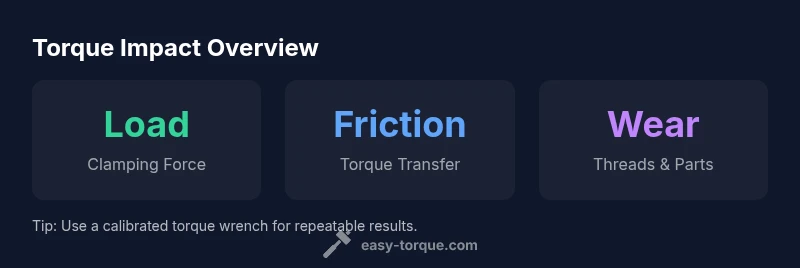
Friction is the gatekeeper of how applied torque translates to clamp load. The coefficient of friction between bolt threads and nut or threaded insert determines how much of the applied torque becomes preload rather than losses to sliding. Lubricants lower friction, shifting the torque-setpoint; dry threads require higher torque to achieve the same preload, increasing risk of over-tightening. As torque increases, bolt extension (strain) increases; this is the mechanical basis by which joint stiffness improves but material yields or creep can occur if you exceed limits. The distribution of load across the clamped parts also changes with torque: misaligned components or uneven surface finishes create eccentric loading, causing uneven clamp forces and potential loosening under vibration.
Practical Contexts: Automotive, Industrial, and DIY
In automotive applications, torque accuracy governs head bolts, connecting rods, and wheel fasteners where heat cycles and load reversals are common. In industrial equipment, precise torque mitigates fatigue in pulleys and mounting brackets under cyclic loads. For DIY projects, user-calibrated torque decisions prevent strip-outs in plastic housings or aluminum components. Across all contexts, the common thread is that the impact of torque is not merely a single value, but a system-aware parameter that must be tuned to material properties, lubricant conditions, and expected service life.
How to Measure and Control Torque Impact: Practical Methods
Start with a calibrated torque tool and a surface-clean interface. Record the target preload for your joint and select an appropriate lubricant or lubricant-free condition based on manufacturer guidelines. Use torque plus angular validation when precision matters; angular torque methods can compensate for friction variability. Document the torque value, tool calibration date, and environmental factors such as temperature. For critical assemblies, implement a two-step process: initial tightening to a specified torque, followed by an angular final tightening to achieve the target clamping force reliably.
Common Pitfalls: Over-torquing, Under-torquing, and Tool Inconsistency
Common mistakes include relying on feel rather than measured torque, mismatching lubricants with fasteners, and using worn or inaccurate tools. Over-torquing can strip threads or crack components; under-torquing can leave joints susceptible to loosening. Regular calibration of wrenches and reuse of compatible lubricants are essential. Always consider the environment: high vibration, thermal cycling, and dynamic loads amplify the consequences of torque errors.
Comparison of how torque affects different joint aspects
| Aspect of Torque | Impact Level | Key Factor | Notes |
|---|---|---|---|
| Joint preload | high | Torque magnitude | Directly controls clamping force and preload stability |
| Thread wear | medium | Lubrication + torque | Lubricants shift torque needs and wear dynamics |
| Lubrication effects | high | Friction | Friction changes how torque translates to preload |
| Loosening risk | high | Vibration + under-torque | Proper torque reduces loosening potential |
Your Questions Answered
What torque point has the most impact on joint reliability?
Preload consistency is the most impactful factor. The torque that establishes preload determines clamping force, which drives joint stability and resistance to loosening under vibration.
Preload consistency is the key. The torque you use to achieve preload largely dictates joint stability.
Does higher torque always make a joint stronger?
No. Excess torque can yield threads, crush softer materials, or cause bolt failure. Strength comes from matching torque to material properties and lubrication, not simply increasing torque.
More torque isn't always better; it can damage parts. Match torque to materials and lubrication for real strength.
How do lubricants affect torque requirements?
Lubricants reduce friction, so the effective torque needed for a given preload decreases. Different lubricants change the torque-preload relationship; always follow manufacturer guidance and, if possible, verify preload with measurement.
Lubricants reduce friction, so you may need less torque for the same preload. Check guidelines and verify preload.
What tools help enforce proper torque?
Calibrated torque wrenches, torque-angle gauges, and, for precision, automated torque control systems help maintain consistent preload and prevent over- or under-tightening.
Use a calibrated torque wrench and a torque-angle gauge to keep preload consistent.
What happens if torque values are inconsistent across bolts in an assembly?
Inconsistent torque causes uneven preload, leading to uneven load distribution, higher stress on some fasteners, and increased risk of loosening or failure.
Inconsistent torque means uneven preload and higher failure risk.
“Precise torque control is the foundation of a reliable assembly; without it, preload fluctuations undermine joint integrity.”
Top Takeaways
- Apply torque targets that suit the friction profile and preload goals
- Calibrate tools and follow lubrication guidelines to maintain consistency
- Use torque plus angle methods for critical joints when possible
- Inspect joints for signs of over- or under-tightening and correct promptly